Saturday, December 1, 2012

Indian Agriculture - Plantation Crops


 Agriculture and allied sectors are considered to be the mainstay of the Indian economy.'Agriculture and allied' industry is further divided into several segments, namely:- horticulture and its allied sectors (including fruits and vegetables, flowers, plantation crops, spices, aromatic and medicinal plants); fisheries sector; animal husbandry and livestock; and sericulture. 'Horticulture and allied' sector is an integral element for food and nutritional security in the country. India's varied agro-climatic conditions are highly favourable for the growth of large number of horticultural crops, which occupy around 10 per cent of gross cropped area of the country producing 160.75 million tonnes.Horticulture is the main segment, while its various sub-segments are fruits, vegetables, aromatic and herbal plants, flowers, spices and plantation crops.

Plantation crops in India are considered to be the main segment of the horticulture crops. They are the mainstay of agrarian economies in many States and Union Territories (UTs) of the country. They play an important role in the agricultural and industrial development of the country as a whole. They contribute a significant amount to the national exchequer and country's exports by way of excise and export earnings. They also provide direct and indirect employment to large number of people in the country, and thus tries to supplement the poverty alleviation programmes, especially in rural sector.

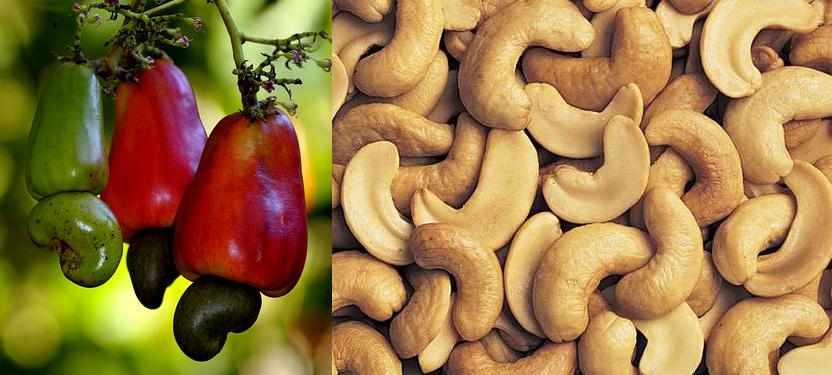
Plantation farming means the cultivation of a single cash crop in plantations or estates (large areas of land) on a large scale. The farming is carried on with the help of technically advanced methods of cultivation and tools. Plantation crops constitute a large group of crops. The major plantation crops include coconut, arecanut, oil palm, cashew, tea, coffee and rubber; and the minor plantation crops include cocoa. India is the second largest producer and largest consumer of cashew nuts (2010). The total production of cashew is around 0.57 million tonnes from an area of 0.24 million hectares. India also occupies number one position in arecanut production.

 Tea and coffee are the main and oldest industries in the country, which provide ample employment opportunities to the people at large and holds immense potential for export. India is one of the largest tea producer in the world. Coffee is the second largest traded commodity in the world and is an extremely important foreign exchange earner. The coffee industry of India is one of the largest producer of coffee in the world. India contributes 4 per cent of total world production.India is the fourth largest producer of natural rubber (NR) with a share of 8.8 per cent in world production in 2006.

India is the third largest producer of coconut and leads 90 coconut-producing countries of the world. The area for coconut plantation in India has been majorly distributed over 18 States and 3 UTs, under different agro-climatic conditions. India is a premier coir manufacturing country in the world. Wide range of coconut products, edible and non-edible, are available for both domestic and export market. Tender coconut water concentrate is another product, apart from soft drinks, which is manufactured and marketed successfully.

But, in India, plantation crops have been continuously facing the problem of lack of investment and depressed yields, and are in great need of modernisation. Their total coverage is comparatively less and they are mostly confined to small holdings. Thus, the Government of India has identified some prominent crops as high-value crops of great economic importance. It is taking all possible steps and initiatives to commercialize the sector. Tea, coffee, rubber and coconut industries are providing greater business opportunities to the investors worldwide.

 The Economic Importance of Plantation Crops: 

1. They contribute to national economy by way of export earnings. These crops occupy less than 2 per cent of the total cultivated area (i.e. 3.82 per cent of total crop land) but they generate an income of around Rs. 16,000 million or 75 per cent of total earnings from the export of agricultural produces.

2. India is the leading country in the total production of certain plantation crops in the world. For instance, our production meets the share of 47 per cent in tea and 66 per cent in each of cashew and arecanut,

3. Plantation industry provides direct as well as indirect employment lo many millions of people. For instance, tea industry offers direct employment to 10 lakhs and indirect employment to 10 lakh people, while-cashew processing factories alone provide employment to 3 lakhs people besides 2 lakhs farmers are employed in cashew cultivation.

4. Plantation industry supports many by-product industries and also many rural industries. For example, coconut husk is used to produce coir fiber annually to a tune of 2,19,600 tones in India.

5. These crops help to conserve the soil and ecosystem. Tea planted in hill slopes and cashew in barrel and waste lands protect the land from soil erosion during the rainy season or due to heavy winds.

The Department of Agriculture and Cooperation, Ministry of Agriculture, is the nodal agency in India which deals with various aspects of plantation crops. It is, not only, engaged in formulation of national policies, schemes and programmes for promoting entrepreneurship in the sector, but also supplements and complements the efforts being made by the State Governments to promote production and productivity of varied plantation crops.

The Central Plantation Crops Research Institute (CPCRI) has been set up as the pioneering institute in India for conducting research on plantation crops. It was established in 1916, but subsequently brought under the mandate of Indian Council of Agricultural Research (ICAR) during 1970. Its initial mandate was on crop husbandry of coconut, arecanut, cocoa, oil palm, cashew and spices. However, the restructuring process resulted in the establishment of separate Research Institute/Centres for Spices, Cashew and oil palm, but the CPCRI continued to maintain strong linkage with these institutes. The main aim of the institute is to develop appropriate production, protection and processing technologies for coconut, arecanut and cocoa through basic and applied research.

 There is a Tea Board of India, which has been set up under the Ministry of Commerce and Industry, for promoting sound development of tea industries in India. The main functions of tea board include rendering financial and technical assistance for cultivation, manufacture, marketing of tea; promoting tea exports; aiding research and developmental activities for augmentation of tea production and improvement of tea quality as well as encouraging and assisting small growers sector financially and technically.

The Coffee Board of India is an autonomous body, functioning under the Ministry of Commerce and Industry, which serves as a guide of the coffee industry in India. The Board focuses on research, development, extension, quality upgradation, market information, and the domestic and external promotion of Indian coffee.

There is Rubber Board, under the Ministry of Commerce and Industry, which is actively engaged in the development of the rubber industry in India. It perform various activities like assisting and encouraging scientific, technical and economic research in the area of rubber; supplying technical advice to rubber growers; and training growers regarding improved methods of plantation and cultivation.

Besides, the Directorate of Cashewnut and Cocoa Development is a national agency primarily engaged in the overall development of cashew and cocoa in India.

Schemes and Incentives 

For the integrated promotion of entrepreneurship in the sector of plantation crops, the Government has framed many schemes and policies, from time to time. All these aim to increase the productivity levels of plantation crops like tea, coffee, rubber, etc. as well as to provide greater incentives to the growers of the crops. Presently, one of the most prominent schemes has been the 'Price Stabilization Fund Scheme (PSFS)'. The main objective of PSF has been to safeguard the interests of growers and provide financial relief when prices fall below a specified level without resorting to the practice of procurement operations by the Government agencies.

In order to protect the interest of the coconut growers, the Government has launched the 'Technology Mission on Coconut'. The main aim of the Mission is to help develop a mechanism which makes coconut farming competitive and ensures reasonable returns.

more info - Click Here


National Water Policy (2012)


The Ministry of Water Resources has formulated a draft National Water Policy (2012) after extensive consultation process with Members of Parliament; Academia, Experts and Professionals; Non-Governmental Organizations; Corporate Sector and representatives of Panchayati Raj Institutions. The Ministry also circulated the draft National Water Policy (2012) amongst all States and related Central Ministries earlier in 2012.

Need for a Water Policy

Water is a natural resource, fundamental to life, livelihood, food security and sustainable development. It is also a scarce resource. India has more than 17 percent of the world’s population, but has only 4% of world’s renewable water resources with 2.6% of world’s land area. There are further limits on utilizable quantities of water owing to uneven distribution over time and space. In addition, there are challenges of frequent floods and droughts in one or the other part of the country. With a growing population and rising needs of a fast developing nation as well as the given indications of the impact of climate change, availability of utilizable water will be under further strain in future with the possibility of deepening water conflicts among different user groups. Low consciousness about the scarcity of water and its life sustaining and economic value results in its mismanagement, wastage, and inefficient use, as also pollution and reduction of flows below minimum ecological needs. In addition, there are inequities in distribution and lack of a unified perspective in planning, management and use of water resources.

The objective of the National Water Policy is to take cognizance of the existing situation, to propose a framework for creation of a system of laws and institutions and for a plan of action with a unified national perspective.

Even while it is recognized that States have the right to frame suitable policies, laws and regulations on water; there is a felt need to evolve a broad over-arching national legal framework of general principles on water to lead the way for essential legislation on water governance in every State of the Union and devolution of necessary authority to the lower tiers of government to deal with the local water situation.

 Concerns related to water resources as recognised by the Draft National Water Policy (2012)

The present scenario of water resources and their management in India has given rise to several concerns, important amongst them are :
  1. Large parts of India have already become water stressed. Rapid growth in demand for water due to population growth, urbanization and changing lifestyle pose serious challenges to water security.
  2. Issues related to water governance have not been addressed adequately. Mismanagement of water resources has led to a critical situation in many parts of the country.
  3. There is wide temporal and spatial variation in availability of water, which may increase substantially due to a combination of climate change, causing deepening of water crisis and incidences of water related disasters, i.e., floods, increased erosion and increased frequency of droughts, etc.
  4. Climate change may also increase the sea levels. This may lead to salinity intrusion in ground water aquifers / surface waters and increased coastal inundation in coastal regions, adversely impacting habitations, agriculture and industry in such regions.
  5. Access to safe water for drinking and other domestic needs still continues to be a problem in many areas. Skewed availability of water between different regions and different people in the same region and also the intermittent and unreliable water supply system has the potential of causing social unrest.
  6. Groundwater, though part of hydrological cycle and a community resource, is still perceived as an individual property and is exploited inequitably and without any consideration to its sustainability leading to its over-exploitation in several areas.
  7. Water resources projects, though multi-disciplinary with multiple stakeholders, are being planned and implemented in a fragmented manner without giving due consideration to optimum utilization, environment sustainability and holistic benefit to the people.
  8. Inter-regional, inter-State, intra-State, as also inter-sectoral disputes in sharing of water, strain relationships and hamper the optimal utilization of water through scientific planning on basin/sub-basin basis.
  9. Grossly inadequate maintenance of existing irrigation infrastructure has resulted in wastage and under-utilization of available resources. There is a widening gap between irrigation potential created and utilized.
  10. Natural water bodies and drainage channels are being encroached upon, and diverted for other purposes. Groundwater recharge zones are often blocked.
  11. Growing pollution of water sources, especially through industrial effluents, is affecting the availability of safe water besides causing environmental and health hazards. In many parts of the country, large stretches of rivers are both heavily polluted and devoid of flows to support aquatic ecology, cultural needs and aesthetics.
  12. Access to water for sanitation and hygiene is an even more serious problem. Inadequate sanitation and lack of sewage treatment are polluting the water sources.
  13. Low public consciousness about the overall scarcity and economic value of water results in its wastage and inefficient use.
  14. The lack of adequate trained personnel for scientific planning, utilizing modern techniques and analytical capabilities incorporating information technology constrains good water management.
  15. A holistic and inter-disciplinary approach at water related problems is missing.
  16. The public agencies in charge of taking water related decisions tend to take these on their own without consultation with stakeholders, often resulting in poor and unreliable service characterized by inequities of various kinds. 
  17. Characteristics of catchment areas of streams, rivers and recharge zones of aquifers are changing as a consequence of land use and land cover changes, affecting water resource availability and quality.
The basic principles guiding the Draft National Water Policy (2012)

Public policies on water resources need to be governed by certain basic principles, so that there is some commonality in approaches in dealing with planning, development and management of water resources. These basic principles are:  
  • Planning, development and management of water resources need to be governed by common integrated perspective considering local, regional, State and national context, having an environmentally sound basis, keeping in view the human, social and economic needs.
  • Principle of equity and social justice must inform use and allocation of water.
  • Good governance through transparent informed decision making is crucial to the objectives of equity, social justice and sustainability. Meaningful intensive participation, transparency and accountability should guide decision making and regulation of water resources.
  • Water needs to be managed as a common pool community resource held, by the state, under public trust doctrine to achieve food security, support livelihood, and ensure equitable and sustainable development for all.
  • Water is essential for sustenance of eco-system, and therefore, minimum ecological needs should be given due consideration.
  • Water, after meeting the pre-emptive needs for safe drinking water, sanitation and high priority allocation for other domestic needs (including needs of animals), achieving food security, supporting sustenance agriculture and minimum eco-system needs, may be treated as economic good so as to promote its conservation and efficient use.
  • All the elements of the water cycle, i.e., evapo-transpiration, precipitation, runoff, river, lakes, soil moisture, and ground water, sea, etc., are interdependent and the basic hydrological unit is the river basin, which should be considered as the basic hydrological unit for planning.
  • Given the limits on enhancing the availability of utilizable water resources and increased variability in supplies due to climate change, meeting the future needs will depend more on demand management, and hence, this needs to be given priority, especially through (a) evolving an agricultural system which economizes on water use and maximizes value from water, and (b) bringing in maximum efficiency in use of water and avoiding wastages.
  • Water quality and quantity are interlinked and need to be managed in an integrated manner, consistent with broader environmental management approaches inter-alia including the use of economic incentives and penalties to reduce pollution and wastage.
  • The impact of climate change on water resources availability must be factored into water management related decisions. Water using activities need to be regulated keeping in mind the local geo climatic and hydrological situation.
Salient Features of Revised Draft National Water Policy (November,2012) 

1. Emphasis on the need for a national water framework law, comprehensive legislation for optimum development of inter-State rivers and river valleys, amendment of Irrigation Acts, Indian Easements Act, 1882, etc.

2. Water, after meeting the pre-emptive needs for safe drinking water and sanitation, achieving food security, supporting poor people dependent on agriculture for their livelihood and high priority allocation for minimum eco-system needs, be treated as economic good so as to promote its conservation and efficient use.

3. Ecological needs of the river should be determined recognizing that river flows are characterized by low or no flows, small floods (freshets), large floods and flow variability and should accommodate development needs. A portion of river flows should be kept aside to meet ecological needs ensuring that the proportional low and high flow releases correspond in time closely to the natural flow regime.

4. Adaptation strategies in view of climate change for designing and management of water resources structures and review of acceptability criteria has been emphasized.

5. A system to evolve benchmarks for water uses for different purposes, i.e., water footprints, and water auditing be developed to ensure efficient use of water. Project financing has been suggested as a tool to incentivize efficient & economic use of water.

6. Setting up of Water Regulatory Authority has been recommended. Incentivization of recycle and re-use has been recommended.

7. Water Users Associations should be given statutory powers to collect and retain a portion of water charges, manage the volumetric quantum of water allotted to them and maintain the distribution system in their jurisdiction.

8. Removal of large disparity in stipulations for water supply in urban areas and in rural areas has been recommended.

9. Water resources projects and services should be managed with community participation. Wherever the State Governments or local governing bodies so decide, the private sector can be encouraged to become a service provider in public private partnership model to meet agreed terms of service delivery, including penalties for failure.

10. Adequate grants to the States to update technology, design practices, planning and management practices, preparation of annual water balances and accounts for the site and basin, preparation of hydrologic balances for water systems, and benchmarking and performance evaluation.

Details 


Draft National Water Policy 2012


Indian Wildlife (Animals)


India has some of the world's most biodiverse regions. India's rich and abundant animal life is attributed to it's diverse climate and geography.The political boundaries of India encompass a wide range of ecozones—desert, high mountains, highlands, tropical and temperate forests, swamplands, plains, grasslands, areas surrounding rivers, as well as island archipelago. It hosts 3 biodiversity hotspots: the Western Ghats, the Himalayas and the Indo-Burma region. These hotspots have numerous endemic species.

India displays significant biodiversity. One of eighteen megadiverse countries, it is home to 7.6% of all mammalian, 12.6% of all avian, 6.2% of all reptilian, 4.4% of all amphibian, 11.7% of all fish, and 6.0% of all flowering plant species.  

There are about 2,546 species of fishes (about 11% of the world species) found in Indian waters. About 197 species of amphibians (4.4% of the world total) and more than 408 reptile species (6% of the world total) are found in India. Among these groups the highest levels of endemism are found in the amphibians.There are about 1,250 species of birds from India, with some variations, depending on taxonomic treatments, accounting for about 12% of the world species.There are about 410 species of mammals known from India, which is about 8.86% of the world species 

Important Animals of India 

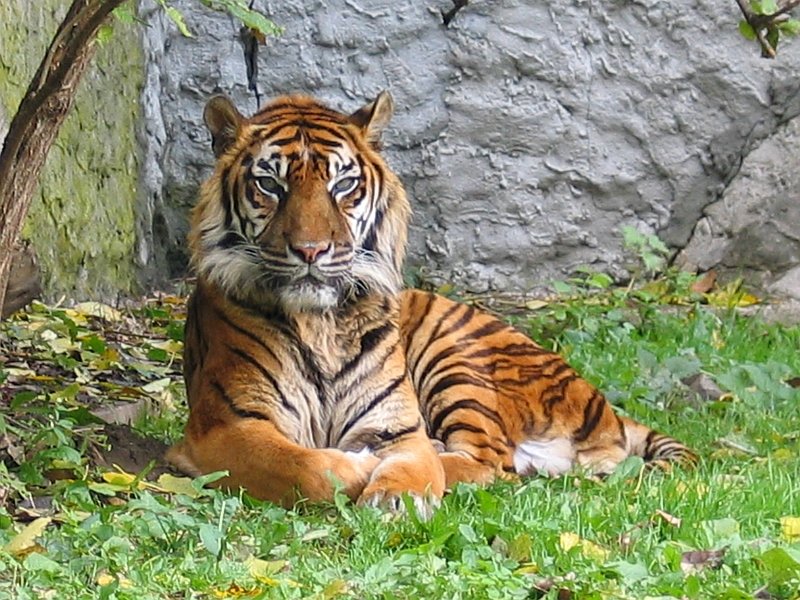
Bengal Tiger


Bengal tiger is a subspecies of tiger, which is found in the Bengal region of the Indian subcontinent. One of the most common tiger subspecies, it is also found in a number of other Asian countries, like Bangladesh, Nepal, Bhutan, Myanmar, Tibet, etc. Usually Royal Bengal Tigers of India are reddish-brown to rust-brown in color with black stripes all over. However, a mutation may result in their color being white also. Such a tiger is known as the White tiger. Bengal tiger is the national animal of both the Indian subcontinent as well as Bangladesh. One can visit Bengal Tiger to any Tiger Reserve in India.

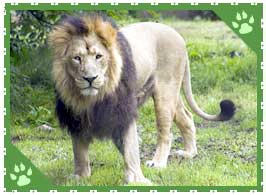
Indian Asiatic Lion


Asiatic Lions once used to roam around the area, stretching from northern Greece, across Southwest Asia, to central India. However, today, the natural habitat of the majestic animal has been reduced to the Gir forests of India only, making the Asiatic Lion almost synonymous with the Indian Lion. Known scientifically as Panthera Leo persica, the royal animal is depicted on the National Emblem of India, since it represents power, strength and sovereignty. Gir National Park is the only remaining place in the world, where one is likely to see the Asiatic Lion.

Indian Clouded Leopard


The Clouded Leopard (Neofelis nebulosa) is a medium-sized cat found in North-East India and Southeast Asia. It has a tan or tawny coat, and is distinctively marked with large, irregularly-shaped, dark-edged ellipses which are said to be shaped like clouds. This unique appearance gave the mammal both its common and scientific species name (Nebulosus is the Latin for “cloudy”). The Clouded Leopard was a confusion to scientists for a long time because of the appearance and skeleton. It was what seemed to be a cross in between a big cat and a small cat. The scientific name of the genus, Neofelis, originates from neo, which means “new”, and felis, which means “small cat”, so it literally means new kind of small cat.

Indian Leopard


Indian leopard is one of the 8-9 valid leopard subspecies found throughout the world. Known by the scientific name of Panthera pardus, it is the fourth largest of the four 'big cats' of the Panthera genus. At the same time, leopards are also the fifth largest of all cat species. The name 'Leopard' has been derived from a combination of two Greek and Latin words leo and pard, 'leo' meaning lion and 'pard' meaning panther. This name was given to the animal since it was initially believed to be crossbreed of a lion and a panther.

Indian Snow Leopard


Snow leopard is a native animal of mountain ranges of central and southern Asia, including India. It is also known as Ounce and has a scientific name of "Panthera uncia". Snow leopards can live for a maximum of 18 years in then wild. In captivity, their lifespan increases to 20 years.

Indian Black Bear


Indian black bear is also known by the names of Asiatic Black Bear (Ursus thibetanus), Tibetan black bear, Himalayan black bear and Moon bear. They grow to a length of approximately 4 to 6 feet, right from the nose to the tail. The small eyes of the bear, along with its rounded ears, a long snout, a large body, a short tail, and shaggy hair, differentiate it from the other types of bears. The small shoulder hump, a furry rear instep, a concave facial contour, small and curved claws and narrow ears further accentuate the difference. Last but not the least, Asiatic black bear also has a whitish V-shaped breast patch, not found in the other bear species of India.

The male black bear weighs between 220 and 480 pounds, while the females are110 to 275 pounds in weight. The senses of the Himalayan black bears of India are greatly developed and they boast of almost twice the hearing sensitivity possessed by humans. Black bears have colored vision and their eyesight is very sharp. Even their olfactory senses (ability to smell) are highly evolved. The mating season of the Himalayan black bears is usually from late May to early July. They give birth to two cubs at a time, which stay with the mother for almost seventeen months.

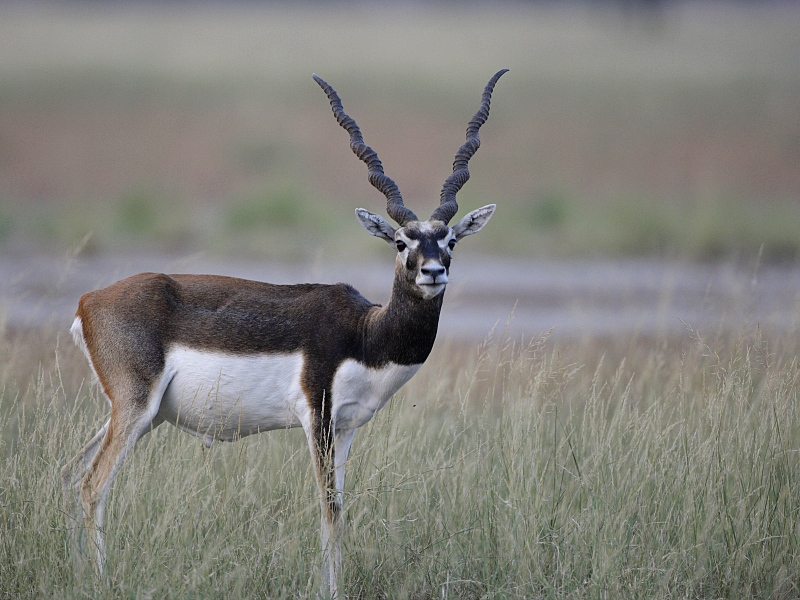
Indian Black Buck


Indian black buck is also known by a number of other names like Kala Hiran, Sasin, Iralai Maan and Krishna Jinka. The scientific name of the black buck antelope is Antilope cervicapra and it natural habitat is the Indian subcontinent. Grass forms the staple diet of the blackbucks. However, they do eat pods, flowers and fruits as supplements. The average lifespan of the Indian kala hiran is twelve years and at the maximum, they live for sixteen years. Black bucks are hunted by dogs and wolves.

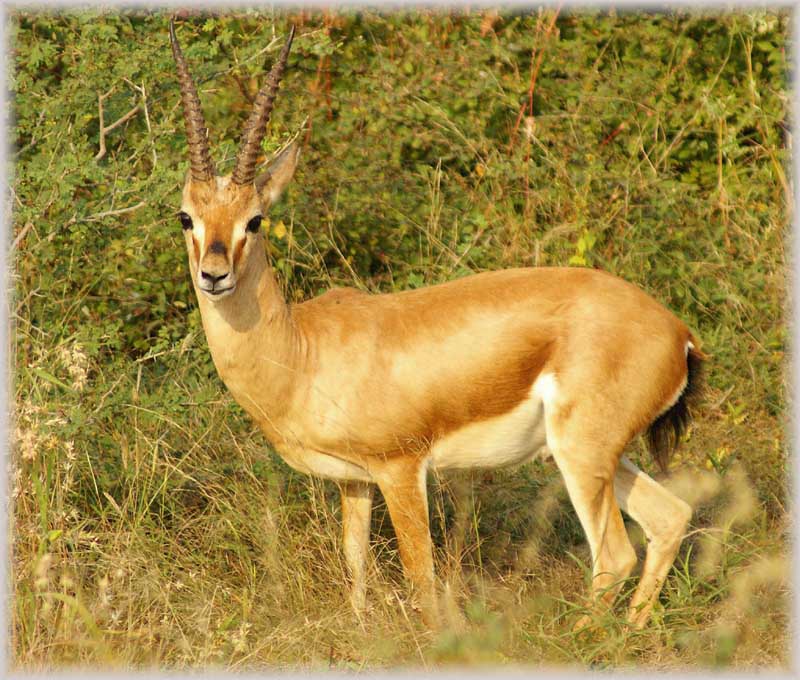
Indian Gazelle


Indian Gazelle, also known as Chinkara, is a species of gazelle found in South Asia. It belongs to the Bovidae family and is scientifically known as Gazella bennettii. The life expectancy of a Chinkara is between 12 to 15 years, less than that of many other deer species. Male gazelles are believed to be territorial in nature and are not prone to wandering for large distances. Gazelles come across as very nervous animals and always seem to be on alert. It is believed that the dwindling population of Chinkaras is leading to a decline in the population of Cheetah, their main predators, in India.

Axis Deer


Axis Deer, also known as Chital Deer or Spotted Deer, is the native animal of the Indian subcontinent. It is found very commonly in India and is one of the most beautiful animals in the country. The spotted deer of India was introduced in the state of Texas in the 1930s. Since that time, axis deer of India has become the most widespread of the entire deer species.

Brow-antlered Deer


Brow-antlered deer are known by the scientific name of Cervus eldii. They have a number of other names also, like Eld's Deer, Sangai Deer, Thamin Deer and even Dancing Deer. The maximum lifespan of the Thamin deer of India is only ten years and the deer has three subspecies also.

Hog Deer


Hog Deer is a subspecies of deer, found in the areas stretching from Pakistan, through northern India, to mainland Southeast Asia. A population of the hog deer was introduced in a number of countries, including Australia, the United States and Sri Lanka.

Sambar Deer


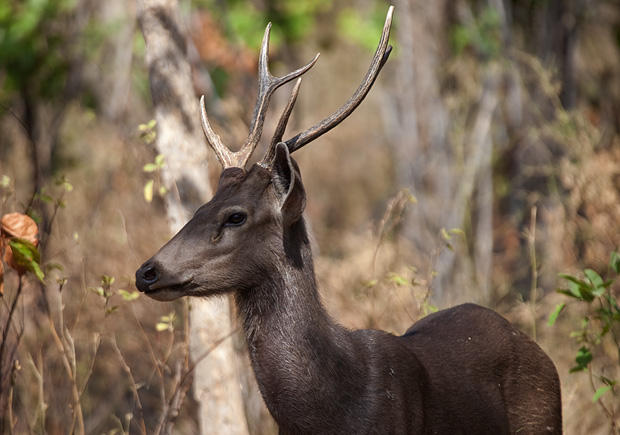
Sambar Deer are dark brown in color and attain a height of 102 cm to 160 cm (40 to 63 inches). The weight of the sambar deer of India may touch 300 kg. There are chestnut marks on the rump as well as the underparts. Sambhur deer of India also have beautiful manes. However, they are not spotted by birth. The spots develop gradually after birth.

Swamp Deer


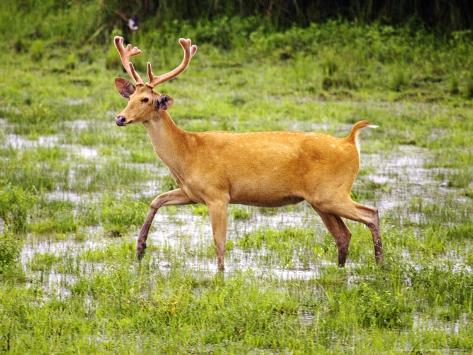
Swamp Deer, also known as Barasingha, is one of the most vulnerable species of deer of the Indian subcontinent as well as the world. Presently, one can find them only in the protected sanctuaries of India. Known by the scientific name of Cervus duvauceli, the swamp deep of India derives its name, Barasingha, from its large antlers.

Nilgai


Nilgai, also known as Blue Bull, is one of the most commonly found wild animals of northern India as well as eastern Pakistan. Even though it is an antelope, it looks quite similar in appearance to an ox. Therefore, it has been given the name of Blue bull of India. The average lifespan of the Neelgai is 21 years.

Indian bison


The gaur (Indian Bison) is a large bovine native to South Asia and Southeast Asia. Gaur is found throughout mainland South and Southeast Asia.Gaur are largely confined to evergreen forests or semi-evergreen and moist deciduous forests, but also occur in deciduous forest areas at the periphery of their range. Gaur habitat is characterized by large, relatively undisturbed forest tracts, hilly terrain below an altitude of 5,000 to 6,000 ft (1,500 to 1,800 m), availability of water, and an abundance of forage in the form of grasses, bamboo, shrubs, and trees. Their apparent preference for hilly terrain may be partly due to the earlier conversion of most of the plains and other low-lying areas to croplands and pastures.They occur from sea level up to at least 2,800 m (9,200 ft) altitude. Low-lying areas seem to comprise optimal habitat.

Indian Elephant


Indian elephant, known with the scientific name of 'Elephas maximus indicus', is a subspecies of the Asian Elephant. It is mainly found in the Indian subcontinent, that to in the scrub forested areas. The other counties where Asian elephants are found include Bangladesh, Bhutan, Borneo, Cambodia, China, Laos, Malaysia, Myanmar, Nepal, Thailand, Sumatra, and Vietnam. Since Indian elephants are very huge and can trample all other creatures, they have no natural enemies. Even lions, hyenas, and tigers attack only the very young elephants and not adults.

Indian Camel


The camels found in India are the single-humped camels, also known as the Dromedary camels. Long-curved neck, deep-narrow chest and a single hump characterize the Indian camel. The hump is used by the camels as reservoir of fatty tissues. In times of scarcity, the tissues are metabolized and the camel receives energy. The size of the hump is not the same in all the camels. It differs from one camel to another, depending upon its nutritional state. In times of starvation, the hump can get reduced to almost a non-existent size.

Indian dromedary camels have a heavy growth of hair on throat, shoulder, and hump, which is longer than the rest of the body. On an average, the camels in India live for a period of 40 to 50 years. They are widely used by the people of Rajasthan as a means of transportation. Infact, the camels are known as the 'Ship of the Desert'. They are used for carrying goods as well as people. Indian camels also provide humans with milk, meat, wool, leather and fuel (from their dried dung).

Indian Rhinoceros


Indian Rhinoceros holds the distinction of being the fourth largest animal, after the three elephant species. Known by the scientific name of Rhinoceros unicornis, the animal is found in only two places in the world, Assam (India) and Nepal. The Great Indian rhinoceros is a brilliant swimmer and has an acute sense of smell and hearing. Its maximum speed reaches 55 km/h, that to for a short period of time.

The only drawback of the Indian rhino, also known as the Great One-Horned Rhinoceros, is that its eyesight is quite poor. The sheer size of the rhinos has resulted in a few natural enemies. They may be attacked by tigers, but there are hardly any recorded incidents of a tiger killing a full-grown Indian rhino. However, they may kill unguarded calves at times.

Indian Wild Ass


Indian wild ass, also known as khur, is one of the subspecies of wild ass belonging to southern Asia. Its scientific name is Equus hemionus khur. Wild ass of India has an average age of 20-25 years.

Indian Wild Boar


 Wild boar is considered to be the wild antecedent of the domestic pig of the Indian subcontinent. It belongs to the Suidae biological family, which also includes the Warthog and Bushpig of Africa, the Pygmy Hog of northern India and the Babirusa of Indonesia. Indian wild boars are also quite closely related to peccary or javelina of North, Central and South America.

Indian Striped Hyena


Striped hyena belongs to the Hyaenidae family and is scientifically known as Hyaena hyaena. Strongly related to the Brown hyena, it is basically a solitary creature. The average lifespan of striped hyenas hovers somewhere around 10 to 12 years in the wild. When kept in captivity, they can live longer also.

Indian Red Panda


Red panda is a beautiful animal, found in only some other countries of the world, including the Indian subcontinent. Scientifically known as Ailurus fulgens, it is slightly bigger than the domestic cat and founds a mention in the list of endangered species. Indian red panda bear is quite apt at climbing trees and is mainly herbivorous. It is also known as the Red fox or the Common panda and is native to the Himalayan ranges of India. A one of its kind animals, Red panda is believed to be a living fossil. The only other fossil close to the panda is that of Parailurus, which lived 3 to 4 million years ago. The lifespan of a Red Panda may range from nine years to fourteen years.

Rhesus Macaque


A typical macaque, the Rhesus monkey of India is believed to be one of the best species of the Old World monkeys. It is an excellent swimmer and enjoys water. Rhesus macaques are quite comfortable around humans and have the tendency to move from rural to urban areas in search of easy food. The average lifespan of Rhesus macaques is approximately 15 years in the wild.

Lion Tailed Macaque


Lion-tailed Macaque is one of the subspecies of macaque, found only in the Western Ghats of South India. Known by the scientific name of Macaca silenus, it has life expectancy of 20 years in the wild and upto 30 years in captivity. Lion-tailed macaques spend most of their time on trees and are excellent swimmers.

Hanuman Langur


Hanuman Langur is believed to be one of the Old World monkeys, belonging to the Semnopithecus Genus. They comprise of 15 subspecies and are terrestrial in nature. Earlier hanuman langurs were believed to comprise of a single species. However, now they are recognized as seven distinct species. Hanuman langur is also known by the name of Gray Langur, Entellus Langur and Common Indian Langur.

Golden Langur


Golden Langur, or Gee's Golden Langur, is known by the scientific name of Trachypithecus geei. An Old World monkey, it was first noticed by the scientific community in the 1950s only. In the Indian subcontinent, Golden langurs are found mainly in the foothills of the Himalayas, along the Assam-Bhutan border. The langurs are considered to be sacred by the Himalayan people. The coat of Indian golden langurs is covered with rich golden to bright creamish hair. The face is black and they have a very long tail, which may measure upto 50 cm in length.

Hoolock Gibbon 


Hoolocks are the second-largest of the gibbons, after the siamang. They reach a size of 60 to 90 cm and weigh 6 to 9 kg. It is the only ape to be found in India and is generally to seen in the forests of the North- East India and neighboring Bangladesh and Burma. The males have a black coat and the females can be distinguished by their lighter coat having grayish color.

Hoolocks prefer to live in small groups in the hilly forests and feed on tender leaves, fruits, and insects including spiders. Their main source of water is from the dew which forms on the leaves. The young ones are normally born in the winter months between December and March. The average height of a Gibbon is 3 feet and the arms are normally double the length of its legs.

More Info :

List of Animal Species

Species of India - Apes Family of India

Species of India - Cats Family of India 

Species of India - Dog Family of India

Species of India - Bears Family of India 

Species of India - Ungulates of India 

Species of India - Antelopes & Gazelles 

Species of India - Deer Family of India 


Friday, November 30, 2012

The Mauryan Empire


The Maurya Empire was a geographically extensive Iron Age historical power in ancient India, ruled by the Mauryan dynasty from 321 to 185 BCE. Historians have used a variety of sources to reconstruct the history of the Mauryan Empire. These include archaeological finds, especially sculpture.Also valuable are contemporary works, such as the account of Megasthenes (a Greek ambassador to the court of Chandragupta Maurya), which survives in fragments.Another source that is often used is the Arthashastra, parts of which were probably composed by Kautilya or Chanakya, traditionally believed to be the minister of Chandragupta.Besides, the Mauryas are mentioned in later Buddhist, Jaina and Puranic literature, as well as in Sanskrit literary works.While these are useful, the inscriptions of Asoka (c. 272/268-231 BCE) on rocks and pillars are often regarded as amongst the most valuable sources.Mudrarakshasa of Vishakhadatta describes how Chanakya won the diplomatic battle against the Nanda minister Rakshasa, how Rakshasa was compelled to work for Chandragupta and also how the Nandas were finally over thrown.

Sources of information about Mauryas are listed below :

Literary sources 
  • Kautilya’s ‘Arthasastra’
  • Megasthenese’s ‘Indica’
  • Justin's 'Anepitome'
  • Plutarch (1st century CE, Parallel Lives Ch Life of Alexander)
  • Strabo (1st century BCE, Geographica)
  • Appian (2nd century CE, Historia Romana book XI)  
  • Visakha Datta’s ‘Mudra Rakshasa’: although it was written during Gupta Period, it describes how Chandragupta Maurya get Chanakya’s assistance to overthrow the Nandas.
  • Puranas
  • Buddhist text Jatakas potrays a general picture of socio-economic conditions of Mauryan Period.
  • Buddhist chronicles Dipavamsa and Mahavamsa describe the part played by Ashoka in spreading Buddhism to Sri Lanka.
  • Tibetan Buddhist text Divyavadana gives information about Ashoka and his efforts to spread Buddhism  
Archaeological Sources   
  • Punch mark coins
  •  Wooden palace of Chandragupta Maurya
  •  Northen Black Polished Ware (NBPW)
  •  Ashokan Edicts and Inscriptions: There are Rock Edicts, Pillar Edicts and Cave inscriptions located at several places in the Indian sub-continent.
  •  Junagadh Rock Inscription of Rudradaman
  •  Sohgaura Copper Plate Inscription in Gorakhpur district
  •  Mahasthan Inscription in Bogara district of Bangladesh.
  •  Inscription from Taxila informs about the officer name Romeodeto
 Important Rulers

Chandragupta Maurya

Chandragupta Maurya was the founder of the empire in 305 BC. His family is identified by some with the tribe of Moriya mentioned by Greeks. According to one tradition, the designation is derived from Mura, the mother or grandmother of Chandragupta, who was wife of a Nanda king.Buddhist writers represent Chandragupta as member of Kshatriya caste, belonging to the ruling clan of little republic of Pipphalivana, lying probably between Rummindei in the Nepalese Tarai and Kasai in the Gorakhpur district. Under Chandragupta Maurya, for the first time, the whole of northern India was united.Chandragupta became a Jain and went to Sravanbelgola with Bhadrabahu, where he died by slow starvation.Chandragupta was the protege of the Brahman, Kautilya or Chanakya, who was his guide and mentor, both in acquirnig a throne and in keeping it.Megasthenese was a Greek ambassador sent to the court of Chandragupta Maurya by Seleucus.

Bindusara

Chandragupta was succeeded by his son Bindusara in 297 B.C. To the Greeks, Bindusara was known as Amitrochates, perhaps the Greek translation of the Sanskrit Amitraghata, the destroyer of the foes.A Greek named Deimachos was received as Ambassador of Greece in Bindusara's court.Bindusara extended Mauryan control in Deccan as far south as Mysore.Bindusar patronized Ajivikas.

Asoka


According to the Buddhist tradition, Asoka usurped the throne alter killing his 99 brothers and spared Tissa, the youngest one. Radhagupta a Minister of Bindusar helped him in fratricidal struggle.During Bindusara's reign, Ashoka successively held the important viceroyalties of Taxila and Ujjain.Ashoka is referred to as Devanampiya (the beloved of gods) Piyadassi (of amiable appearance) in inscriptions.Under Asoka. the Mauryan Empire reached its climax. For the first time, the whole of the subcontinent, leaving out the extreme south, was under imperial control.Asoka (ought the Kalinga war in 261 BC in the 9th years of his coronation. The king was moved by massacre in this war and therefore abandoned the policy of physical occupation in favour of policy of cultural conquest. In oilier words, Bherighosha was replaced by Dhammaghosha.Asoka was not an extreme pacifist. He did not pursue the policy of peace for sake of peace under all conditions. Thus he retained Kalinga after its conquest and incorporated it into his empire.According to the Kashmir chronicle of Kalhana, Ashoka's favourite deity was Shiva. Ashoka claimed of spiritual conquest of the realms of his Hellenistic, Tamil and Ceylonese neighbours. Hellenistic neighbours of Ashoka were: Antiochos II (Theos of Syria), Ptolemy II (Philadelphos of Egypt), Antigonos (Gonatas of Macedonia), Magas (of Cyrene) and Alexander (of Epirus).

After making deep study of Buddhist scriptures Ashoka started undertaking dharam-yatras (tours of morality) in course of which he visited the people of his country and instructed them on Dharma (morality and piety).Asoka’s Dhamma cannot be regarded as sectarian faith. Its broad objective was to preserve the social order it ordained that people should obey their parents, pay respect to Brahmanas and Buddhist monks and show mercy to slave and servants.He held that if people behaved well they would attain Swarga (heaven). He never said that they would attain Nirvana, which was goal of Buddhist Teaching.

During Ashok's reign the Buddhist church underwent reorganization, with the meeting of the third Buddhist Council at Patliputra in 250 B.C.Ashoka's son Prince Mahendra visited Ceylon (modern Sri Lanka) as a Buddhist missionary and convinced the ruler of the island kingdom, Devanampiya Tissa to convert to Buddhism.

Ashoka ruled for 37 years and died in 232 B.C. With his death a political decline set in, and soon after the empire broke up.As per the Puranic texts, the immediate successor of Ashoka was his son Kunala. The Chronicals of Kashmir, however, mention Jalauka as the son and successor. Kunala was succeeded by his sons, one of whom, Bandhupalita, is known only in Puranas, and another, Sampadi, is mentioned by all traditional authorities. Then there was Dasratha who ruled Magadha shortly after Ashoka and has left three epigraphs in the Nagarjuni Hills in Bihar, recording the gift of caves to the Ajivikas.The last king of the Maurya dynasty was Brihadratha, who was overthrown by his commanderin- chief, Pushyamitra, who laid the foundation of the Sunga dynasty.

The Mauryan Administration

The establishment of elaborate bureaucracy appear to be a remarkable feature of the Mauryas.

Central Administration:

The Mauryan government was a centralised bureaucracy of which the nucleus was the king.The Arthshastra refers to the highest officers as the eighteen tirthas, the chief among them were the Mantrin (chief minister), Purohit (high priest), Yuvraja (heir-apparent) and Senapati (commander-in-chief).The head of the judiciary was the king himself, but there were special tribunals of justice, headed by Mahamatras and Rajukas.According to Arthshastra there are 34 departments headed by 'Adyakshas' to carry on the administration.(Ex:Akara-mining,Kupya-forests,Panya-Trade&Commerce,Lakshana-Minting,etc.) 

Provincial Administration:

The empire was divided into a number of provinces. Probably, five. The northern province, called Uttarapatha had Taxila as its capital. Western province, known as Avantipatha had its capital in Ujjain. Prachyapatha with its capital Toshali (Kalinga) formed the Eastern province while Dakshinapatha with its capital Surarnagiri was the Southernmost province. Central province. Magdha, with its capital at Pataliputra, was the headquarters of the entire kingdom.

The terms used in the Ashokan edicts for provincial governors are Kumara and Aryaputra. The former may have been the title of the sons of the king and later may have referred to close relatives.

District Administration:

Provinces were sub-divided into districts(Aharas) for purposes of administration, and a group of officials worked in each district. In the inscriptions of Ashoka there are references to Rajukas and Pradesikas, charged with the welfare of Janapadas or country parts and Pradesas or districts. Mahamatras were charged with the administration of cities (Nagala Viyohalaka) and sundry other matters, and a host of minor officials, including clerks (Yuta), scribes (Lipikar) and reporters (Pativedaka).

Urban Administration:

Urban administration had its own hierarchy offcials. Kautilya lays down in detail the duties of the Nagaraka which included maintenance of law and order, supervision of sanitation arrangement and to take measures against outbreaks of fire. The Nagaraka has under him subordinate officials called sthanika and gopa who were placed in charge of the wards into which the town was divided.

Rural Administration:

The rural areas were governed by Gramika Head of a village. He was generally elected by the people. He was not a paid servant.

Military Administration:

The most striking feature of Mauryan military administration was maintanence of a huge army.They also maintained a Navy.According to Megasthenes the administration of Army was carried by a board of 30 officers divided into six committees, each committee consisting of 5 members. They are:

Army

Cavalry

Elephants

Chariots

Navy

Transport

Beside this Ashoka appointed Dhammamahamatra, the most important official entrusted with establishing and promoting Dhamma. Authorized to tour and alleviate the woes of people.

Arthashastra:

Arthashastra, written by Chandragupta Maurya’s Prime Minister Chanakya, primarily delves into the statecraft and administration.The Arthashastra has 15 adhikarnas or books. Of which, the first five deal with tantra or internal administration of the state, eight deal with avapa or its relations with neighboring stales, and the last two are miscellaneous in character.

Economy

In order to raise resources to meet the heavy expenditure on an ever increasing bureaucracy and huge standing army, the Mauryan state founded new settlements. The shudras for the first time were aided by the state in settling down as farmers in the settlements. In the newly- settled areas, which formed the crown land or crown village(sita), land was granted to retired village officials and priests.

The state controlled almost all economic activities.The chief sources of revenue were the bhaga and the bali. The bhaga was the king's share of the produce of the soil, which was normally fixed at one-sixth, though in special cases it was raised to one-fourth or reduced to one-eighth. Bali was an extra impost levied on special tracts for the subsistence of certain officials. Taxes on the land were collected by the Agronomoi who measured the land and superintended the irrigation works.

In urban areas the main sources of revenue were birth and death taxes, fines and tithes on sales. Arthshastra refers to certain high revenue functionaries styled the samaharti and the sannidharti.

The state also provided irrigation facilities and charged water-tax.Tolls were also levied on commodities brought to town for sale and they were collected at gate.The slate enjoyed monopoly in mining, sale of liquor, manufacture of arms etc.

During Mauryan period, the punch marked coins were the common units of transactions.The copper coin of eighty ratis (146.4 grs) was known as Karshapana. The name was also applied to silver and gold coins, particularly in south.

Tamralipti m the Gangetic delta was the most prosperous port on the East Coast of India.Broach was a major port during the Mauryan period.

Society

Megasthenes had mentioned 7 castes in Mauryan society. They were philosophers, farmers, soldiers, herdsmen, artisans, magistrates and councilors.

Slavery was an established institution during the Maurya period.

Varna (caste) and ashram (periods of stages of religious discipline), the two characteristic institutions of the Hindu social polity, reached a definite stage in the Maurya period.

Art & Architecture


 The Mauryas were famous for their art and architecture.Mauryan art encompasses the arts produced during the period of the Mauryan Empire (4th to 2nd century BCE), which was the first empire to rule over most of the Indian subcontinent.

A few characteristic features of the Mauryan sculptural and architectural remains are: 

(i) They are all monumental in conception and design, inordinately fine and precise in execution.

(ii) Two types of stone were used for Mauryan pillars, the spotted red and white sandstone from the region around Mathura and the buff-coloured Chunar sandstone obtained from the region around Varanasi.Most of the monolithic pillars, were executed in hard sand stone mostly quarried at Chunar near Varanasi (U.P.). They were always very finely chiselled and very highly polished to glossiness "that has hardly any parallel in India and in the world except in ancient Iran".The pillars represent the Masterpiece of Mauryan sculpture. Each pillar is made of single piece of sandstone. only their capitals which are beautiful pieces of sculpture in form of lion or bulls are joined with pillar on the top.The most important art remains are animal capitals of the pillars, single Lion capital at Rampurva and Lauriya Nandangarh, single bull capital at Rampurva, four lion capital at Sarnath and Sanchi.

(iii) The Mauryan art was basically a royal or court art. The huge resources of the State made available to the artists rendered possible the conception, planning and execution in such large and gigantic proportions.

(iv) The Mauryas introduced stone masonry on large scale.The Mauryan artisans also started the practice of hewing out caves from rocks for monks to live in. The earliest example are Barabar caves in Gaya.

(v) Stupas were built throughout the empire to enshrine (the relics of Buddha). Of these, the most famous are at Sanchi and Bui hut.Ashoka is credited with the construction of a large number of stupas.

The well known art historian A.K.Coomaraswamy divides Mauryan art into two: indigenous/popular art and official or court art. Court art is represented by the pillars and their capitals and popular art by superb individual icons such as Yakshi of Besanagar, the Yaksha of Parkham and Chauri-bearer from Didar- ganj. It is difficult to say whether the evolution of the Mauryan art was the outcome of natural historical process or directly or indirectly conditioned by India's contact with the con- temporary west-Asiatic world. Many scholars have suggested that the Mauryan art, particularly the pillars and animal figures, were greatly influenced by the art of the Achaemenid dynasty of Iran.Wheeler has suggested that the Mauryan craftsmen employed by the State may have been Persians (Iranians) who had settled in India. A few other historians have pointed out the Hellenic (Greek) influence on the Mauryan art. Though clearly inspired by foreign models, the Mauryan art is clearly distinguishable from them and in some respects superior to them.

The sum total of the Mauryan treasure of art may be said to include:


(i) The remains of the royal palace and city of Pataliputra.The famous metropolis of Pataliputra, known to the Greek and Latin writers as Palibothra, Palibotra and Palimbothra, situated at the confluence of Sone and the Ganges, stretched in the form of a parallelogram. It was enclosed by a wooden wall pierced with loopholes for the discharge of arrows and crowned with 570 towers, apparently for keeping watch.The approaches to the city consisted of 64 gates. Sumptuous palaces adorned the city, which housed a large population including many foreigners. The Mauryan wooden palace survived till at least the end of the 4th century A.D. when Fahien visited India and found it so astounding that he considered it "a work of spirits". The palace seems to have been destroyed by fire as maybe inferred from the ashes and burnt fragments of wooden pillars found at Kumrahar near Patna.

(ii) The rock-cut Chaitya-halls or cave dwellings in the Barabar and Nagarjuni Hills of Gaya (Bihar)

(iii) The Edict-bearing and the non-Edict bearing Asokan pillars

(iv) The animal sculptures crowning the pillars with animal and vegetal reliefs decorating the abaci of the capitals

 (v) other individual Mauryan sculptures and the terracotta figures discovered from various sites.

Ashokan Inscriptions:


Ashoka used the medium of his edicts to expound the policy of Dhamma. These inscriptions are inscribed on rocks, pillars and cave.The Ashokan inscriptions were in local script. Those found in northwest, in the region of Peshawar, are in the Kharoshthi script (derived from Aramaic script used in Iran), near modern Kandhar, the extreme west of empire, these are in Greek and Aramaic, and elsewhere in India these are in the Brahmi script.

Major Rock Edicts

Manshera - Hazara, Pakistan

Shahbazgarhi - Peshawar, Pakistan

Girnar (Junagarh) - Gujarat

Sopara - Thana, Maharashtra

Yerragudi - Kurnool, A.P

Jaugarh or Jaugada - Ganjam, Orissa

Dhauli - Puri, Orissa

Kalsi - Dehradun, Uttrakhand

Minor Rock Edicts

Ahraura - U.P.

Sahasram - Bihar

Rupnath - M.P.

Gujjarra - M.P.

Panguraria (Budhni)- M.P.

Bhabru - Rajasthan

Bairat - Rajasthan

Yerragudi - Andhra Pradesh

Maski - Andhra Pradesh

Rajul-Mandagiri - Andhra Pradesh

Govimath - Karnataka

Palkigundu - Karnataka

Siddhapur - Karnataka

Jatinga-Rameshwar - Karnataka

Brahmagiri - Karnataka

Udayagolam - Karnataka

Mittur - Karnataka

Sannatai - Karnataka

New Delhi - Amarpuri colony of Lajpat Nagar

Bahapur - New Delhi.

Pillar Edicts

Delhi –Topara

Delhi – Meerut

Lauriya – Araraj – Bihar

Lauriya – Nandangarh – Bihar -Lion Capital

Rampurva -Bihar-Bull Capital

Prayag – Kaushmbi – U.P.

Minor Pillar Edicts :

Rummindei - Nepal border-Horse Capital

Nigliva-Sagar - Nepal, near Rummindei

Sanchi - M.P.

Sarnath - U.P - 4 lions standing back to back

Prayag - U.P. (Warning to monks)

Queen’s Edict - Prayag

Cave Edicts

Ashoka’s Edicts have been located in the caves in the Barabar Hills (old name Khallitak and Pravaragizi), which were donated to Ajivikas. These caves are called – Sudama, Karnachopar and Vishwajhonpadi.A cave of Lomash Rishi was also found here but with no inscriptions.

Dusharatha’s Cave Edicts: In the Ajivika caves in the Nagarjuni Hills which were called – Gopi, Vapi and Vadathik.


More Details

Click Here


Friday, November 23, 2012

Civil Disobedience Movement


There are three distinct phases that mark the development of Indian Nationalism. In the first phase, the ideology of the moderates dominated the political scenario.This was followed by the prominence of the extremist ideologies. In the third phase of Indian Nationalism the most significant incident was the rise of MK Gandhi.Under his spirited guidance, the National Movements of the country took shape.The Gandhi Era in the Indian Freedom Struggle started with the Non Cooperation Movement(1920).Before the Non-Coperation movement Gandhi led  Champaran agitation and Kheda satyagraha but they were not National movements against British rule because they were confined to certain regions of the country.The other major national movements led by Gandhi are Civil Disobedience movement and Quit India movement.The Civil Disobedience Movement  led by M K Gandhi, in the year 1930 was an important milestone in the history of Indian Nationalism.

What is Civil Disobedience Movement ?

The civil disobedience was organized against repressive laws.It was a Civil movement against the rules and policies of the british government (non-violent movement).Civil disobedience is the active, professed refusal to obey certain laws, demands, and commands of a government, or of an occupying international power. Civil disobedience is a symbolic or ritualistic violation of the law, rather than a rejection of the system as a whole.The Civil Disobedience movement can be divided into two phases - Phase 1 (1930-1931) and Phase 2 (1932-1934).

Events leading to the Civil Disobedience Movement
  • The Simon Commission formed by the British Government in November 1927, to draft and formalize a constitution for India included solely the members of the British Parliament.Accused of being an 'All-White Commission', the Simon Commission was rejected by all political and social segments of the country.
  • Death of leaders like Lala Lajpat Rai in the agitations against Simon Commission and increasing support to violence and revolutionary terrorism.
  • 1929-33-Great Depression: The Great Depression was a severe worldwide economic depression in the decade preceding World War II.Cities all around the world were hit hard, especially those dependent on heavy industry. Construction was virtually halted in many countries. Farming and rural areas suffered as crop prices fell by approximately 60%.Facing plummeting demand with few alternate sources of jobs, areas dependent on primary sector industries such as cash cropping, mining and logging suffered the most.In India the economic crisis resulted in closure of industries and incresed unemployment. Indians were not allowed to manufacture salt and other products to support the British imports and industries.Government imposed ban on some news papers ,books,etc.
  •  An All-Party Conference was organized in Bombay in May of 1928. Dr MA Ansari was the president of the conference. Motilal Nehru was given the responsibility to preside over the drafting committee, appointed at the conference to prepare a constitution for India. Motilal Nehru Report called for dominion status for India.Some leaders like Jawaharlal Nehru and Subhash Chandra Bose demanded Poorn Swaraj.Congress accepted the Motilal Nehru Report.The Indian National Congress pressurized the British government to accept all the parts the Nehru Report, in December 1928. At the Calcutta Session of the Indian National Congress held in December, 1928, the British government was warned that if India was not granted the status of a dominion, a Civil Disobedience Movement would be initiated in the entire country.
  • Lord Irwin met with Mahatma Gandhi, Jawaharlal Nehru, Sardar Vallabhbhai Patel, Mohammad Ali Jinnah and Tej Bahadur Sapru in New Delhi in the month of December 1929. Erwin however, could not arrive at an agreement for framing a constitution under `Dominion Status`. Indian National Congress also refused to attend the London Round Table Conference due to communal division and the lack of British support for Indian freedom.
  • 1929 Congress in Lahore - Jawaharlal Nehru was the president.The congress passed resolution for poorn swaraj. Gandhi supported poorn swaraj.
  • Indian National Congress started the agitation for reduction in land revenue, abolition of the salt tax, cutting down military expenditure, levying duty on foreign cloth,prohibition of intoxicating drinks,release of political prisoners,protection of native industries,reduction of rupee-sterling exchange ratio,change in Arms Act,etc.
 There was no favorable response from the British government. The patience of the Indian masses were wearing out. The political intelligentsia of the country was sure that the technique of persuasion would not be effective with the British government. The Congress had no other recourse but to launch the Civil Disobedience Movement. In Bardoli, the peasants had already taken to satyagraha under the guidance of Sardar Patel in the year 1928. Their non tax agitations were partially successful. The Congress took the decision to use the non violent weapon of satyagraha on a nation wide scale against the government.

Progress of the movement 
  •  MK Gandhi was urged by the Congress to render his much needed leadership to the Civil Disobedience Movement. On the historic day of 12th March 1930, Gandhi inaugurated The Civil Disobedience Movement by conducting the historic Dandi Salt March, where he broke the Salt Laws imposed by the British Government. Gandhi commenced his march from sabarmati ashram  with seventy-eight volunteers,by the time he reached Dandi the movement was joined by thousands of people.The movement spread to all coastal areas of India.Each and every corner of the country was gripped in a unique fervor of nationalism. Soon this act of violation of the Salt Laws assumed an all India character.
  •  The program of the Civil Disobedience Movement incorporated besides the breaking of the Salt Laws, picketing of shops selling foreign goods and liquor, bonfire of cloth, breaking forest rules, refusal to pay taxes and avoidance of offices by the public officers and schools by the students. Even the women joined forces against the British.
  •  In the North-West Frontier Province, the movement was led by Khan Abdul Ghaffar Khan, popularly known as ‘Frontier Gandhi’.
  • In Tamil Nadu, C Rajagopalchari led a similar march from Trichinopoly to Vedaranyam.
  • The Economic depression brought agricultural prices crashing down to half of less of their normal levels dealt a severe blow to the already impoverished peasants burdened with high taxes and rents. Therefore the peasants were placed in a situation where they had to continue to pay taxes, rents and debts at pre-depression rates while their incomes continued to spiral steadily downward. The civil disobedience movement was launched in this atmosphere of discontent in 1930s and in many parts of the country it soon took on the form of no-tax and no-rent campaign. Peasants emboldened by the recent success of the Bardoli Satyagraha (1928) joined the protest in large numbers. In Bihar and Bengal powerful movements were launched against the hated chowkidar tax by which villages were made to pay for the upkeep of their own oppressors.
  • In Punjab a no-revenue campaign was accompanied by the emergence of Kisan Sabhas that demanded a reduction in land revenue and water rates and the scaling down of debts. The consolidation of left after the formation of the Congress Socialist Party in 1934 acted as a spur to the formation of an all India body to coordinate the Kisan Movement a process that was already underway through the efforts of N.G Ranga and other Kisan leaders. 
 Perturbed by the growing popularity of the movement, the British government imprisoned many leaders of the movement including Gandhi.

Round Table Conferences and Gandhi-Irwin Pact 

The three Round Table Conferences of 1930–32 were a series of conferences organized by the British government to discuss constitutional reforms in India. They were conducted as per the recommendation by the report submitted by the Simon Commission in May 1930. Demands for swaraj, or self-rule, in India had been growing increasingly strong. By the 1930s, many British politicians believed that India needed to move towards dominion status. However, there were significant disagreements between the Indian and the British political parties that the Conferences would not resolve.

The Round Table Conference was opened officially by King George V on November 12, 1930 at London and chaired by the British Prime Minister, Ramsay MacDonald. The three British political parties were represented by sixteen delegates. There were fifty-seven political leaders from British India and sixteen delegates from the princely states. However, the Indian National Congress, along with Indian business leaders, kept away from the conference. Many of them were in jail for their participation in civil disobedience.

After the conclusion of the First Round Table Conference, the British government realized that the cooperation of the Indian National Congress was necessary for further advancement in the making of the Indian constitution. Thus, Lord Irwin, the Viceroy, extended an invitation to Gandhi for talks.In the March of 1930, Gandhi met with the Viceroy, Lord Irwin and signed an agreement known as the Gandhi-Irwin Pact.

The agreement between Gandhi and Irwin was signed on March 5, 1931. Following are the salient points of this agreement:

1.The Congress would discontinue the Civil Disobedience Movement.

2.The Congress would participate in the Round Table Conference.

3.The Government would withdraw all ordinances issued to curb the Congress.

4.The Government would withdraw all prosecutions relating to offenses not involving violence.

5.The Government would release all persons undergoing sentences of imprisonment for their activities in the civil disobedience movement.

6.Government would restore confiscated properties of the satyagrahis.

7.Government would permit free collection or manufacture of salt by persons near the sea-coast.

The pact shows that the British Government was anxious to bring the Congress to the conference table.

Gandhi attended The Second Round Table Conference in London accompanied by Sarojini Naidu.  The main task of the conference was done through the two committees on federal structure and minorities. Gandhi was a member of both the committees. At this Conference, it was claimed by MK Gandhi that the Congress represented more than eighty five percent of the Indian population. Gandhi's claim was not endorsed by the British and also the Muslim representatives.During the Conference, Gandhi could not reach agreement with the Muslims, ,the depressed classes, the Indian Christians, the Anglo-Indians, and the Europeans on representation-safeguards.


At the end of the conference(Third Conference) Ramsay MacDonald undertook to produce a Communal Award for minority representation, with the provision that any free agreement between the parties could be substituted for his award.According to the Award, the right of separate electorate was not only given to the Muslims of India but also to all the minority communities in the country. The Award also declared untouchables as a minority and thus the Hindu depressed classes were given a number of special seats, to be filled from special depressed class electorates in the area where their voters were concentrated.

Gandhi took particular exception to the treatment of untouchables as a minority separate from the rest of the Hindu community. He clashed with the leader of depressed classes, B. R. Ambedkar, over this issue.The two eventually resolved the situation with the Poona Pact of September,1932.

Second Phase of Civil Disobedience Movement 

The Viceroy, Lord Willingdon, who succeeded Lord Irwin adopted the policy of repression. The Gandhi-Irwin Pact was violated and the Viceroy took to the suppression of the Congress. The Conservative party, which was in power in England, complied with the decision to assume a repressive stance against the Congress and the Indians. The Congress was held responsible by the government to have instigated the 'Red Shirts' to participate in The Civil Disobedience Movement, led by Khan Abdul Ghaffar and provoking the cultivators of U.P to refuse to pay land revenue. Adding to this was the serious economic crisis that took hold of the country. Under such circumstances,the Congress Working Committee took the decision to restart the Civil Disobedience Movement.

Gandhi resumed the movement in January 1932 and appealed to the entire nation to join in. The Viceroy was also informed of the stance assumed by the Congress. Four ordinances were promulgated by the government to deal with the situation. The police was given the power to arrest any person, even on the basis of mere suspicion. Sardar Patel, the President of Congress and Gandhi were arrested, along with other Congressmen. The second phase of The Civil Disobedience Movement lacked the organization that marked its first phase. Nonetheless the entire nation put up a tough fight and the movement continued for six months. Gandhi commenced his twenty one days of fast on May 8th, 1933, to make amends for the sins committed against the untouchables by the caste Hindus. The Civil Disobedience Movement was suspended, when Mahatma Gandi withdrew mass satyagraha on July 14th 1933. The movement ceased completely on April 7th 1934.

Salient features of Civil Disobedience Movement
  • The Civil Disobedience movement was a mass movement spread across the country.The salt laws were challenged in all parts of the country. Salt became the symbol of people’s defiance of the government.Besides the breaking  the Salt Laws, picketing of shops selling foreign goods and liquor, bonfire of cloth, breaking forest rules, refusal to pay taxes and avoidance of offices by the public officers and schools by the students.  
  •  The Congress took the decision to use the non violent weapon of satyagraha on a nation wide scale against the government.People faced the batons and bullets of the police with supreme courage. No one retaliated ,the reports and photographs of this extraordinary protest began to appear in newspapers across the world, there was a growing tide of support for India’s freedom struggle.
  • Anti liquor movement became part of civil disobedience movement - it was a non political movement to engage common people for social and village development who would later join the political movement for independence.
  • Imports from the Europe came down because of the large scale mass movement.
  • The first phase of the civil disobedience movement ended with historic pact - Gandhi Irwin Pact.Govt agreed to release all political prisoners.Govt agreed to return all confiscated properties during the movement to the owners .Govt agreed to allow Indians to protest against liquor peacefully.People living in coastal areas are allowed to manufacture salt. Congress agreed to participated second round table conference.
  • The Civil Disobedience movement united  the people of different sections and prepared ground for a large scale movement for independence in future.The major drawback is lack of participation of muslims in large scale.Hindu muslim unity seen in 1920-22 during non-cooperation movement was missing in CDM. 
 Although The Civil Disobedience Movement failed to achieve any positive outcome, it was an important juncture in the history of Indian independence. The leadership of  Gandhi had a beneficial impact. The warring factions within the Congress united under the aegis of The Civil Disobedience Movement, led by Gandhi.It united the people of different sections and prepared ground for a large scale movement for independence in future.Satyagraha was put on a firm footing through its large scale usage in the movement. Last but not the least India rediscovered its inherent strength and confidence to crusade against the British for its freedom.