Showing posts with label History. Show all posts

Sunday, March 2, 2014

The Hindu Code Bill

The decade of 1940s was a vital decade in Indian history. The nation was bestowed with the unprecedented opportunity to transform itself as a modern nation. To build a modern nation, a variety of economic , political, social and cultural factors had to come to terms with each other. The vision of planned economic development and self reliance within a curious mixture of socialism and capitalism led to the evolution of political structures within the ambit a democratic set up.

As economic and political forces reconfigured themselves to contribute towards the emergence of the modern economy, the cultural milieu also experienced the need for alignment to the aspirations of an emerging nation.The protracted debate over the Hindu Code Bill with widespread participation across all regions and segments of the Indian society between 1941 and 1956 , known as the Hindu Code Bill debate , epitomised the necessity of the society to strike an alliance with the forces of modernization. Customary Hindu laws, frozen in religious beliefs of centuries , came to be challenged by the egalitarian, secular structure envisioned by the leaders of the modern Indian nation.The extensive Hindu Code Bill debate, in both public and legislative spheres, was of momentous importance to the entire project of carving a new, secular India. It was the debate that contributed to the family law reforms that influenced, to a great extent, the distribution of power and resources within the society, particularly at a granular level, within the family and enabled Indian society to align with the planned economic progress and modernisation.

While there may be a permanence of certain fundamental beliefs about the nature of life that is pervasive through Hinduism, Hindus as a group are highly non-homogenous. As Derrett says in his book on Hindu law, "We find the Hindus to be as diverse in race, psychology, habitat, employment and way of life as any collection of human beings that might be gathered from the ends of the earth." The Dharmaśāstra—the textual authority on matters of marriage, adoption, the joint family, minorities, succession, religious endowments, and caste privileges—has often been seen as the private law of the Hindus. However, whatever is known and interpreted about this Hindu law is a jumble of rules, often inconsistent and incompatible with one another, that are lacking in uniformity.

Hindu law's content and structure has ultimately survived as a result of its administration by British judges who gave a lot of attention to Hindu religious-legal texts, while simultaneously invoking English procedure, jurisprudence, and English law to fill any gaps. Opinions often differ as to the extent of the discrepancy between the current law and the public's needs, but most agree that a substantial inconsistency exists.The British colonial government administered India largely through a policy of noninterference, allowing civil matters to be dealt with through respective religious communities. Matters that fell under the jurisdiction of these communities were called "personal laws." The British began the intensive process of codifying Hindu personal law in the early 1940s in an attempt to notate and therefore organise the Indian political system.

In 1941, the colonial government had appointed a four-member Hindu Law Committee, known as the Rau Committee after its chairman B. N. Rau. The committee was to resolve doubts about the Deshmukh Act's(Hindu Women's Rights to Property Act 1937 -which had given the widow a son's share in property that was one of the most substantial steps towards the Hindu Code Bill.) construction,ensure that its introduction of new female heirs was not made at the expense of the decedent's own daughter, and consider bills introduced to abolish women's limited estate and to make polygamy a ground for separate residence and maintenance. Later in 1941 the Committee reported that the time had come for a Hindu Code. Social progress and modernization could only be achieved though fundamental reforms, which recognized gender equality. The code was to be shaped with the aid of orthodox, conservative and reformist Hindus and by a comprehensive blending of the best of the current schools of Hindu law and the ancient texts.

The 1941 Report was accompanied by two draft bills, each of which was laid before a select committee of both houses of the legislature. Much publicity was given to the project, and as a result of these committees' reports, the Hindu Law Committee itself was revived in 1944 and under its chairman, B. N. Rau, prepared a Draft Code dealing with Succession, Maintenance, Marriage and Divorce, Minority and Guardianship and Adoption. It was this Code which was widely circulated and discussed and given the name "Hindu Code Bill". After publication in twelve regional languages and a wide publicity campaign, the Rau Committee toured the country and examined witnesses.( The result 1947 report of the committee included and went far beyond the 1941 proposals, recommending the abolition of the joint-family property system, the introduction of the daughter's simultaneous succession with the son to the father's estate, the abolition of the barrier to intercaste marriages, the assimilation of civil and sacramental marriages, and the introduction of divorce for the higher castes.It was the intention of the Government that this first draft should become law on 1 January 1948, but the whole project was temporarily suspended when independence led to the priorities of the legislature to be consumed with the task of creating the new regime.)

In December 1946, the Constituent Assembly convened to devise a Constitution for the soon-to-be-independent India. There were extensive debates over the place of personal laws in the new Indian legal system. Some argued that India's various personal laws were too divisive and that a uniform civil code should be instituted in their place. And once the notion of a uniform civil code was put forward, it soon became accepted as an important part of the effort to construct an Indian national identity, over the separate identities of caste, religion and ethnicity.Some resistance to the code was on the grounds that its imposition would destroy the cultural identity of minorities, the protection of which is crucial to democracy. Certain feminists thus argue that the uniform civil code debate balances on the polarity of the state and community, rendering the gender-based axis upon which it turns, invisible.

A compromise was reached in the inclusion in the first draft of an article that compelled the state "to endeavour to secure for the citizens a uniform civil code throughout the territory of India." This clause—which equated to a goal, not a right—became Article 44 in the Constitution. It was widely criticised by proponents of a uniform code because it contained no mechanism and provided no timetable for enforcement. However, Prime Minister Jawaharlal Nehru and others insisted on its inclusion, arguing that though only symbolic it was an important step towards national unity.Though Nehru himself likely would have favored a uniform code, he knew that personal laws were linked with religious identity in India and therefore could not be easily abolished. Recognizing that what he wanted was not a political reality he settled for an unenforceable clause.

Following India's independence in 1947, the postcolonial government led by Prime Minister Jawaharlal Nehru completed the codification and reform of Hindu personal law, a process started by the British. According to the British policy of noninterference, reform of personal law should have arisen from a demand from the Hindu community. This was not the case, as there was significant opposition from various Hindu politicians, organisations and devotees who saw themselves unjustly singled out as the sole religious community whose laws were to be reformed. However, the Nehru administration saw such codification as necessary in order to unify the Hindu community, which ideally would be a first step towards unifying the nation.

The Ministry of Law revised the first draft in 1948 and made some small alterations to it, making it more suitable for discussion in the Constituent Assembly, where it was finally introduced. It was referred to a select committee under the chairmanship of law minister B. R. Ambedkar, and this committee made a number of important changes in the Bill. This edition had eight sections: part one delineated who would be considered a Hindu and did away with the caste system. Significantly, part one stipulated that the Hindu Code would apply to anyone who was not a Muslim, Parsi, Christian or Jew, and asserted that all Hindus would be governed under a uniform law. Part two of the bill concerned marriage; part three adoption; part four, guardianship; part five the policy on joint-family property, and was controversial as it included the nontraditional allocation of property to women. Part six concerned policies regarding women's property, and parts seven and eight established policies on succession and maintenance. By allowing for divorce, Ambedkar's version of the Hindu Code conflicted with traditional Hindu personal law, which did not sanction divorce (although it was practiced). It also "established one joint family system of property ownership for all Hindus", doing away with regional rules. Finally, it allotted portions of inheritance to daughters, while giving widows complete property rights where they had previously been restricted.

Conflicts also arose from the categorization of who would be considered Hindu. The Code established "Hindu" to be a negative category that would include all those who did not identify as a Muslim, Jew, Christian, or Parsi. Such a broad designation ignored the tremendous diversity of region, tradition and custom in Hinduism. Those who practised Sikhism, Jainism, and Buddhism were considered to be Hindus under the jurisdiction of the Code Bill. While these had originally included aspects of Hinduism, by this time they had evolved into unique religions with their own customs, traditions, and rituals. There was also significant controversy over what was established to be Hindu personal law. Sanctioned under Hinduism were a variety of practices and perspectives. Therefore, the administration had to arbitrate between these variations, legitimating some and disregarding or marginalising others.

The Hindu Code Bill's proponents included both men and women within and outside of Parliament belonging to various political parties. Significant support for the bills came from Congress' women's wing (All-India Women's Conference), and several other women's organizations. Advocates largely sought to convince the public that the bills did not stray far from classical Hindu personal law. Essentially, those in Parliament who opposed the bills were men, and largely came from Nehru's own Congress party. They believed that the code bills would institute reform that strayed too far from the classical Hindu social order, and were too radical. They argued that practices such as divorce were absolutely not condoned by Hinduism. "To a Hindu the marriage is sacramental and as such indissoluble."They also felt that should equal property rights be given to women, the Mitākṣarā concept of a joint family would crumble, as would the foundation of Hindu society. They also insisted that were daughters and wives given inheritance more conflicts would arise within families. Their main argument, however, was that the bills lacked public support. Therefore, they were a direct contradiction to the policy of noninterference and would mean the government was meddling in personal law. They implied that these were bills propagated by a small minority of Hindus onto the majority who did not want them.

The draft that Ambedkar submitted to the Constituent Assembly was opposed by several sections of lawmakers. The motion to begin discussion on the Hindu Code Bill was debated for over fifty hours, and discussion was postponed for over a year. Realizing that he would have to make significant concessions to get the bill passed, Nehru suggested that the proposed law be split into several sections. He told the Constituent Assembly they would only contend with the first 55 clauses concerning marriage and divorce, while the rest would be considered by the Parliament of India after the first general election. However, this compromise was largely ineffective in convincing conservatives to support the bill. When only 3 of the 55 clauses passed after an additional week of debating, Nehru had Ambedkar's committee distribute a new draft that complied with many of the critics' demands, including the reinstitution of the Mitākṣarā joint family system, an amendment to allow for brothers to buy out daughters' share of the inheritance, and a stipulation allowing divorce only after three years of marriage.However, after the bills were defeated again in the assembly, Ambedkar resigned. In a letter which he released to the press, he held that his decision was largely based on the treatment which had been accorded to the Hindu Code Bill as well as the administration's inability to get it passed.

In 1951–52, India held its first general elections. Nehru made the Hindu Code Bill one of his top campaign initiatives, declaring that should the Indian National Congress win, he would succeed in getting it passed through parliament. Congress won sweeping victories, with Nehru reinstated as prime minister, and he began a comprehensive effort to devise a Bill that could actually get passed. Nehru split the Code Bill into four separate bills, including the Hindu Marriage Act, the Hindu Succession Act, the Hindu Minority and Guardianship Act, and the Hindu Adoptions and Maintenance Act. These were met with significantly less opposition, and between the years of 1952 and 1956 each was effectively introduced in and passed by Parliament.

Nehru's primary purpose in instituting the Hindu code bills was to unify the Hindu community. Therefore, it made sense to define Hindu in the broadest possible sense. Through legal equity Nehru intended to "erase distinctions within the Hindu community and create Hindu social unity." "The integration of Hindus into a homogeneous society could best be done by enacting an all-embracing code which encompasses within its fold every sect, caste, and religious denomination." The debates over Article 44 in the Constitution revealed that many believed varied laws and legal divisions helped create, or at least were reflective of, social divisions.Nehru and his supporters insisted that the Hindu community, which comprised 80% of the Indian population, first needed to be united before any actions were taken to unify the rest of India. Therefore, the codification of Hindu personal law became a symbolic beginning on the road to establishing the Indian national identity.Nehru also felt that because he was Hindu, it was his prerogative to codify specifically Hindu law, as opposed to Muslim or Jewish law.

Those in Parliament who supported the bills also saw them as a vital move towards the modernization of Hindu society, as they would clearly delineate secular laws from religious law. Many also heralded the bills' opportunity to implement greater rights for women, which were established to be necessary for India's development.


Sunday, August 25, 2013

The Boxer Rebellion


Beginning in 1898, groups of peasants in northern China began to band together into a secret society known as I-ho ch'üan ("Righteous and Harmonious Fists"), called the "Boxers" by Western press. Members of the secret society practiced boxing and calisthenic rituals (hence the nickname, the "Boxers") which they believed would make them impervious to bullets.

At first, the Boxers wanted to destroy the Ch'ing dynasty (which had ruled China for over 250 years) and wanted to rid China of all foreign influence (which they considered a threat to Chinese culture). When the Empress Dowager backed the Boxers, the Boxers turned solely to ridding China of foreigners.

By late 1899, bands of Boxers were massacring Christian missionaries and Chinese Christians. By May 1900, the Boxer Rebellion had come out of the countryside and was being waged in the capital of Peking (now Beijing). To help their fellow countrymen and to protect their interests in China, an international force of 2,100 American, British, Russian, French, Italian, and Japanese soldiers were sent to subdue the "rebellion."

On June 18, 1900, the Empress Dowager ordered all foreigners to be killed. Several foreign ministers and their families were killed before the international force could protect them. On August 14, 1900, the international force took Peking and subdued the rebellion.

The Boxer Rebellion weakened the Ch'ing dynasty's power and hastened the Republican Revolution of 1911 that overthrew the boy emperor and made China a republic.


Boxer Fighters
Troops of the Eight nations alliance in 1900.
 Left to right: Britain, United States, Australian, British India,
Germany, France, Austria-Hungary, Italy, Japan

Monday, January 28, 2013

What the Ancients Did for Us - The Indians


India is one of the oldest and richest civilizations in the world. It is home to the world’s first planned cities, where every house had its own bathroom and toilet five thousand years ago.Harappan cities, like the 4,000 year old Dholavira were built to a grid-plan and boasted the world’s first sewage system. Herbal remedies, using ingredients such as cocoa butter, ginseng and ginger, invented by Indians have been adopted into Western medicine. Surgery, including early plastic surgery, was developed by Indians.Two thousand years ago the Indians pioneered plastic surgery, reconstructing the noses and ears on the faces of people who had been disfigured through punishment or warfare. They performed eye operations such as cataract removal and invented inoculation to protect their population from Smallpox, saving thousands of lives. Inoculation against smallpox emerged centuries before Edward Jenner. The Ancient Indians have not only given yoga, meditation and complementary medicines, but have furthered the knowledge of science, maths – and invented Chaturanga, which became the game of chess. Chess is a simplified version of the ancient Indian game of military strategy chaturanga.Indians invented easy numerals to count, they are the numbers 1-9 and ‘zero’, without which there would be no computers or digital age. Unfairly we call this system of counting Arabic numbers – a misplaced credit.

To create images of their gods they invented a technique of casting bronze called 'Lost Wax', a five-millennia old process still in use today. India was one of the first civilizations to successfully extract Iron from ore and they quickly learnt how to cast huge structures with it - some of them surviving. Their metallurgists went on to invent steel which they called Wotz.This metal working resulted in wonders like the iron pillar of Mehrouli. It would take the British until the 19th century to rediscover same substance.In 1790 the Indians defeated the British Army in the battle of Pollilur with a secret invention – the rocket. The British eventually stole the idea and used it against Napoleon's fleet.

Perhaps the most important invention the Indians have given is cotton. 3500 years ago whilst others were lumbering around in animal skins and itchy wool they were cultivating a plant and weaving it into a material that would revolutionise the west. They also pioneered the printing and dyeing of cotton in a staggering array of colours and invented the spinning wheel - something Europe wouldn't catch up with until the Middle Ages. The mechanisation of this simple device by Hargreaves and Arkwright led to the industrial revolution and turned Britain into a superpower.

This is the documentary , "What the Ancients Did for Us - The Indians".This episode features reports from Darling in India and demonstrations from Hart-Davis, Jopson and other experts that examine the ideas and inventions that emerged from Ancient India.


Friday, January 25, 2013

Treasure Seekers - Empires of India


“Discover the incredible history of India - as shaped by Babur, father of the Moghul Empire, and Clive, father of the British Raj in India”

India, a land of seductive riches, land of the Koh-i-noor diamond, the priceless gem.Famed for its wealth, cultural treasures,exoticism and spirituality, India has for centuries beckoned the outsider.For centuries India has seemed to outsiders an alluring, pliant world ripe for conquest and control. Many have vied for control of this fabled and diverse land.Among those were two great empires, one established by invading Moguls, the other by the British,both flourished on this vast subcontinent.One stormed south across the mountains. One came from across the seas. Both were hungry for wealth and dominion. In the 16th century the Turkaman warlord Babur stormed out of Central Asia and made the country his own. The Moghul Empire he founded became one of the most opulent and sophisticated in human history. As it faded, a new conqueror and a new colonial power emerged on the scene. Robert Clive, a strange and self-destructive character took hold of the country in the 18th century and delivered it into the hands of the British. This documentary is part of the highly acclaimed ‘Treasure Seekers’ series, produced for National Geographic.This is the story of India and its conquerors.


Wednesday, December 26, 2012

Battle of the Hydaspes


Battle of the Hydaspes (River Jhelum) (326 bce), fourth and last pitched battle fought by Alexander the Great during his campaign of conquest in Asia. It took place after Alexander’s conquest of the  Achaemenid Persian Empire  and immediately before his army began the journey homeward to Macedonia. Porus, the Indian ruler of the territory between the Jhelum and the Chenab rivers (in modern Pakistan), was his opponent. After facing the Indians for days across an unfordable river, Alexander, by using diversionary tactics, managed to cross the stream above their camp. More troublesome to Alexander than the numerical superiority of Porus’s 34,000-man army were the 200 elephants that threatened the effectiveness of the Macedonian cavalry. During the battle, Alexander overwhelmed Porus’s left wing, forcing it back upon the elephants, which panicked and plunged riderless into the Indian ranks. The Macedonian phalanx then routed the Porus's army. Alexander made an alliance with Porus and allowed him to remain ruler in his kingdom.This documentary focuses on the Indian campaigns of Alexander the Great. It goes into great detail of Battle of the Hydaspes (Jhelum).


Tuesday, December 25, 2012

Lost Temples of India


Historians and others examine temples built in India more than 1,000 years ago. They remain quite intriguing, though today’s tourists rarely visit them. Records reveal that trained elephants had to drag millions of stone blocks to help erect these structures. The program notes that due to the temples’ size, the U.S. Senate, Versailles, the Houses of Parliament, and St. Paul’s Basilica in Rome could all fit within a single one of them. Michael Bell narrates as footage and animated maps are used to help viewers learn more about what these ancient structures look like and why they were built. In this intriguing program, we are transported to this exotic land and examine the mysteries behind some of the most fascinating structures found there. Southern India has the largest temple complexes ever built. In “Lost Temples of India”, we examine these 1,000-year-old temples adorned with intricate and beautiful sculptures. We learn how the kings used large herds of trained elephants to drag the millions of stone blocks into place and how these temples are virtually unknown and unvisited by Western tourists.


Friday, November 30, 2012

The Mauryan Empire


The Maurya Empire was a geographically extensive Iron Age historical power in ancient India, ruled by the Mauryan dynasty from 321 to 185 BCE. Historians have used a variety of sources to reconstruct the history of the Mauryan Empire. These include archaeological finds, especially sculpture.Also valuable are contemporary works, such as the account of Megasthenes (a Greek ambassador to the court of Chandragupta Maurya), which survives in fragments.Another source that is often used is the Arthashastra, parts of which were probably composed by Kautilya or Chanakya, traditionally believed to be the minister of Chandragupta.Besides, the Mauryas are mentioned in later Buddhist, Jaina and Puranic literature, as well as in Sanskrit literary works.While these are useful, the inscriptions of Asoka (c. 272/268-231 BCE) on rocks and pillars are often regarded as amongst the most valuable sources.Mudrarakshasa of Vishakhadatta describes how Chanakya won the diplomatic battle against the Nanda minister Rakshasa, how Rakshasa was compelled to work for Chandragupta and also how the Nandas were finally over thrown.

Sources of information about Mauryas are listed below :

Literary sources 
  • Kautilya’s ‘Arthasastra’
  • Megasthenese’s ‘Indica’
  • Justin's 'Anepitome'
  • Plutarch (1st century CE, Parallel Lives Ch Life of Alexander)
  • Strabo (1st century BCE, Geographica)
  • Appian (2nd century CE, Historia Romana book XI)  
  • Visakha Datta’s ‘Mudra Rakshasa’: although it was written during Gupta Period, it describes how Chandragupta Maurya get Chanakya’s assistance to overthrow the Nandas.
  • Puranas
  • Buddhist text Jatakas potrays a general picture of socio-economic conditions of Mauryan Period.
  • Buddhist chronicles Dipavamsa and Mahavamsa describe the part played by Ashoka in spreading Buddhism to Sri Lanka.
  • Tibetan Buddhist text Divyavadana gives information about Ashoka and his efforts to spread Buddhism  
Archaeological Sources   
  • Punch mark coins
  •  Wooden palace of Chandragupta Maurya
  •  Northen Black Polished Ware (NBPW)
  •  Ashokan Edicts and Inscriptions: There are Rock Edicts, Pillar Edicts and Cave inscriptions located at several places in the Indian sub-continent.
  •  Junagadh Rock Inscription of Rudradaman
  •  Sohgaura Copper Plate Inscription in Gorakhpur district
  •  Mahasthan Inscription in Bogara district of Bangladesh.
  •  Inscription from Taxila informs about the officer name Romeodeto
 Important Rulers

Chandragupta Maurya

Chandragupta Maurya was the founder of the empire in 305 BC. His family is identified by some with the tribe of Moriya mentioned by Greeks. According to one tradition, the designation is derived from Mura, the mother or grandmother of Chandragupta, who was wife of a Nanda king.Buddhist writers represent Chandragupta as member of Kshatriya caste, belonging to the ruling clan of little republic of Pipphalivana, lying probably between Rummindei in the Nepalese Tarai and Kasai in the Gorakhpur district. Under Chandragupta Maurya, for the first time, the whole of northern India was united.Chandragupta became a Jain and went to Sravanbelgola with Bhadrabahu, where he died by slow starvation.Chandragupta was the protege of the Brahman, Kautilya or Chanakya, who was his guide and mentor, both in acquirnig a throne and in keeping it.Megasthenese was a Greek ambassador sent to the court of Chandragupta Maurya by Seleucus.

Bindusara

Chandragupta was succeeded by his son Bindusara in 297 B.C. To the Greeks, Bindusara was known as Amitrochates, perhaps the Greek translation of the Sanskrit Amitraghata, the destroyer of the foes.A Greek named Deimachos was received as Ambassador of Greece in Bindusara's court.Bindusara extended Mauryan control in Deccan as far south as Mysore.Bindusar patronized Ajivikas.

Asoka


According to the Buddhist tradition, Asoka usurped the throne alter killing his 99 brothers and spared Tissa, the youngest one. Radhagupta a Minister of Bindusar helped him in fratricidal struggle.During Bindusara's reign, Ashoka successively held the important viceroyalties of Taxila and Ujjain.Ashoka is referred to as Devanampiya (the beloved of gods) Piyadassi (of amiable appearance) in inscriptions.Under Asoka. the Mauryan Empire reached its climax. For the first time, the whole of the subcontinent, leaving out the extreme south, was under imperial control.Asoka (ought the Kalinga war in 261 BC in the 9th years of his coronation. The king was moved by massacre in this war and therefore abandoned the policy of physical occupation in favour of policy of cultural conquest. In oilier words, Bherighosha was replaced by Dhammaghosha.Asoka was not an extreme pacifist. He did not pursue the policy of peace for sake of peace under all conditions. Thus he retained Kalinga after its conquest and incorporated it into his empire.According to the Kashmir chronicle of Kalhana, Ashoka's favourite deity was Shiva. Ashoka claimed of spiritual conquest of the realms of his Hellenistic, Tamil and Ceylonese neighbours. Hellenistic neighbours of Ashoka were: Antiochos II (Theos of Syria), Ptolemy II (Philadelphos of Egypt), Antigonos (Gonatas of Macedonia), Magas (of Cyrene) and Alexander (of Epirus).

After making deep study of Buddhist scriptures Ashoka started undertaking dharam-yatras (tours of morality) in course of which he visited the people of his country and instructed them on Dharma (morality and piety).Asoka’s Dhamma cannot be regarded as sectarian faith. Its broad objective was to preserve the social order it ordained that people should obey their parents, pay respect to Brahmanas and Buddhist monks and show mercy to slave and servants.He held that if people behaved well they would attain Swarga (heaven). He never said that they would attain Nirvana, which was goal of Buddhist Teaching.

During Ashok's reign the Buddhist church underwent reorganization, with the meeting of the third Buddhist Council at Patliputra in 250 B.C.Ashoka's son Prince Mahendra visited Ceylon (modern Sri Lanka) as a Buddhist missionary and convinced the ruler of the island kingdom, Devanampiya Tissa to convert to Buddhism.

Ashoka ruled for 37 years and died in 232 B.C. With his death a political decline set in, and soon after the empire broke up.As per the Puranic texts, the immediate successor of Ashoka was his son Kunala. The Chronicals of Kashmir, however, mention Jalauka as the son and successor. Kunala was succeeded by his sons, one of whom, Bandhupalita, is known only in Puranas, and another, Sampadi, is mentioned by all traditional authorities. Then there was Dasratha who ruled Magadha shortly after Ashoka and has left three epigraphs in the Nagarjuni Hills in Bihar, recording the gift of caves to the Ajivikas.The last king of the Maurya dynasty was Brihadratha, who was overthrown by his commanderin- chief, Pushyamitra, who laid the foundation of the Sunga dynasty.

The Mauryan Administration

The establishment of elaborate bureaucracy appear to be a remarkable feature of the Mauryas.

Central Administration:

The Mauryan government was a centralised bureaucracy of which the nucleus was the king.The Arthshastra refers to the highest officers as the eighteen tirthas, the chief among them were the Mantrin (chief minister), Purohit (high priest), Yuvraja (heir-apparent) and Senapati (commander-in-chief).The head of the judiciary was the king himself, but there were special tribunals of justice, headed by Mahamatras and Rajukas.According to Arthshastra there are 34 departments headed by 'Adyakshas' to carry on the administration.(Ex:Akara-mining,Kupya-forests,Panya-Trade&Commerce,Lakshana-Minting,etc.) 

Provincial Administration:

The empire was divided into a number of provinces. Probably, five. The northern province, called Uttarapatha had Taxila as its capital. Western province, known as Avantipatha had its capital in Ujjain. Prachyapatha with its capital Toshali (Kalinga) formed the Eastern province while Dakshinapatha with its capital Surarnagiri was the Southernmost province. Central province. Magdha, with its capital at Pataliputra, was the headquarters of the entire kingdom.

The terms used in the Ashokan edicts for provincial governors are Kumara and Aryaputra. The former may have been the title of the sons of the king and later may have referred to close relatives.

District Administration:

Provinces were sub-divided into districts(Aharas) for purposes of administration, and a group of officials worked in each district. In the inscriptions of Ashoka there are references to Rajukas and Pradesikas, charged with the welfare of Janapadas or country parts and Pradesas or districts. Mahamatras were charged with the administration of cities (Nagala Viyohalaka) and sundry other matters, and a host of minor officials, including clerks (Yuta), scribes (Lipikar) and reporters (Pativedaka).

Urban Administration:

Urban administration had its own hierarchy offcials. Kautilya lays down in detail the duties of the Nagaraka which included maintenance of law and order, supervision of sanitation arrangement and to take measures against outbreaks of fire. The Nagaraka has under him subordinate officials called sthanika and gopa who were placed in charge of the wards into which the town was divided.

Rural Administration:

The rural areas were governed by Gramika Head of a village. He was generally elected by the people. He was not a paid servant.

Military Administration:

The most striking feature of Mauryan military administration was maintanence of a huge army.They also maintained a Navy.According to Megasthenes the administration of Army was carried by a board of 30 officers divided into six committees, each committee consisting of 5 members. They are:

Army

Cavalry

Elephants

Chariots

Navy

Transport

Beside this Ashoka appointed Dhammamahamatra, the most important official entrusted with establishing and promoting Dhamma. Authorized to tour and alleviate the woes of people.

Arthashastra:

Arthashastra, written by Chandragupta Maurya’s Prime Minister Chanakya, primarily delves into the statecraft and administration.The Arthashastra has 15 adhikarnas or books. Of which, the first five deal with tantra or internal administration of the state, eight deal with avapa or its relations with neighboring stales, and the last two are miscellaneous in character.

Economy

In order to raise resources to meet the heavy expenditure on an ever increasing bureaucracy and huge standing army, the Mauryan state founded new settlements. The shudras for the first time were aided by the state in settling down as farmers in the settlements. In the newly- settled areas, which formed the crown land or crown village(sita), land was granted to retired village officials and priests.

The state controlled almost all economic activities.The chief sources of revenue were the bhaga and the bali. The bhaga was the king's share of the produce of the soil, which was normally fixed at one-sixth, though in special cases it was raised to one-fourth or reduced to one-eighth. Bali was an extra impost levied on special tracts for the subsistence of certain officials. Taxes on the land were collected by the Agronomoi who measured the land and superintended the irrigation works.

In urban areas the main sources of revenue were birth and death taxes, fines and tithes on sales. Arthshastra refers to certain high revenue functionaries styled the samaharti and the sannidharti.

The state also provided irrigation facilities and charged water-tax.Tolls were also levied on commodities brought to town for sale and they were collected at gate.The slate enjoyed monopoly in mining, sale of liquor, manufacture of arms etc.

During Mauryan period, the punch marked coins were the common units of transactions.The copper coin of eighty ratis (146.4 grs) was known as Karshapana. The name was also applied to silver and gold coins, particularly in south.

Tamralipti m the Gangetic delta was the most prosperous port on the East Coast of India.Broach was a major port during the Mauryan period.

Society

Megasthenes had mentioned 7 castes in Mauryan society. They were philosophers, farmers, soldiers, herdsmen, artisans, magistrates and councilors.

Slavery was an established institution during the Maurya period.

Varna (caste) and ashram (periods of stages of religious discipline), the two characteristic institutions of the Hindu social polity, reached a definite stage in the Maurya period.

Art & Architecture


 The Mauryas were famous for their art and architecture.Mauryan art encompasses the arts produced during the period of the Mauryan Empire (4th to 2nd century BCE), which was the first empire to rule over most of the Indian subcontinent.

A few characteristic features of the Mauryan sculptural and architectural remains are: 

(i) They are all monumental in conception and design, inordinately fine and precise in execution.

(ii) Two types of stone were used for Mauryan pillars, the spotted red and white sandstone from the region around Mathura and the buff-coloured Chunar sandstone obtained from the region around Varanasi.Most of the monolithic pillars, were executed in hard sand stone mostly quarried at Chunar near Varanasi (U.P.). They were always very finely chiselled and very highly polished to glossiness "that has hardly any parallel in India and in the world except in ancient Iran".The pillars represent the Masterpiece of Mauryan sculpture. Each pillar is made of single piece of sandstone. only their capitals which are beautiful pieces of sculpture in form of lion or bulls are joined with pillar on the top.The most important art remains are animal capitals of the pillars, single Lion capital at Rampurva and Lauriya Nandangarh, single bull capital at Rampurva, four lion capital at Sarnath and Sanchi.

(iii) The Mauryan art was basically a royal or court art. The huge resources of the State made available to the artists rendered possible the conception, planning and execution in such large and gigantic proportions.

(iv) The Mauryas introduced stone masonry on large scale.The Mauryan artisans also started the practice of hewing out caves from rocks for monks to live in. The earliest example are Barabar caves in Gaya.

(v) Stupas were built throughout the empire to enshrine (the relics of Buddha). Of these, the most famous are at Sanchi and Bui hut.Ashoka is credited with the construction of a large number of stupas.

The well known art historian A.K.Coomaraswamy divides Mauryan art into two: indigenous/popular art and official or court art. Court art is represented by the pillars and their capitals and popular art by superb individual icons such as Yakshi of Besanagar, the Yaksha of Parkham and Chauri-bearer from Didar- ganj. It is difficult to say whether the evolution of the Mauryan art was the outcome of natural historical process or directly or indirectly conditioned by India's contact with the con- temporary west-Asiatic world. Many scholars have suggested that the Mauryan art, particularly the pillars and animal figures, were greatly influenced by the art of the Achaemenid dynasty of Iran.Wheeler has suggested that the Mauryan craftsmen employed by the State may have been Persians (Iranians) who had settled in India. A few other historians have pointed out the Hellenic (Greek) influence on the Mauryan art. Though clearly inspired by foreign models, the Mauryan art is clearly distinguishable from them and in some respects superior to them.

The sum total of the Mauryan treasure of art may be said to include:


(i) The remains of the royal palace and city of Pataliputra.The famous metropolis of Pataliputra, known to the Greek and Latin writers as Palibothra, Palibotra and Palimbothra, situated at the confluence of Sone and the Ganges, stretched in the form of a parallelogram. It was enclosed by a wooden wall pierced with loopholes for the discharge of arrows and crowned with 570 towers, apparently for keeping watch.The approaches to the city consisted of 64 gates. Sumptuous palaces adorned the city, which housed a large population including many foreigners. The Mauryan wooden palace survived till at least the end of the 4th century A.D. when Fahien visited India and found it so astounding that he considered it "a work of spirits". The palace seems to have been destroyed by fire as maybe inferred from the ashes and burnt fragments of wooden pillars found at Kumrahar near Patna.

(ii) The rock-cut Chaitya-halls or cave dwellings in the Barabar and Nagarjuni Hills of Gaya (Bihar)

(iii) The Edict-bearing and the non-Edict bearing Asokan pillars

(iv) The animal sculptures crowning the pillars with animal and vegetal reliefs decorating the abaci of the capitals

 (v) other individual Mauryan sculptures and the terracotta figures discovered from various sites.

Ashokan Inscriptions:


Ashoka used the medium of his edicts to expound the policy of Dhamma. These inscriptions are inscribed on rocks, pillars and cave.The Ashokan inscriptions were in local script. Those found in northwest, in the region of Peshawar, are in the Kharoshthi script (derived from Aramaic script used in Iran), near modern Kandhar, the extreme west of empire, these are in Greek and Aramaic, and elsewhere in India these are in the Brahmi script.

Major Rock Edicts

Manshera - Hazara, Pakistan

Shahbazgarhi - Peshawar, Pakistan

Girnar (Junagarh) - Gujarat

Sopara - Thana, Maharashtra

Yerragudi - Kurnool, A.P

Jaugarh or Jaugada - Ganjam, Orissa

Dhauli - Puri, Orissa

Kalsi - Dehradun, Uttrakhand

Minor Rock Edicts

Ahraura - U.P.

Sahasram - Bihar

Rupnath - M.P.

Gujjarra - M.P.

Panguraria (Budhni)- M.P.

Bhabru - Rajasthan

Bairat - Rajasthan

Yerragudi - Andhra Pradesh

Maski - Andhra Pradesh

Rajul-Mandagiri - Andhra Pradesh

Govimath - Karnataka

Palkigundu - Karnataka

Siddhapur - Karnataka

Jatinga-Rameshwar - Karnataka

Brahmagiri - Karnataka

Udayagolam - Karnataka

Mittur - Karnataka

Sannatai - Karnataka

New Delhi - Amarpuri colony of Lajpat Nagar

Bahapur - New Delhi.

Pillar Edicts

Delhi –Topara

Delhi – Meerut

Lauriya – Araraj – Bihar

Lauriya – Nandangarh – Bihar -Lion Capital

Rampurva -Bihar-Bull Capital

Prayag – Kaushmbi – U.P.

Minor Pillar Edicts :

Rummindei - Nepal border-Horse Capital

Nigliva-Sagar - Nepal, near Rummindei

Sanchi - M.P.

Sarnath - U.P - 4 lions standing back to back

Prayag - U.P. (Warning to monks)

Queen’s Edict - Prayag

Cave Edicts

Ashoka’s Edicts have been located in the caves in the Barabar Hills (old name Khallitak and Pravaragizi), which were donated to Ajivikas. These caves are called – Sudama, Karnachopar and Vishwajhonpadi.A cave of Lomash Rishi was also found here but with no inscriptions.

Dusharatha’s Cave Edicts: In the Ajivika caves in the Nagarjuni Hills which were called – Gopi, Vapi and Vadathik.


More Details

Click Here


Friday, November 23, 2012

Civil Disobedience Movement


There are three distinct phases that mark the development of Indian Nationalism. In the first phase, the ideology of the moderates dominated the political scenario.This was followed by the prominence of the extremist ideologies. In the third phase of Indian Nationalism the most significant incident was the rise of MK Gandhi.Under his spirited guidance, the National Movements of the country took shape.The Gandhi Era in the Indian Freedom Struggle started with the Non Cooperation Movement(1920).Before the Non-Coperation movement Gandhi led  Champaran agitation and Kheda satyagraha but they were not National movements against British rule because they were confined to certain regions of the country.The other major national movements led by Gandhi are Civil Disobedience movement and Quit India movement.The Civil Disobedience Movement  led by M K Gandhi, in the year 1930 was an important milestone in the history of Indian Nationalism.

What is Civil Disobedience Movement ?

The civil disobedience was organized against repressive laws.It was a Civil movement against the rules and policies of the british government (non-violent movement).Civil disobedience is the active, professed refusal to obey certain laws, demands, and commands of a government, or of an occupying international power. Civil disobedience is a symbolic or ritualistic violation of the law, rather than a rejection of the system as a whole.The Civil Disobedience movement can be divided into two phases - Phase 1 (1930-1931) and Phase 2 (1932-1934).

Events leading to the Civil Disobedience Movement
  • The Simon Commission formed by the British Government in November 1927, to draft and formalize a constitution for India included solely the members of the British Parliament.Accused of being an 'All-White Commission', the Simon Commission was rejected by all political and social segments of the country.
  • Death of leaders like Lala Lajpat Rai in the agitations against Simon Commission and increasing support to violence and revolutionary terrorism.
  • 1929-33-Great Depression: The Great Depression was a severe worldwide economic depression in the decade preceding World War II.Cities all around the world were hit hard, especially those dependent on heavy industry. Construction was virtually halted in many countries. Farming and rural areas suffered as crop prices fell by approximately 60%.Facing plummeting demand with few alternate sources of jobs, areas dependent on primary sector industries such as cash cropping, mining and logging suffered the most.In India the economic crisis resulted in closure of industries and incresed unemployment. Indians were not allowed to manufacture salt and other products to support the British imports and industries.Government imposed ban on some news papers ,books,etc.
  •  An All-Party Conference was organized in Bombay in May of 1928. Dr MA Ansari was the president of the conference. Motilal Nehru was given the responsibility to preside over the drafting committee, appointed at the conference to prepare a constitution for India. Motilal Nehru Report called for dominion status for India.Some leaders like Jawaharlal Nehru and Subhash Chandra Bose demanded Poorn Swaraj.Congress accepted the Motilal Nehru Report.The Indian National Congress pressurized the British government to accept all the parts the Nehru Report, in December 1928. At the Calcutta Session of the Indian National Congress held in December, 1928, the British government was warned that if India was not granted the status of a dominion, a Civil Disobedience Movement would be initiated in the entire country.
  • Lord Irwin met with Mahatma Gandhi, Jawaharlal Nehru, Sardar Vallabhbhai Patel, Mohammad Ali Jinnah and Tej Bahadur Sapru in New Delhi in the month of December 1929. Erwin however, could not arrive at an agreement for framing a constitution under `Dominion Status`. Indian National Congress also refused to attend the London Round Table Conference due to communal division and the lack of British support for Indian freedom.
  • 1929 Congress in Lahore - Jawaharlal Nehru was the president.The congress passed resolution for poorn swaraj. Gandhi supported poorn swaraj.
  • Indian National Congress started the agitation for reduction in land revenue, abolition of the salt tax, cutting down military expenditure, levying duty on foreign cloth,prohibition of intoxicating drinks,release of political prisoners,protection of native industries,reduction of rupee-sterling exchange ratio,change in Arms Act,etc.
 There was no favorable response from the British government. The patience of the Indian masses were wearing out. The political intelligentsia of the country was sure that the technique of persuasion would not be effective with the British government. The Congress had no other recourse but to launch the Civil Disobedience Movement. In Bardoli, the peasants had already taken to satyagraha under the guidance of Sardar Patel in the year 1928. Their non tax agitations were partially successful. The Congress took the decision to use the non violent weapon of satyagraha on a nation wide scale against the government.

Progress of the movement 
  •  MK Gandhi was urged by the Congress to render his much needed leadership to the Civil Disobedience Movement. On the historic day of 12th March 1930, Gandhi inaugurated The Civil Disobedience Movement by conducting the historic Dandi Salt March, where he broke the Salt Laws imposed by the British Government. Gandhi commenced his march from sabarmati ashram  with seventy-eight volunteers,by the time he reached Dandi the movement was joined by thousands of people.The movement spread to all coastal areas of India.Each and every corner of the country was gripped in a unique fervor of nationalism. Soon this act of violation of the Salt Laws assumed an all India character.
  •  The program of the Civil Disobedience Movement incorporated besides the breaking of the Salt Laws, picketing of shops selling foreign goods and liquor, bonfire of cloth, breaking forest rules, refusal to pay taxes and avoidance of offices by the public officers and schools by the students. Even the women joined forces against the British.
  •  In the North-West Frontier Province, the movement was led by Khan Abdul Ghaffar Khan, popularly known as ‘Frontier Gandhi’.
  • In Tamil Nadu, C Rajagopalchari led a similar march from Trichinopoly to Vedaranyam.
  • The Economic depression brought agricultural prices crashing down to half of less of their normal levels dealt a severe blow to the already impoverished peasants burdened with high taxes and rents. Therefore the peasants were placed in a situation where they had to continue to pay taxes, rents and debts at pre-depression rates while their incomes continued to spiral steadily downward. The civil disobedience movement was launched in this atmosphere of discontent in 1930s and in many parts of the country it soon took on the form of no-tax and no-rent campaign. Peasants emboldened by the recent success of the Bardoli Satyagraha (1928) joined the protest in large numbers. In Bihar and Bengal powerful movements were launched against the hated chowkidar tax by which villages were made to pay for the upkeep of their own oppressors.
  • In Punjab a no-revenue campaign was accompanied by the emergence of Kisan Sabhas that demanded a reduction in land revenue and water rates and the scaling down of debts. The consolidation of left after the formation of the Congress Socialist Party in 1934 acted as a spur to the formation of an all India body to coordinate the Kisan Movement a process that was already underway through the efforts of N.G Ranga and other Kisan leaders. 
 Perturbed by the growing popularity of the movement, the British government imprisoned many leaders of the movement including Gandhi.

Round Table Conferences and Gandhi-Irwin Pact 

The three Round Table Conferences of 1930–32 were a series of conferences organized by the British government to discuss constitutional reforms in India. They were conducted as per the recommendation by the report submitted by the Simon Commission in May 1930. Demands for swaraj, or self-rule, in India had been growing increasingly strong. By the 1930s, many British politicians believed that India needed to move towards dominion status. However, there were significant disagreements between the Indian and the British political parties that the Conferences would not resolve.

The Round Table Conference was opened officially by King George V on November 12, 1930 at London and chaired by the British Prime Minister, Ramsay MacDonald. The three British political parties were represented by sixteen delegates. There were fifty-seven political leaders from British India and sixteen delegates from the princely states. However, the Indian National Congress, along with Indian business leaders, kept away from the conference. Many of them were in jail for their participation in civil disobedience.

After the conclusion of the First Round Table Conference, the British government realized that the cooperation of the Indian National Congress was necessary for further advancement in the making of the Indian constitution. Thus, Lord Irwin, the Viceroy, extended an invitation to Gandhi for talks.In the March of 1930, Gandhi met with the Viceroy, Lord Irwin and signed an agreement known as the Gandhi-Irwin Pact.

The agreement between Gandhi and Irwin was signed on March 5, 1931. Following are the salient points of this agreement:

1.The Congress would discontinue the Civil Disobedience Movement.

2.The Congress would participate in the Round Table Conference.

3.The Government would withdraw all ordinances issued to curb the Congress.

4.The Government would withdraw all prosecutions relating to offenses not involving violence.

5.The Government would release all persons undergoing sentences of imprisonment for their activities in the civil disobedience movement.

6.Government would restore confiscated properties of the satyagrahis.

7.Government would permit free collection or manufacture of salt by persons near the sea-coast.

The pact shows that the British Government was anxious to bring the Congress to the conference table.

Gandhi attended The Second Round Table Conference in London accompanied by Sarojini Naidu.  The main task of the conference was done through the two committees on federal structure and minorities. Gandhi was a member of both the committees. At this Conference, it was claimed by MK Gandhi that the Congress represented more than eighty five percent of the Indian population. Gandhi's claim was not endorsed by the British and also the Muslim representatives.During the Conference, Gandhi could not reach agreement with the Muslims, ,the depressed classes, the Indian Christians, the Anglo-Indians, and the Europeans on representation-safeguards.


At the end of the conference(Third Conference) Ramsay MacDonald undertook to produce a Communal Award for minority representation, with the provision that any free agreement between the parties could be substituted for his award.According to the Award, the right of separate electorate was not only given to the Muslims of India but also to all the minority communities in the country. The Award also declared untouchables as a minority and thus the Hindu depressed classes were given a number of special seats, to be filled from special depressed class electorates in the area where their voters were concentrated.

Gandhi took particular exception to the treatment of untouchables as a minority separate from the rest of the Hindu community. He clashed with the leader of depressed classes, B. R. Ambedkar, over this issue.The two eventually resolved the situation with the Poona Pact of September,1932.

Second Phase of Civil Disobedience Movement 

The Viceroy, Lord Willingdon, who succeeded Lord Irwin adopted the policy of repression. The Gandhi-Irwin Pact was violated and the Viceroy took to the suppression of the Congress. The Conservative party, which was in power in England, complied with the decision to assume a repressive stance against the Congress and the Indians. The Congress was held responsible by the government to have instigated the 'Red Shirts' to participate in The Civil Disobedience Movement, led by Khan Abdul Ghaffar and provoking the cultivators of U.P to refuse to pay land revenue. Adding to this was the serious economic crisis that took hold of the country. Under such circumstances,the Congress Working Committee took the decision to restart the Civil Disobedience Movement.

Gandhi resumed the movement in January 1932 and appealed to the entire nation to join in. The Viceroy was also informed of the stance assumed by the Congress. Four ordinances were promulgated by the government to deal with the situation. The police was given the power to arrest any person, even on the basis of mere suspicion. Sardar Patel, the President of Congress and Gandhi were arrested, along with other Congressmen. The second phase of The Civil Disobedience Movement lacked the organization that marked its first phase. Nonetheless the entire nation put up a tough fight and the movement continued for six months. Gandhi commenced his twenty one days of fast on May 8th, 1933, to make amends for the sins committed against the untouchables by the caste Hindus. The Civil Disobedience Movement was suspended, when Mahatma Gandi withdrew mass satyagraha on July 14th 1933. The movement ceased completely on April 7th 1934.

Salient features of Civil Disobedience Movement
  • The Civil Disobedience movement was a mass movement spread across the country.The salt laws were challenged in all parts of the country. Salt became the symbol of people’s defiance of the government.Besides the breaking  the Salt Laws, picketing of shops selling foreign goods and liquor, bonfire of cloth, breaking forest rules, refusal to pay taxes and avoidance of offices by the public officers and schools by the students.  
  •  The Congress took the decision to use the non violent weapon of satyagraha on a nation wide scale against the government.People faced the batons and bullets of the police with supreme courage. No one retaliated ,the reports and photographs of this extraordinary protest began to appear in newspapers across the world, there was a growing tide of support for India’s freedom struggle.
  • Anti liquor movement became part of civil disobedience movement - it was a non political movement to engage common people for social and village development who would later join the political movement for independence.
  • Imports from the Europe came down because of the large scale mass movement.
  • The first phase of the civil disobedience movement ended with historic pact - Gandhi Irwin Pact.Govt agreed to release all political prisoners.Govt agreed to return all confiscated properties during the movement to the owners .Govt agreed to allow Indians to protest against liquor peacefully.People living in coastal areas are allowed to manufacture salt. Congress agreed to participated second round table conference.
  • The Civil Disobedience movement united  the people of different sections and prepared ground for a large scale movement for independence in future.The major drawback is lack of participation of muslims in large scale.Hindu muslim unity seen in 1920-22 during non-cooperation movement was missing in CDM. 
 Although The Civil Disobedience Movement failed to achieve any positive outcome, it was an important juncture in the history of Indian independence. The leadership of  Gandhi had a beneficial impact. The warring factions within the Congress united under the aegis of The Civil Disobedience Movement, led by Gandhi.It united the people of different sections and prepared ground for a large scale movement for independence in future.Satyagraha was put on a firm footing through its large scale usage in the movement. Last but not the least India rediscovered its inherent strength and confidence to crusade against the British for its freedom.

Tuesday, January 10, 2012

Indus Valley Civilization


The earliest traces of civilization in the Indian subcontinent are to be found in places along, or close, to the Indus river. Excavations first conducted in 1921-22, in the ancient cities of Harappa and Mohenjodaro  pointed to a highly complex civilization that first developed some 4,500-5,000 years ago, and subsequent archaeological and historical research has now furnished us with a more detailed picture of the Indus Valley Civilization and its inhabitants. Though the Indus Valley script remains undeciphered down to the present day, the numerous seals discovered during the excavations, as well as statuary ,pottery and skeletal remains, not to mention the ruins of numerous Indus Valley cities, have enabled scholars to construct a reasonably plausible account of the Indus Valley Civilization.

How big was the Indus civilisation?

The Indus Valley civilisation was  four times bigger than Britain! There were more than 1,400 towns and cities. The biggest cities were Harappa and Mohenjo-Daro. Each city had as many as 80,000 people.There were lots of smaller cities, such as Lothal, Dholavira, Kalibangan and Banawali. These names of these cities were given in later times. We do not know what the Indus people themselves called their cities.


Map of Indus Valley Civilization :


What were Indus cities like?

The Indus Valley Civilization (IVC) was a Bronze Age civilization .An Indus city was made of mud-brick buildings. It had walls and roads.Indus Valley Civilization had elaborated town planning and it followed the Grid System. Water was very important to Indus people, so the builders started by digging wells, and laying drains. Main streets were up to 10 metres wide, wide enough for carts to pass. Side streets were narrow, more like alleys.Some cities had a citadel high on a mound. In the citadel were bigger buildings. Perhaps the city's rulers lived there. Most people lived and worked in the lower part of town.Most Indus people did not live in cities at all. Perhaps 9 out of 10 people were farmers and traders who lived in small villages.

All Indus Valley bricks were the same ratio of 1 : 2 : 4 but came in different sizes. A common size was 7 cm high x 14 cm wide x 28 cm long. Bricks were laid in rows or 'courses', end to end and crossways, using wet mud as cement to stick the bricks together. Indus Valley walls were so strong that many have stood for over 4,000 years!

Indus Valley people had clean water and excellent drains - better than any other ancient civilisation. Most city homes had a bathroom and toilet, connected to the city drains. Some people had private wells, for clean water. Others went to public wells, to fetch water in jars or animal- skin bags. Waste water flowed out of the house through pipes into the street-drains. Workers cleaned the drains and emptied the pits where sewage from toilets collected.


Great Bath - Mohanjedaro


An Indus city house :

An Indus Valley house was cool inside. Thick walls kept people cool in the heat of summer. Some houses had just one room. Big houses had lots of rooms arranged around a central courtyard. There were no windows onto the main street. This kept out dust and noise. Side windows let in light and air. From a model house found at Harappa, we can see that windows may have had wooden shutters with grilles (barred openings) to let in air and light. All that are left today are the ground floors of houses that once had two or three floors. Stairs led to the upper floors and roof. Walls were covered with mud plaster. It is not clear if people painted the walls.

Most people living in an Indus city had small homes which were also used as workshops. There was not much space to relax. For richer families, the courtyard was a pleasant, airy space, open to the sky. Children could play there, with toys and with pets such as monkeys, dogs and birds. People could tend plants in pots, and enjoy the air. In the courtyard, a rich family had its own private well, for water. The very rich lived in grand houses with more than one courtyard, and 30 to 40 rooms.

People of Indus valley Civilization :

Anthropological investigation and examination of the human remains shows that four racial types existed in this civilization. They were the proto - Australiod, Mediterranean, Alpine and the Mongoloid. Archaeological excavation reveal the existence of various racial types. Of all these the existence of the Dravidian race holds its relevance owing to its wide spread acceptance. Scholars are differed in their opinion about the race of Indus people. Some say it is of the Aryans while others opine that it is of the Dravidians. From this analysis on Indus Valley Civilization, scholars believes that it is the Dravidians who were the original inhabitants of Indus valley civilization.

Religion and Gods of Indus Valley People :

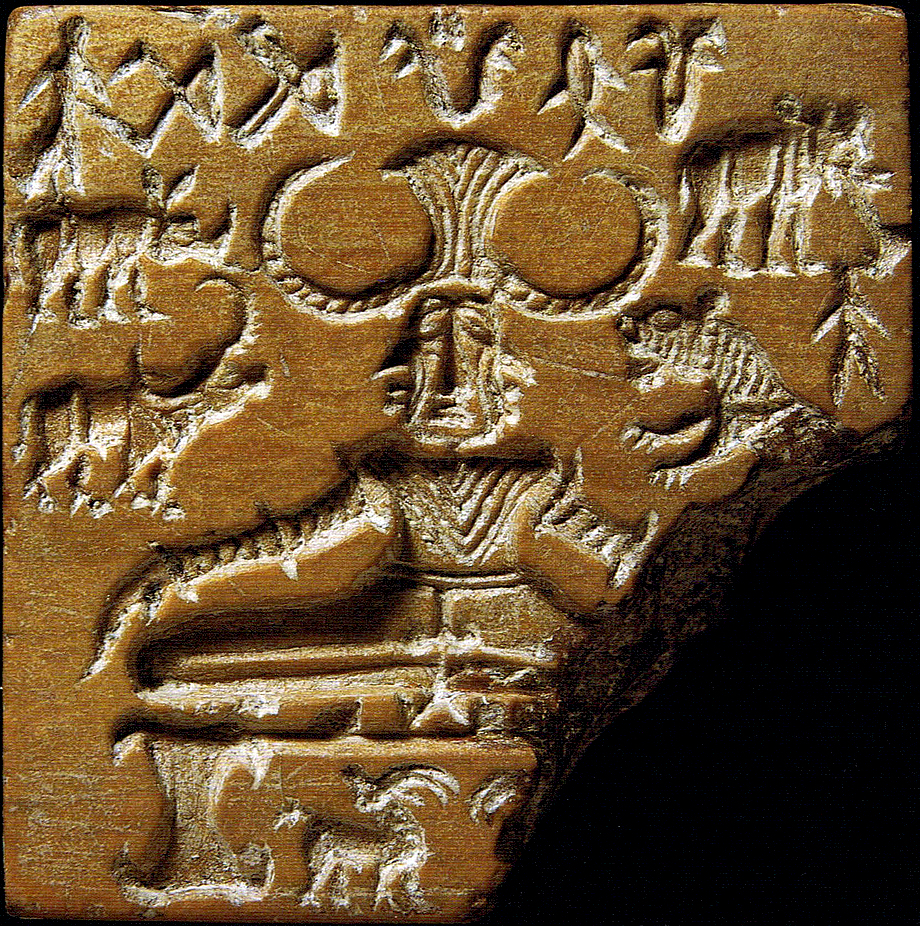
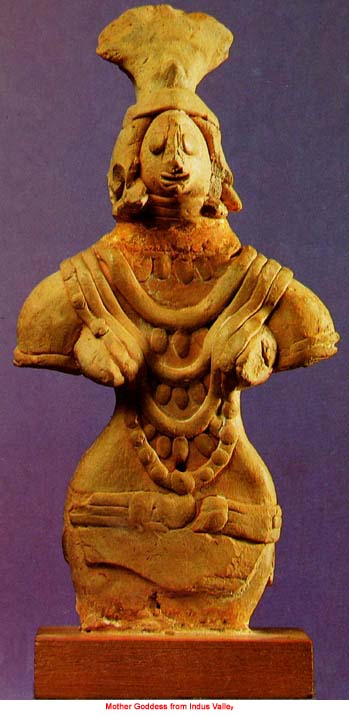
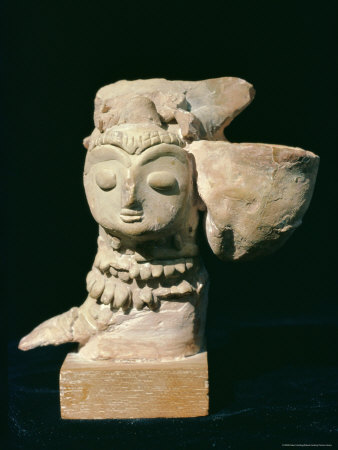
Unlike Mesopotamia or Egypt, there were no such buildings discovered so that we can conclude it might be a temple or involve any kind of public worship.Pictures on seals and other artefacts show what look like figures of gods. Various figures of the Mother Goddess were found. People probably believed this goddess gave health and fertility to people, animals and plants.Another seal picture shows a male god with horns and three faces. Around him are animals, including an elephant, tiger, rhino and buffalo. This god is a bit like the Hindu god Shiva (the God was given the name Pasupathimahadeva/Proto-Shiva by archaeologists).It is also important to note that Shiva is not one of the gods invoked in the Rig Veda and the Vedas condemned idolatry of all forms. The revered cow of the Hindus also does not appear on the seals. Evidences show that plants, trees and animals were probably important to Indus people. The pipal or fig tree is shown in Indus seals, and is still a sacred tree for many Hindus. Many seals reveal the symbol of swastika which is also found in Hinduism.People believed in magic and superstitions also and wore amulets for some protection. A dancing-girl of Mohenjodaro, a bronze figure, has also been found suggesting ritual dancing in the temples. Evidence shows that the Harappan people not only buried their dead but they also conducted cremations and kept the ashes in urns. The discovery of pottery items and ornaments in the burial grounds suggest that they might have believed in life after death.

It can be concluded that the present day Hinduism which is a fusion of  ancient Vedic religion and forms of Animism-Little tradition probably has its roots in the Indus Valley civilisation.

Pasupati Mahdeva

Mother Goddess


Language in Indus Valley Civilization :

It is difficult to be sure about the language that the Harappan people spoke. The scholars have not been able to decipher the language of the Harappans. Sir John Marshall was the first to suggest that the people of the Indus Civilization spoke Dravidian language. Most scholars agreed with Marshall. On the other hand, Piero Meriggi suggested that they used Brahvi language. This is a dravidian language still used in Baluchistan.

It is believed that their writing was a pictographic script, or atleast seems to be. The script seems to have had about 400 basic signs with several variations. The sign probably stood forwards and for syllables. The direction of the writing was generally from right to left. Most of the inscriptions were found on seals. The seals were probably used in trade and also for official and administrative work. So the Harappans seem to have used writing mainly for these sorts of things. A lot of the inscribed material was found at different Harappan site.

Costumes : 

The costumes of Indus valley civilization have been revealed from unearthed figurines. The dress on the clay figurine can be considered as the normal attire of the female of the time. The waist is bare and a very scanty skirt is worn. The skirt is held by a girdle that is made of beads or of bands of woven material secured by a pin or fastening of some kind. One figure wears a cloak which is wrapped around the upper part of the body. Head-dresses are used which are made of stiffened cotton cloth. A tight collar that gives an appearance of greater length to the neck is worn by a few of the figurines.

The male figures are generally seen to be nude. Probably a rob with or without embroidery was worn over the left shoulder and under the right arm. The figure of a man at Harappa might be wearing a close-clinging dhoti. Footwear as such was not found. Cotton as a fabric was used but no evidence was available as far as use of linen and wool are considered.

Ornaments used in Indus Valley Civilisation :

People seem to have been fond of jewellery and hair-dressing. Jewellery made of stones; gold and silver have been unearthed. Men had varied styles of hair-dressing. For instance, one wears his hair parted in the middle and the short locks at the back of the head are which are kept tidy by a woven fillet. Some show the hair woven into a bun after the hair being plaited. Some other figurines show the hair coiled in a ring on the top of the head and in similar rings concealing the ears. Beards were trimmed in various styles.

Metal ornaments were made of gold, electrum, silver, copper and bronze. Stones like lapis lazuli, turquoise, jadeite, carnelian, agate, onyx, Amazon stone, heliotrope, plasma, tachylite, chalcedony, nepheline-sodalite, shell, pottery, faience, vitreous paste; quartz, serpentine and haematite were used. The ornaments used are girdles, necklace, bracelets, pectorals, beads, cones, ear rings, nose-rings, finger-rings, anklets, bangles and hair-pins.


Amusements in Indus Valley Civilization :

 Toys were used by children for amusement. Men were indulged in gambling. This was the board game in which men were moved on the boards and dice was used. Games were also played with pebbles. Dancing was popular. Drum, tambourine, castanets are the musical instruments that have been found.Men of Indus Valley loved hunting expeditions. This is adequately exemplified by the figures of men hunting as well as figurines of animals like wild goat, antelope, tigers etc.


Condition of Women:

Condition of women was pretty good. They were entitled equal honour along with men in the society. The worship of mother goddess demonstrates that they were venerated in the form of mother.


 Food:

Vegetarian and non-vegetarian items of provisions were eaten by the subjects of Indus Valley Civilization. Significant stuffs of food comprised wheat, barley, rice, milk, fish, beef, mutton etc., in addition to date, which was their preferred fruit.

Indus Valley Civilization - Economic Activities :

(a) Agriculture- The Harappans were agriculturalists. Their economy was entirely dominated by horticulture. The Indus River valley was quite fertile when the Harappans thrived there. Agriculture was their chief line of work. Main agricultural products comprised wheat, barely, rice, cotton, vegetables etc. There were vast storehouses to gather food grains etc. Sickles and other types of agricultural equipments have also been found.

(b) Domestication of Animals-This was another means of sustenance of the Indus Valley civilisation. The seals identified, depict that primary animals were cow, bulls, buffaloes, sheep, goat, camels etc.

(c) Hunting-Besides being a means of entertainment, hunting was also a means of sustenance. They merchandised the skins, hair and bones of different animals. Fishing was also admired.

(d) Weaving and Spinning-Various objects excavated, establish that weaving and spinning were admired among the community. Cotton as well as wool was used for designing clothes.

(e) Pottery-Indus Valley inhabitants were skilled to manufacture pottery of a very lofty standard and it is "the earliest example of its kind in the ancient world". It was constructed on a wheel. Numerous statuettes on the pots have been excavated. Domestic vessels like heaters, store-jars, offering stands etc., were manufactured. Glazing vessels of copper, bronze, silver and porcelain were also created.

(f) Metals and Minerals-Gold, silver, bronze and lead were utilised. Most of the pots unearthed were made from copper and bronze. The use of these metals itself establishes the economic conditions of the people. However, iron was possibly alien to them.

Indus Valley Civilization - Political Structure :

After studying the different artefacts, the plan of the cities ,etc. many people proposed their own hypotheses.For example if we consider the cities  they were amazingly well planned with broad main streets and good secondary streets. Each city was laid out on a grid plan with a high citadel and a lower city of domestic dwellings. Urban planning is evident in the neat arrangement of major buildings contained in the citadel, including the placement of a large granary and water tank or bath at right angles to one another. The lower city, which was tightly packed with residential units, was also constructed on a grid pattern consisting of a number of blocks separated by major cross streets. The cities had an elaborate public drainage system. Sanitation was provided through an extensive system of covered drains running through the length of the main streets . Based on these facts Gordon childe proposed his "Municipal administration hypothesis"(Each city is separately administered...cities are not under control of single administration) and A.L.Basham a great australian indologist proposed "Centralized Administration hypotheses"(All cities/towns under control of one administration -- because of similarities in the structure and pattern of the cities/settlements)Some historians believed that there was priestly rule .Historians who took into account the flourishing trade proposed Merchant rule hypotheses .


Indus Valley Civilization - Trade : 

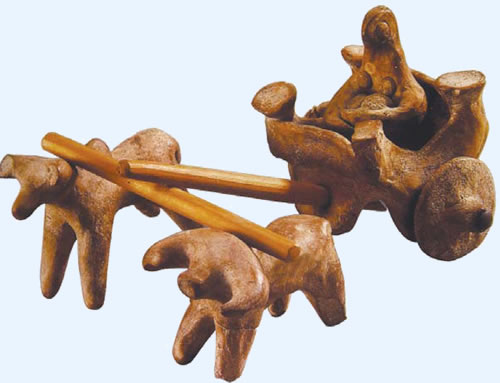
Indus Valley cities lived by trade. Farmers brought food into the cities. City workers made such things as pots, beads and cotton cloth. Traders brought the materials workers needed, and took away finished goods to trade in other cities.Trade goods included terracotta pots, beads, gold and silver, coloured gem stones such as turquoise and lapis lazuli, metals, flints (for making stone tools), seashells and pearls. Minerals came from Iran and Afghanistan. Lead and copper came from India. Jade came from China and cedar tree wood was floated down the rivers from Kashmir and the Himalayas.Indus Valley traders crossed mountains and forests. They followed rivers walking along the river bank. They also used boats. In a boat, it was easier and quicker going downstream (the same direction as the river was flowing). Some traders carried goods on their backs. Others drove wooden carts pulled by Bullocks. Archaeologists  have found clay models of carts, which look like the bullock-carts still seen in India today.Traders probably journeyed in groups. At night they made camp, or slept in roadside hotels. Sometimes it was safer to travel in groups, for protection against robbers or hungry tigers.Some traders settled in other lands. Traders from another civilisation called Mesopotamia made their homes in Indus cities, and people from the Indus Valley went to live in cities in Mesopotamia.

Trade with Mesopotamia:

Sargon of Akkad (2334 to 2279 BC) was a king in Mesopotamia. This was one of the first ancient civilisations. We know Indus Valley traders went there, because Indus seals have been found in Mesopotamia. Sargon's scribes kept written records of ships from other lands. So we learn that the Mesopotamians bought gold, copper and jewellery from 'Meluhha'. Was Meluhha the Mesopotamian name for the Indus civilisation? Or was it the Indus Valley people's own name for their land?.Most Probably. To reach Mesopotamia, Indus ships sailed west. They probably kept close to land. Bits of old Indus pottery found on beaches in Oman, in the Gulf, came from storage jars left behind by traders.


 Impact of Indus Art on Indian Art and Craft :

Interestingly, Indus art and craft has a deep effect on modern Indian art and crafts as well. In modern India the use of Collerium and other toiletry items are seen that were also prevalent in the Indus civilisation. The ability to create powerful symbols was something that could only be done by using special technologies and specific raw materials that were not easily accessible to the common people. The new elites and powerful merchants of the state controlled the crafts that became very significant in strengthening social and ritual status. From one generation to the next, through network of kins, the awareness of definite craft technologies were passed on. Faience working and seal carving are the crafts which were indisputably associated with the growth and integration of new social groups which used distinct types of artifacts to demarcate themselves and their ideologies, customs and tradition. There is a very preliminary but stimulating pattern in the predominant location of craft production on the southern half of the city mounds. Else the northern halves of mounds tend to have either private habitations or public buildings. While the Harappan culture has revealed excellence in sculpture and crafts, there are very few remains of paintings. Patterns on pottery are considered as rare exceptions. The pots had beautiful forms finished with a reddish glaze which were decorated with a diversity of geometric designs done in black.

It is said that the artists of the Indus Valley had a great feel for natural forms and could depict them with marvelous skill. It can well be understood from the power and energy of the bulls and the fierceness of the tigers on the seals. They could model or carve with enormous sensitivity. In the art of Indus Valley the appearance of yogic postures is very fascinating, and also the association of humans with trees. These are motifs which have evolved through centuries enriching the language of Indian art. Thus, Indus art and craft, display some of the most interesting characteristics of rich artistic heritage that existed ages back. These also have an influence on the modern art and craft. The excavated bits and pieces are a source of wide ranging information about their handicrafts, which is really attractive. Indus art and crafts speak a great deal about the civilisation that vanished without a trace.

Decline of the Indus Valley Civilization:

By about 1700 B.C., the Harappan culture was on the verge of decline. The causes of its decline are not certain. The physical existence of the civilization may have ended due to various factors.

 (a) Ecological changes - might have led to the decline of land and agriculture, thereby enforcing the need to evacuate to other area might have been the reason for the disintegration of the Indus valley. Shifts in the monsoon pattern and changes in temperature led to the area become even more arid. The decline in monsoon rains led to weakened river dynamics, and played a critical role both in the development and the collapse of the Harappan culture which was dependent on river floods to fuel their agricultural surplus.

(b) Increase in population, excessive deforestation, decline in agriculture etc. might have created economic problems leading to the gradual decay of the culture. The marked decline in the quality of building and town planning indicates that the authorities were losing control.

(c) The changes in the river flow patterns and correspondent widespread flooding would have disrupted the agricultural base.

(d) The invasion of the Aryans is the other view that is said to be another reason which might have also led to the decline of the Indus valley.