Thursday, February 23, 2012

Census of India (2011)


The census 2011 has many firsts to its credit. Foremost among them is the creation of a National Population Register, a database of all ‘residents’ (as opposed to citizens) above the age of 15 years. The NPR will be a biometric database that will include photographs, fingerprints and iris prints apart from relevant demographic information. Built at an expenditure of Rs. 3,539.24 crore, the NPR is also an initiative yet to undertaken elsewhere in the world.

In other firsts, citizens’ access to new technologies like mobiles, computers and internet will also be recorded as part of the census. Technology will also be heavily relied upon to make the information collection process more efficient. For instance, GIS technology will be used to update population maps. The census has also found its way to Facebook and Twitter, where regular updates and important information will be provided routinely.

The 2011 census has detailed questions on disability, an attempt to recognise multiple types of disorders, apart from simply recording overall numbers.

Slogan of Census 2011 is “Our Census, Our Future"


New Features of Census 2011

Fresh Categories  :

The following fresh categories have been incorporated for comprehensive and better data:
  1. Gender: New category "Other" introduced in addition to Male and Female.
  2. Date of Birth question introduced along with Age.
  3. Current Marital Status: Separate codes Assigned for Separated and Divorced.
  4. New filter Question on SC/ST Introduced - "Is this person SC/ST?"
  5. Disability: Household Schedule of Census 2011 attempts to collect information on eight types of disabilities as against five included in the Household Schedule of Census of India 2001. The information is being collected on disabilities namely, disability 'In Seeing', 'In Hearing', 'In Speech', 'In Movement', 'Mental retardation', 'Mental Illness', 'Any Other' and 'Multiple Disability'.
  6. Literacy Status for "Other" sex added in addition to existing Male and Female.
  7. New Codes under Status of Attendance in Educational Institutions introduced for Not Attending viz., (i) Attended before and (ii) Never attended.
  8. Work: Marginal workers have been classified into two categories viz., (i) worked for 3 months or more but less than 6 months (ii) worked for less than 3 months. The definition of 'Main worker' remains the same.
  9. A separate code-5 has been included under Non-economic activity for renters.
  10. Migration - Provision to specify the present name of the Village/Town of the Birth Place as well as the Place of Last Residence introduced.
  11. Name of the Institutional Household is also being recorded.
   12. Census in Schools : Census 2011 has taken initiatives to sensitise school students about census operations. The Census Organization is implementing "Census in School' programme across the  country. This is specifically designed for the active participation of children in ensuring authenticity of census data of their families.The programme covers about 60 to 80 schools in each of the 640 Districts  in the country.

Census 2011 has taken initiatives to sensitise school students about census operations. The Census Organization is implementing "Census in School' programme across the country. This is specifically designed  for the active participation of children in ensuring authenticity of census data of their families.
The programme covers about 60 to 80 schools in each of the 640 Districts in the country.
                           
  13. The mascot of an enumerator has been created for Census 2011 to make the process more people-  friendly. The mascot helps people relate with the Census process and elucidates the key role of enumerators in the process.          

Census 2011 covered 35 States/Union Territories, 640 districts, 5,924 sub-districts, 7,935 Towns and 6,40,867 Villages. In Census 2001, the corresponding figures were 593 Districts, 5,463 sub-Districts, 5,161 Towns and 6,38,588 Villages. There is an increase of 47 Districts, 461 Sub Districts, 2774 Towns (242 Statutory and 2532 Census Towns) and 2279 Villages in Census 2011 as compared to Census 2001.

 The growth rate of population for India in the last decade was 17.64%. The growth rate of population in rural and urban areas was 12.18% and 31.80% respectively. Bihar (23.90%) exhibited the highest decadal growth rate in rural population.

 India’s population in 1901 was about 238.4 million, which has increased by more than four times in 110 years to reach a population of 1,210 million in 2011.

The population of the country as per the provisional figures of Census 2011 is 1210.19 million of which 623.7 million (51.54%) are males and 586.46 million (48.46%) are females. The provisional figures of Census 2011 were released in New Delhi on Thursday by Union home secretary Shri G.K.Pillai and RGI Shri C Chandramouli.

The major highlights of the Census 2011 (Provisional figures) are as under
:

*The population of India has increased by more than 181 million during the decade 2001-2011.

*Percentage growth in 2001-2011 is 17.64; males 17.19 and females 18.12.

*2001-2011 is the first decade (with the exception of 1911-1921) which has actually added lesser population compared to the previous decade.

*Uttar Pradesh (199.5 million) is the most populous State in the country followed by Maharashtra with 112 million.

*The percentage decadal growth rates of the six most populous States have declined during 2001-2011 compared to 1991-2001:

-Uttar Pradesh (25.85% to 20.09%)

-Maharashtra (22.73% to 15.99%)

-Bihar (28.62% to 25.07%)

-West Bengal (17.77 % to 13.93%)

-Andhra Pradesh (14.59% to 11.10%)

-Madhya Pradesh (24.26% to 20.30%)

*During 2001-2011, as many as 25 States/UTs with a share of about 85% of the country's population registered an annual growth rate of less than 2% as compared to, 15 States/UTs with a share of about 42% during the period 1991-2001.

*15 States/UTs have grown by less than 1.5 per cent per annum during 2001-2011, while the number of such States/UTs was only 4 during the previous decade.

*The total number of children in the age-group 0-6 is 158.8 million (-5 million since 2001)

*Twenty States and Union Territories now have over one million children in the age group 0-6 years. On the other extreme, there are five States and Union Territories in the country that are yet to reach the one hundred thousand mark.

*Uttar Pradesh (29.7 million), Bihar (18.6 million), Maharashtra (12.8 million), Madhya Pradesh (10.5 million) and Rajasthan (10.5 million) constitute 52% children in the age group of 0-6 years.

*Population (0-6 years) 2001-2011 registered minus (-)3.08 percent growth with minus (-)2.42 for males and -3.80 for females.

*The proportion of Child Population in the age group of 0-6 years to total population is 13.1 percent while the corresponding figure in 2001 was 15.9 percent. The decline has been to the extent of 2.8 points.

*Overall sex ratio at the national level has increased by 7 points to reach 940 at Census 2011 as against 933 in Census 2001. This is the highest sex ratio recorded since Census 1971 and a shade lower than 1961. Increase in sex ratio is observed in 29 States/UTs.

*Three major States (J&K, Bihar & Gujarat) have shown decline in sex ratio as compared to Census 2001.

*Kerala with 1084 has the highest sex ratio followed by Puducherry with 1038, Daman & Diu has the lowest sex ratio of 618.

*Child sex ratio (0-6 years) is 914. Increasing trend in the child sex ratio (0-6) seen in Punjab, Haryana, Himachal Pradesh, Gujarat, Tamil Nadu, Mizoram and A&N Islands. In all remaining 27 States/UTs, the child sex ratio show decline over Census 2001.

*Mizoram has the highest child sex ratio (0-6 years) of 971 followed by Meghalaya with 970. Haryana is at the bottom with ratio of 830 followed by Punjab with 846.

*Literacy rate has gone up from 64.83 per cent in 2001 to 74.04 per cent in 2011 showing an increase of 9.21 percentage points.

*Percentage growth in literacy during 2001-2011 is 38.82; males : 31.98% & females : 49.10%.

 *Literates constitute 74 per cent of the total population aged seven and above and illiterates form 26 percent.

Links 


Introduction (Census of India)


Size,Growth Rate and Distribution of Population 


Size ,Growth Rate and Distribution of Child Population ( 0 - 6 years age group)


Density of Population 


Gender Composition of the Population 


State of Literacy 


Thursday, February 16, 2012

Modernization and Westernization


People most of the times tend to believe modernization and westernization as synonymous of each other. But in reality they are not so. Both of the process are totally different and play a difference role in people live respectively. In the previous one the society tries to get betterment and advancement by the utilization of its own resources, opportunities and manpower. This process makes the society self-sufficient, healthy and confident.  Modernization is not a simple single wave movement, its processes that have been going on for past three to four centuries and even before that previous two centuries were spent in preparation of society for modernization. Genesis of modernization was in deep dissatisfaction with institutionalization of backwardness and blind beliefs in society during dark ages in Europe. That dissatisfaction was reflected during renaissance period (15th and 16th century) when emphasis on classical art and science set the foundation for Enlightenment. Then with Age of Enlightenment in next century emphasis on education, culture, reason set the foundations for Epoch of Modernization which is still in operation.

By modernization we simply mean "current" (from Latin root "modernus"), which means a break from past, (then meant a break from roman past to Christian present when roman emperor Constantine accepted Christianity as state religion) however in social terms it means a cultural, political and scientific movement which brought in profound changes like individual consciousness, idea of nation state, acceptance of change, industrial revolution, rejection of normative and acceptance of actual.

In political arena first modern ideas were promulgated by Niccolò Machiavelli, when he separated ethics from statecraft. In arena of music it's considered to begin with Rossini, Beethoven and Bach as they mathematically structured their symphonies to produce beautiful music from equations. Similarly in paintings it's considered to begin with Jacques David Louis of France and later defined by Van Gogh's portrayal of dark side of human life i.e. portraying life as it is instead of portraying normative beauty and romance.

However it's the social aspects of modernity that we are most concerned with; which are defined by three pillars of Reason, Individuality and Progress. In case of India, modernity is considered to begin with introduction of western education in India which brought consciousness towards backwardness of our dogmas and doctrines and culture. This in turn brought cultural reform movement, women emancipation movement by western educated intellectuals like Raja Ram Mohan Roy, Ishwar Chander Vidya Sagar, and M. G. Ranade. Most important contribution of such movements was to secure dignity of individual's life over and above one's social life and commitments. For example 'Sati' system was one of the most exploitative system, where women's life has no other meaning than serving her husband and no existence after his death. Such disrespect for an individual life was a big blot and matter of shame for Indian society and that's why it became the first target of all the social reformers.

Similarly, apart from such movements other important contribution of modernity in our society was to introduce culture of reason and scientific inquiry instead of belief in superstition. This movement is still in operation and has not been completely successful yet. But with Universalization of education and spread of scientific ideas into common man's daily life it is likely to be achieved soon.

Thus, we can say that modernization was brought to India and other non European countries by introduction of western modern education and almost all of its modern tenets were developed and pioneered in Western Europe. But that does not mean "all that is western is modern and all that is modern is western", as even western society also suffers from same problems of backwardness, male chauvinism, although in a different and complex manner. What was explicit in other societies is subtle and implicit in western society. Modern myths, urban legends, celebrity worship and cults of personality haunt western society far more than they affect other societies. Latest addition to it is cult of violence promoted by Hollywood, gun culture, violent video games in USA and Europe.

Similarly modern intellectuals in west criticize their own society for dehumanization and too much individualization; similarly they deny presence of any grand truths or mega doctrines under the present movement called post modernism which has risen as critique to western style of modernization. It is trying to inculcate fresh ideas like green development, human rights, sustainable development, compassion and embrace of new ideas from Eastern wisdom and African naturalism and animism. We can also see the changes this movement has brought in west, where people are more considerate and open to other cultures and ideas and embracing new practices like Yoga, Meditation and Mysticism.

Thus it would be sad if we under the belief that "all western is modern" are embracing even the ills of western life like too much individualism, Death metal music (which is more of an expression of frustration than creativity), drugs cult etc.

Western civilization certainly did have profound impact on us, and brought western industrial modernity to the world and it would be great if today instead of embracing the west blindly we can synthesize the west and east picking up best of both and then fusing it to create a new universal culture and expression. We must strive for excellence like ancient Greeks, Romans and Indians instead of accepting mediocrity in name of acceptance of self and actual which has became the common practice in modern times. People search the books by best seller tag, music by chartbuster tag and art by price tag; whereby none of these characteristics define the quality of work. Thus accepting mediocrity in name of popularity would destroy scholarship and will bring non researched facts and beliefs in people's sub-consciousness and over time will become  new doctrines and dogmas thus bringing new type of backwardness to society. That's exactly is what Hollywood and pop culture doing to west and we must be careful to avoid it. Sitting in McDonalds sipping coca-cola and eating burgers won't make anyone modern, similarly neither watching FRIENDS on star world or violent and shameless reality shows will do that. West brought modernity to itself by reviving its ancient Greco-Roman aesthetics, arts and reason. similarly we also must dig into our past and must bring alive our ancient wisdom and aesthetics to enlighten our future.


Tuesday, January 31, 2012

Banks - India

  • Organized banking in India originated in the late 18th century
  • The State Bank of India, headquartered in Mumbai, is the largest bank in India
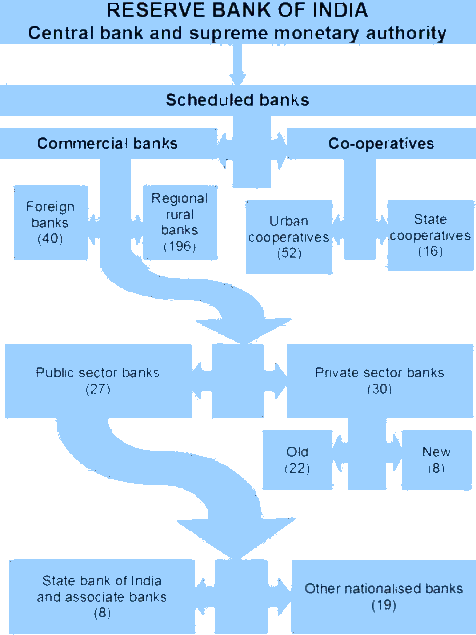
  • Currently, India has 88 Scheduled Banks – 27 public sector banks, 31 private banks and 38 foreign banks
  • The public sector banks hold over 75% of banking assets in the country, followed by private banks (18.2%) and foreign banks (6.5%)
  • Central banking in India is the responsibility of the Reserve Bank of India
  • Banking in India is the responsibility of the Department of Financial Services, Ministry of Finance
  • Currently there are 170 scheduled commercial banks, which includes 91 regional rural banks, 19 nationalised banks, 8 banks in the SBI group and the IDBI
Non-Scheduled banks : Click Here


History of banking in India


  • The oldest banks in India were the General Bank of India and the Bank of Hindustan, both founded in 1786. However both banks are now defunct
  • The oldest existing bank in India is the State Bank of India. The origins of the SBI go back to the Bank of Calcutta (founded 1806, renamed Bank of Bengal in 1809)
  • The Bank of Madras was established in 1843 and the Bank of Bombay in 1868
  • The Bank of Bengal, Bank of Bombay and Bank of Madras merged to form the Imperial Bank of India in 1921. The Imperial Bank of India was renamed the State Bank of India in 1955. Although a normal commercial bank, the Imperial Bank of India also functioned as a central governmental until 1935
  • The Reserve Bank of India was established in 1935
  • The oldest joint stock bank is the Allahabad Bank, established in 1865.
  • The first entirely Indian joint stock bank was the Oudh Commercial Bank (Faizabad, 1881). However, it failed in 1958. The next oldest is the Punjab National Bank (Lahore, 1895)
  • The Dakshina Kannada and Udipi districts of Karnataka (called South Canara), is known as the Cradle of Indian Banking
Nationalisation of banks


  • The Government of India nationalised 14 of the largest banks in 1969
  • This achieved by an ordinance to the effect in July 1969. This was formalized by the Banking Companies (Acquisition and Transfer of Undertaking) Bill 1969
  • The banks that were nationalized in 1969 were: Allahabad Bank, Bank of Baroda, Bank of India, Bank of Maharastra, Canara Bank, Central Bank of India, Dena Bank, Indian Bank, Indian Overseas Bank, Punjab National Bank, Syndicate Bank, UCO Bank, Union Bank of India and United Bank of India
  • In 1980, six more banks were nationalized. The banks that were nationalized in 1980 were: Andhra Bank, Corporation Bank, Oriental Bank of Commerce, Punjab and Sind Bank, New Bank of India and Vijaya Bank
  • In 1993, the New Bank of India was merged with Punjab National Bank. There are 19 nationalized banks in operation today
  • Following this, the GoI controlled about 91% of the banking business in India
RESERVE BANK OF INDIA


Overview


  • The Reserve Bank of India is the central bank of India
  • It was established in 1935 and nationalised in 1949. Its headquarters was initially Calcutta, but moved to Bombay in 1937. It is currently headquartered in Mumbai.
  • The first Governor of the RBI was Sir Osborne Smith. The current Governor of the RBI is Dr. Duvvuri Subbarao
  • The RBI functions under the provisions of the Reserve Bank of India Act 1934
Objectives


Maintain price stability
Ensure adequate flow of credit
Protect depositor’s interests
Provide cost-effective banking services to the public
Facilitate external trade and payment
Promote development of foreign exchange market in India
Provide supplies of currency notes and coins in the country

Functions
Formulates, implements and monitors monetary policies
Regulates operations of banking and financial services sector in the country
Manages the Foreign Exchange Management Act 1999
Issues, exchanges and destroys currency notes and coins
Perform promotional functions to support national objectives
Acts as banker to banks by maintaining accounts of all scheduled banks
Acts as banker to the Central and state governments

 Important RBI Governors

1. Sir Osborne Smith- 1935-1937 - First Governor of the RBI
Did not sign any bank notes

2. Sir James Taylor -1937-1943- Governor during WWII
Started the practice of signing bank notes

3. Sir C D Deshmukh- 1943-1949 -First Indian Governor of RBI
Oversaw Independence & Partition
Represented India at the Bretton Woods Conference 1944
Served as Minister of Finance 1950-1956

13. M Narasimhan- May 1977 – Nov 1977 -Only Governor to be appointed from the Reserve Bank cadre
Chairperson of Committee on Financial System (1991) and Committee on Banking Sector Reforms (1998)
Served as Executive Director for India at the World Bank and the IMF

15. Dr. Manmohan Singh -1982-1985- Witnessed comprehensive legal reforms in banking sector

22. Dr. D Subbarao 2008-Present -Prior to RBI, he has been Secretary to the PM’s Economic Advisory Council (2005-2007),Lead economist in the World Bank (1999-2004),Finance Secretary to the Government of Andhra Pradesh (1993-1998),Joint Secretary, Dept. of Economic Affairs (1988-1993)


STATE BANK OF INDIA


  • The State Bank of India is derived from the Imperial Bank of India (1921), which was nationalised in 1955
  • The State Bank of India is the oldest bank in India. It traces its ancestry to the Bank of Calcutta, founded in 1806.
  • It is headquartered in Mumbai
  • The State Bank of India is also the largest bank in India. It has a market share of about 20% in deposits and advances
  • The State Bank Group consists of the SBI and its subsidiary banks viz. State Bank of Indore, State Bank of Bikaner & Jaipur, State Bank of Hyderabad, State Bank of Mysore, State Bank of Patiala, State Bank of Travancore
  • The SBI is one of the Big Four Banks in India, along with ICICI Bank, Axis Bank and HDFC Bank
  • The SBI was ranked as the 29th most reputable company in the world by Forbes in 2009
CATEGORIES OF BANKS IN INDIA


Commercial Banks


  • Commercial banks are those that cater to the regular banking and financial needs of the public.
  • Commercial banks include public sector banks and private sector banks. Public sector banks include the State Bank Group and other nationalised banks, while private sector banks include Indian banks and foreign banks
Cooperative Banks
  • Cooperative banking is retail and commercial banking organised on a cooperative basis. Cooperative banks include credit unions, savings and loans associations and building societies and cooperatives
  • Cooperative banks operate on the principles of cooperation – mutual help, democratic decision making and open membership
  • They are governed by controls of the RBI as well as state governments. Cooperative banks in general operate under the Cooperative Credit Societies Act 1904, but large Urban Cooperative Banks operate under the Banking Regulation Act 1949
  • Cooperative banks in India are the primary financiers of agricultural activities, small scale industries and self-employed workers
  • Cooperative banks in India were first established in the late 19th century, following the success of such banks in Britain and Germany
  • The Anyonya Cooperative Bank Ltd. (ABCL) was the first cooperative bank in India. It was established Vithal Laxman (aka Bhausaheb Kavthekar) in 1889 under the name Anyonya Sahayakari Mandali Cooperative Bank Ltd. The bank closed functioning in March 2008 following an order by the RBI. Re-opening is under consideration
Regional Rural Banks
  • Regional Rural Banks (RRBs) were first established in 1975
  • Initially five RRBs were established at Moradabad (UP), Gorapkhpur (UP), Bhiwani (Haryana), Jaipur (Rajasthan), Malda (WB). Currently there are 91 RRBs
  • RRBs exist in all states except Goa and Sikkim
  • The share of RRBs in agricultural credit is around 5%
Scheduled Banks
  • Scheduled Banks are those banks that have been included in Second Schedule of the RBI Act 1934
  • Scheduled Banks must fulfil two conditions-The paid up capital and collected funds of the bank must not be less than Rs 5 lakhs,any activity of the bank should not adversely affect the interest of deposition
Scheduled Banks enjoy the following benefits:

They are eligible for obtaining loans on Bank Rate from the RBI
They acquire membership of the clearing house
Scheduled Banks include commercial banks, cooperative banks and regional rural banks
There are around 302 Scheduled Banks in operation

Non-Scheduled Banks
  • Non-Scheduled Banks are those that are not included in the list of Scheduled Banks
  • They have to follow the Cash Reserve Ratio (CRR) condition. However, they are not compelled to deposit these funds with the RBI
  • They can avail loans from the RBI only under emergencies, and not for daily activities
  • There are only 4 Non-Scheduled Banks in operation
GOVERNMENT ENTITIES IN BANKING


Small Industries Development Bank of India (SIDBI)


  • Established in 1990, headquarters Lucknow
  • The main objective of the SIDBI is to aid the growth and development of micro, small and medium scale industries in India
  • It provides direct credit to micro, small and medium enterprises, supports microfinance institutions and refinancing to state level finance bodies
Industrial Development Bank of India (IDBI)
  • Established in 1964, headquarters Mumbai
  • The IDBI is the tenth largest development bank in the world. It is one of India’s largest public sector bank
  • Its main objective is to provide credit and other banking facilities to industries in India
  • However, in 2004 the IDBI was re-designated as a commercial bank, following the Industrial Development Bank (Transfer of Undertaking and Repeal) Act 2003, and renamed IDBI Ltd
  • Following this, the commercial banking division, IDBI Bank was merged into IDBI
Industrial Finance Corporation of India (IFCI)
  • The IFCI is the first development finance institution in the country to cater to the needs of Indian industry
  • Established 1948, headquarters New Delhi
  • The IFCI was established to provide long term low interest credit to corporate borrowers
  • In 1993, the IFCI was re-registered as a commercial company under the Indian Companies Act 1956, and renamed IFCI Ltd
National Bank for Agricultural and Rural Development (NABARD)
  • Partly owned by the RBI
  • Established 1982, headquarters Mumbai
  • NABARD serves as the apex development bank in India for economic activities in rural areas
  • The main objective of NABARD is to facilitate credit flow for agriculture and small scale industries
  • NABARD provides refinance to State Cooperative Agriculture and Rural Development Banks (SCARDBs), State Cooperative Banks (SCBs), Regional Rural Banks (RRBs), Commercial Banks and other financial institutions approved by the RBI
  • NABARD coordinates the rural financing activities of all institutions engaged in developmental work
  • NABARD has 28 regional offices (state capitals), one Sub Office (in Port Blair) and one Special Cell (in Srinagar)
  • NABARD is famous for its Self Help Group (SHG) Bank Linkage Programme, which serves as an important tool for microfinance
National Housing Bank (NHB)
  • Wholly owned subsidiary of the RBI
  • Established in 1987, headquarters New Delhi
  • Established mainly to provide long term finance to individual households
Export-Import Bank of India (EXIM Bank)
  • Established 1981, headquarters Mumbai
  • The main objective of the EXIM Bank is to provide financial assistance to exporters and importers with a view to promoting the country’s international trade
  • It acts as the apex financial institution for financing foreign trade in India
Bharatiya Reserve Bank Note Mudran Private Ltd (BRBNMPL)
  • Wholly owned subsidiary of the RBI
  • Established in 1995, headquarters Bangalore
  • Main function is to augment the product of bank notes to meet demand
  • The company manages two presses: Mysore and Salboni (West Bengal)
Deposit Insurance and Credit Guarantee Corporation (DICGC)
  • Wholly owned subsidiary of the RBI
  • Established in 1962, headquarters Mumbai
  • India was one of the first countries to provide deposit insurance
  • Main objective is to provide insurance to depositors against collapse and bankruptcy of banks
  • Provides deposit insurance coverage up to Rs 100,000


Sunday, January 22, 2012

FDIs - INDIA


Foreign direct investment (FDI) in India has played an important role in the development of the Indian economy. FDI in India has in a lot of ways enabled India to achieve a certain degree of financial stability, growth and development. This money has allowed India to focus on the areas that needed a boost and economic attention, and address the various problems that continue to challenge the country.
India has continually sought to attract FDI from the world’s major investors. In 1998 and 1999, the Indian national government announced a number of reforms designed to encourage and promote a favorable business environment for investors.

FDIs are permitted through financial collaborations, through private equity or preferential allotments, by way of capital markets through euro issues, and in joint ventures. FDI is not permitted in the arms, nuclear, railway, coal or mining industries.A number of projects have been implemented in areas such as electricity generation, distribution and transmission, as well as the development of roads and highways, with opportunities for foreign investors.


Why does India, a country with resources and a skilled workforce, lag so far behind China in FDI amounts?

Physical infrastructure is the biggest hurdle that India currently faces, to the extent that regional differences in infrastructure concentrates FDI to only a few specific regions. While many of the issues that plague India in the aspects of telecommunications, highways and ports have been identified and remedied, the slow development and improvement of railways, water and sanitation continue to deter major investors.

Federal legislation is another perverse impediment for India. Local authorities in India are not part of the approval process and the large bureaucratic structure of the central government is often perceived as a breeding ground for corruption. Foreign investment is seen as a slow and inefficient way of doing business, especially in a paperwork system that is shrouded in red tape.


Click - FDI Policy of India


 SOURCE OF FDI INTO INDIA BETWEEN APRIL 2000 AND MARCH 2011


A tiny speck of island on the Indian Ocean, Mauritius, for an average Indian, is largely a beach destination that beckons thousands of honeymooners to its coral reefs and picture-perfect underwater world every year. But for a little over a decade, it has also become a key component that oils the Indian capital market as a hub for routing financial investments into India.

Be it a multinational firm investing in its Indian subsidiary, a private equity firm looking to take advantage of tax loopholes or even an Indian promoter routing a part of his/her own holdings in a group company through a Mauritius arm, the island nation is easily the favourite tax haven for investors into India.

However, certain sections of the Indian government have raised concerns of ‘round tripping’ of funds which, in effect, leads to loss for the Indian exchequer. There have been talks of trying to plug the loopholes for quite some time. And there are rumours that this time around, it might just happen. Even as fresh reports suggest that there has been no decision regarding the same, for a stock market that is on the verge of sneezing at any whiff of trouble, it was enough to shave down almost 2 per cent value on Monday.

Mauritius has been the single largest source of FDI into the country in the first 10 years of the new millennium. As much as $55 billion worth of money has been invested in India after being routed through Mauritius. This is 42 per cent of the total FDI in the country in the past decade. For starters, bulk of this money originated not from the island nation itself whose GDP is 150th the size of India.

Over the past several years, Mauritius has been used as a platform by investors to invest into India. Over 40 per cent of total foreign direct investment in India comes from Mauritius, a low tax jurisdiction. The Mauritius structure has also been very common with private equity funds investing in India.

Reasons :


Under the India-Mauritius tax treaty (tax treaty), India does not have a right to tax gains derived by a resident of Mauritius from the sale or disposal of shares of an Indian company. In other words, a Mauritian resident selling shares of an Indian company can take the benefit of the India-Mauritius tax treaty and not be liable to Indian capital gains tax. To add more flesh to this, the Supreme Court of India has held that tax residency certificate issued by Mauritius tax authorities is sufficient evidence to prove tax residency in Mauritius for availing tax treaty benefits. This has lent a lot of credibility to the Mauritius route.

Now, let us look at the concern which India has. As per Press reports, India is estimated to lose over $600 million a year in revenue on account of this benefit under the tax treaty. Further, concerns have also been raised that Mauritius may have been used for illegitimate purposes by Indian tax residents for ‘round-tripping transactions.’

India-Mauritius Tax Treaty Being Re-negotiated


In the backdrop of these concerns, India and Mauritius had set up a Joint Working Group (JWG) way back in August, 2006, comprising of senior officials to work on important issues in the existing tax treaty. Press reports indicate that JWG had met on several occasions in the past to discuss issues relating to adequate safeguards to be put in place to prevent misuse of the tax treaty and strengthening of the mechanism for exchange of information. However, it is understood that there was no consensus reached.

It is learnt that both the countries have recently agreed in principal to recommence discussions in this regard. Press reports indicate that the tax treaty may be revised to introduce:

1. Exchange of information on banking transactions (in addition to the existing information exchange article).

2. Limitation on benefits (LOB) clause to restrict the benefits of the treaty – this should provide guidance on meeting the substance test to qualify for treaty benefits.

Thus, under the revised treaty, a mechanism can be put in place to prevent its abuse. It remains to be seen the conditions which will be prescribed under the LOB clause.

While the above hit the news a couple of days ago, as per a Press report of today, the government has strongly denied holding any talks on revising the double tax avoidance agreement with Mauritius. Indian equity market has been witnessing a volatile bout of sell-offs post news that India and Mauritius are in talks to revise the existing tax treaty.


Introduction Of General Anti-Avoidance Rules (GAAR) In The Indian Tax Legislation


Some believe that a revision of the Mauritius treaty to prevent abuse may not be necessary now, given that anti-avoidance provisions are already proposed under the new Direct tax Code (DTC), to be effective from April 1, 2012.


GAAR is proposed as an anti-avoidance measure under the DTC. Under GAAR, the Indian tax authorities will be empowered to declare any ‘arrangement’ as ‘impermissible avoidance arrangement’, if part or a whole of a structure has been set up with the main purpose of obtaining ‘tax benefit’. An ‘arrangement’ will be presumed to be for obtaining tax benefit, unless the taxpayer demonstrates that obtaining tax benefit was not the main objective of the arrangement.

Under the DTC, GAAR is a tool available with the tax authorities to question any such structure, including the Mauritius structure.In summary, under the DTC regime, commercial substance and bona fide business purpose test will be among the key requirements for availing treaty benefits.


Is Shifting To Any Other Favourable Jurisdiction A Solution?


Countries like Singapore and Cyprus also provide similar tax benefits as Mauritius. The India-Singapore tax treaty already has an LOB clause to prevent abuse. In any case, once GAAR is enacted under the DTC, substance requirements and bona fide business purpose test will have to be satisfied to claim treaty benefits, irrespective of whether the investor comes from Mauritius or any other jurisdiction. Once enacted, GAAR will not only impact the new structures but may also impact the existing structures, if there is a claim for capital gains exemption under the DTC regime.

The Way Forward


PE funds coming into India from Mauritius should take note of these developments, review its existing structure and perform an impact assessment. PE funds, which are likely to be impacted due to these proposals, should see if any corrective step can be taken, if necessary. Alteration of existing structure may, therefore, be on the cards for some of the PE funds. Based on the outcome of the impact assessment, some PE funds may also have to reconcile to the fact that tax cost may have to be factored in while making investment decisions going forward.

The government, of course, looks confident than ever and assumes that India’s strong economic fundamentals will continue to attract investments, notwithstanding the additional tax cost on investors.


IUCN Red List


The IUCN ( International Union for Conservation of Nature ) Red List System was first conceived in 1963 and set a standard for species listing and conservation assessment efforts. The IUCN Red List is the world's most comprehensive inventory of the global conservation status of plant and animal species. It uses a set of criteria to evaluate the extinction risk of thousands of species and subspecies. These criteria are relevant to all species and all regions of the world. With its strong scientific base, the IUCN Red List is recognized as the most authoritative guide to the status of biological diversity.

The overall aim of the Red List is to convey the urgency and scale of conservation problems to the public and policy makers, and to motivate the global community to try to reduce species extinctions.

Who uses the IUCN Red List?

The Red List is used by government agencies, wildlife departments, conservation-related non-governmental organizations (NGOs), natural resource planners, educational organizations, and many others interested in reversing, or at least halting the decline in biodiversity.

Uses of the IUCN Red List
  • Draws attention to the magnitude and importance of threatened biodiversity
  • Identifies and documents those species most in need of conservation action
  • Provides a global index of the decline of biodiversity
  • Establishes a baseline from which to monitor the future status of species
  • Provides information to help establish conservation priorities at the local level and guide conservation action
  • Helps influence national and international policy, and provides information to international agreements such as the Convention on Biological Diversity (CBD) and the Convention on International Trade in Endangered Species of Wild Fauna and Flora (CITES).

How is the IUCN Red List compiled?

There are nine categories in the IUCN Red List system:
  1. Extinct
  2. Extinct in the Wild
  3. Critically Endangered
  4. Endangered
  5. Vulnerable
  6. Near Threatened
  7. Least Concern
  8. Data Deficient
  9. Not Evaluated.
Classification into the categories for species threatened with extinction (Vulnerable, Endangered, and Critically Endangered) is through a set of five quantitative criteria that form the heart of the system. These criteria are based on biological factors related to extinction risk and include: rate of decline, population size, area of geographic distribution, and degree of population and distribution fragmentation.

 Categories:

EXTINCT (EX)
 A taxon ( group of organisms) is Extinct when there is no reasonable doubt that the last individual has died. A taxon is presumed Extinct when exhaustive surveys in known and/or expected habitat, at appropriate times (diurnal, seasonal, annual), throughout its historic range have failed to record an individual. Surveys should be over a time frame appropriate to the taxon's life cycle and life form.

EXTINCT IN THE WILD (EW)
A taxon is Extinct in the Wild when it is known only to survive in cultivation, in captivity or as a naturalized population (or populations) well outside the past range. A taxon is presumed Extinct in the Wild when exhaustive surveys in known and/or expected habitat, at appropriate times (diurnal, seasonal, annual), throughout its historic range have failed to record an individual. Surveys should be over a time frame appropriate to the taxon's life cycle and life form.

CRITICALLY ENDANGERED (CR)
A taxon is Critically Endangered when the best available evidence indicates that it meets any of the criteria A to E for Critically Endangered (see Red List Categories and Criteria booklet for details) and it is therefore considered to be facing an extremely high risk of extinction in the wild.

ENDANGERED (EN)
A taxon is Endangered when the best available evidence indicates that it meets any of the criteria A to E for Endangered (see Red List Categories and Criteria booklet for details), and it is therefore considered to be facing a very high risk of extinction in the wild.

VULNERABLE (VU)
A taxon is Vulnerable when the best available evidence indicates that it meets any of the criteria A to E for Vulnerable (see Red List Categories and Criteria booklet for details), and it is therefore considered to be facing a high risk of extinction in the wild.

NEAR THREATENED (NT)
A taxon is Near Threatened when it has been evaluated against the criteria but does not qualify for Critically Endangered, Endangered or Vulnerable now, but is close to qualifying for, or is likely to qualify for, a threatened category in the near future.

LEAST CONCERN (LC)
A taxon is Least Concern when it has been evaluated against the criteria and does not qualify for Critically Endangered, Endangered, Vulnerable or Near Threatened. Widespread and abundant taxa are included in this category.

DATA DEFICIENT (DD)
A taxon is Data Deficient when there is inadequate information to make a direct, or indirect, assessment of its risk of extinction based on its distribution and/or population status. A taxon in this category may be well studied, and its biology well known, but appropriate data on abundance and/or distribution are lacking. Data Deficient is therefore not a category of threat. Listing of taxa in this category indicates that more information is required and acknowledges the possibility that future research will show that threatened classification is appropriate. It is important to make positive use of whatever data are available. In many cases great care should be exercised in choosing between DD and a threatened status. If the range of a taxon is suspected to be relatively circumscribed, and a considerable period of time has elapsed since the last record of the taxon, threatened status may well be justified.

NOT EVALUATED (NE)
A taxon is Not Evaluated when it is has not yet been evaluated against the criteria.


CLICK --- Critically Endangered Species of India


Tuesday, January 10, 2012

Indus Valley Civilization


The earliest traces of civilization in the Indian subcontinent are to be found in places along, or close, to the Indus river. Excavations first conducted in 1921-22, in the ancient cities of Harappa and Mohenjodaro  pointed to a highly complex civilization that first developed some 4,500-5,000 years ago, and subsequent archaeological and historical research has now furnished us with a more detailed picture of the Indus Valley Civilization and its inhabitants. Though the Indus Valley script remains undeciphered down to the present day, the numerous seals discovered during the excavations, as well as statuary ,pottery and skeletal remains, not to mention the ruins of numerous Indus Valley cities, have enabled scholars to construct a reasonably plausible account of the Indus Valley Civilization.

How big was the Indus civilisation?

The Indus Valley civilisation was  four times bigger than Britain! There were more than 1,400 towns and cities. The biggest cities were Harappa and Mohenjo-Daro. Each city had as many as 80,000 people.There were lots of smaller cities, such as Lothal, Dholavira, Kalibangan and Banawali. These names of these cities were given in later times. We do not know what the Indus people themselves called their cities.


Map of Indus Valley Civilization :


What were Indus cities like?

The Indus Valley Civilization (IVC) was a Bronze Age civilization .An Indus city was made of mud-brick buildings. It had walls and roads.Indus Valley Civilization had elaborated town planning and it followed the Grid System. Water was very important to Indus people, so the builders started by digging wells, and laying drains. Main streets were up to 10 metres wide, wide enough for carts to pass. Side streets were narrow, more like alleys.Some cities had a citadel high on a mound. In the citadel were bigger buildings. Perhaps the city's rulers lived there. Most people lived and worked in the lower part of town.Most Indus people did not live in cities at all. Perhaps 9 out of 10 people were farmers and traders who lived in small villages.

All Indus Valley bricks were the same ratio of 1 : 2 : 4 but came in different sizes. A common size was 7 cm high x 14 cm wide x 28 cm long. Bricks were laid in rows or 'courses', end to end and crossways, using wet mud as cement to stick the bricks together. Indus Valley walls were so strong that many have stood for over 4,000 years!

Indus Valley people had clean water and excellent drains - better than any other ancient civilisation. Most city homes had a bathroom and toilet, connected to the city drains. Some people had private wells, for clean water. Others went to public wells, to fetch water in jars or animal- skin bags. Waste water flowed out of the house through pipes into the street-drains. Workers cleaned the drains and emptied the pits where sewage from toilets collected.


Great Bath - Mohanjedaro


An Indus city house :

An Indus Valley house was cool inside. Thick walls kept people cool in the heat of summer. Some houses had just one room. Big houses had lots of rooms arranged around a central courtyard. There were no windows onto the main street. This kept out dust and noise. Side windows let in light and air. From a model house found at Harappa, we can see that windows may have had wooden shutters with grilles (barred openings) to let in air and light. All that are left today are the ground floors of houses that once had two or three floors. Stairs led to the upper floors and roof. Walls were covered with mud plaster. It is not clear if people painted the walls.

Most people living in an Indus city had small homes which were also used as workshops. There was not much space to relax. For richer families, the courtyard was a pleasant, airy space, open to the sky. Children could play there, with toys and with pets such as monkeys, dogs and birds. People could tend plants in pots, and enjoy the air. In the courtyard, a rich family had its own private well, for water. The very rich lived in grand houses with more than one courtyard, and 30 to 40 rooms.

People of Indus valley Civilization :

Anthropological investigation and examination of the human remains shows that four racial types existed in this civilization. They were the proto - Australiod, Mediterranean, Alpine and the Mongoloid. Archaeological excavation reveal the existence of various racial types. Of all these the existence of the Dravidian race holds its relevance owing to its wide spread acceptance. Scholars are differed in their opinion about the race of Indus people. Some say it is of the Aryans while others opine that it is of the Dravidians. From this analysis on Indus Valley Civilization, scholars believes that it is the Dravidians who were the original inhabitants of Indus valley civilization.

Religion and Gods of Indus Valley People :

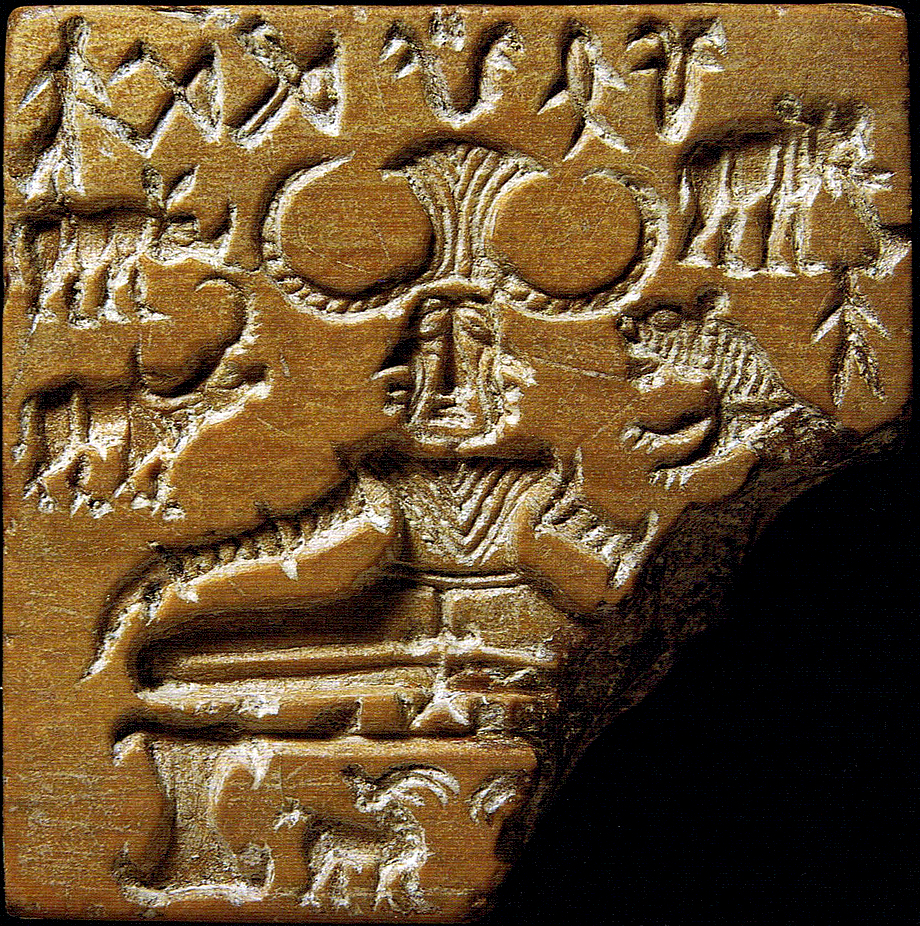
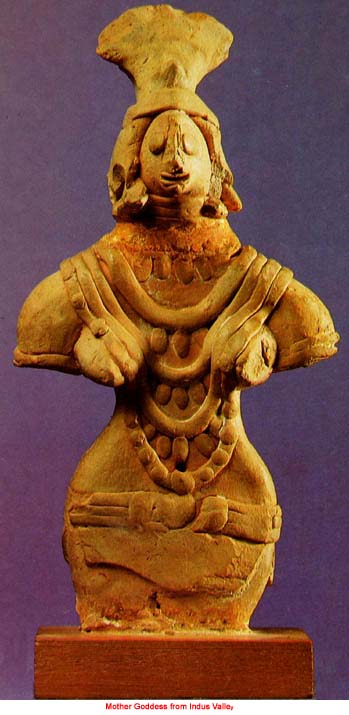
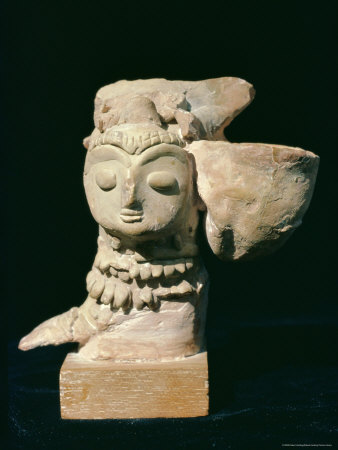
Unlike Mesopotamia or Egypt, there were no such buildings discovered so that we can conclude it might be a temple or involve any kind of public worship.Pictures on seals and other artefacts show what look like figures of gods. Various figures of the Mother Goddess were found. People probably believed this goddess gave health and fertility to people, animals and plants.Another seal picture shows a male god with horns and three faces. Around him are animals, including an elephant, tiger, rhino and buffalo. This god is a bit like the Hindu god Shiva (the God was given the name Pasupathimahadeva/Proto-Shiva by archaeologists).It is also important to note that Shiva is not one of the gods invoked in the Rig Veda and the Vedas condemned idolatry of all forms. The revered cow of the Hindus also does not appear on the seals. Evidences show that plants, trees and animals were probably important to Indus people. The pipal or fig tree is shown in Indus seals, and is still a sacred tree for many Hindus. Many seals reveal the symbol of swastika which is also found in Hinduism.People believed in magic and superstitions also and wore amulets for some protection. A dancing-girl of Mohenjodaro, a bronze figure, has also been found suggesting ritual dancing in the temples. Evidence shows that the Harappan people not only buried their dead but they also conducted cremations and kept the ashes in urns. The discovery of pottery items and ornaments in the burial grounds suggest that they might have believed in life after death.

It can be concluded that the present day Hinduism which is a fusion of  ancient Vedic religion and forms of Animism-Little tradition probably has its roots in the Indus Valley civilisation.

Pasupati Mahdeva

Mother Goddess


Language in Indus Valley Civilization :

It is difficult to be sure about the language that the Harappan people spoke. The scholars have not been able to decipher the language of the Harappans. Sir John Marshall was the first to suggest that the people of the Indus Civilization spoke Dravidian language. Most scholars agreed with Marshall. On the other hand, Piero Meriggi suggested that they used Brahvi language. This is a dravidian language still used in Baluchistan.

It is believed that their writing was a pictographic script, or atleast seems to be. The script seems to have had about 400 basic signs with several variations. The sign probably stood forwards and for syllables. The direction of the writing was generally from right to left. Most of the inscriptions were found on seals. The seals were probably used in trade and also for official and administrative work. So the Harappans seem to have used writing mainly for these sorts of things. A lot of the inscribed material was found at different Harappan site.

Costumes : 

The costumes of Indus valley civilization have been revealed from unearthed figurines. The dress on the clay figurine can be considered as the normal attire of the female of the time. The waist is bare and a very scanty skirt is worn. The skirt is held by a girdle that is made of beads or of bands of woven material secured by a pin or fastening of some kind. One figure wears a cloak which is wrapped around the upper part of the body. Head-dresses are used which are made of stiffened cotton cloth. A tight collar that gives an appearance of greater length to the neck is worn by a few of the figurines.

The male figures are generally seen to be nude. Probably a rob with or without embroidery was worn over the left shoulder and under the right arm. The figure of a man at Harappa might be wearing a close-clinging dhoti. Footwear as such was not found. Cotton as a fabric was used but no evidence was available as far as use of linen and wool are considered.

Ornaments used in Indus Valley Civilisation :

People seem to have been fond of jewellery and hair-dressing. Jewellery made of stones; gold and silver have been unearthed. Men had varied styles of hair-dressing. For instance, one wears his hair parted in the middle and the short locks at the back of the head are which are kept tidy by a woven fillet. Some show the hair woven into a bun after the hair being plaited. Some other figurines show the hair coiled in a ring on the top of the head and in similar rings concealing the ears. Beards were trimmed in various styles.

Metal ornaments were made of gold, electrum, silver, copper and bronze. Stones like lapis lazuli, turquoise, jadeite, carnelian, agate, onyx, Amazon stone, heliotrope, plasma, tachylite, chalcedony, nepheline-sodalite, shell, pottery, faience, vitreous paste; quartz, serpentine and haematite were used. The ornaments used are girdles, necklace, bracelets, pectorals, beads, cones, ear rings, nose-rings, finger-rings, anklets, bangles and hair-pins.


Amusements in Indus Valley Civilization :

 Toys were used by children for amusement. Men were indulged in gambling. This was the board game in which men were moved on the boards and dice was used. Games were also played with pebbles. Dancing was popular. Drum, tambourine, castanets are the musical instruments that have been found.Men of Indus Valley loved hunting expeditions. This is adequately exemplified by the figures of men hunting as well as figurines of animals like wild goat, antelope, tigers etc.


Condition of Women:

Condition of women was pretty good. They were entitled equal honour along with men in the society. The worship of mother goddess demonstrates that they were venerated in the form of mother.


 Food:

Vegetarian and non-vegetarian items of provisions were eaten by the subjects of Indus Valley Civilization. Significant stuffs of food comprised wheat, barley, rice, milk, fish, beef, mutton etc., in addition to date, which was their preferred fruit.

Indus Valley Civilization - Economic Activities :

(a) Agriculture- The Harappans were agriculturalists. Their economy was entirely dominated by horticulture. The Indus River valley was quite fertile when the Harappans thrived there. Agriculture was their chief line of work. Main agricultural products comprised wheat, barely, rice, cotton, vegetables etc. There were vast storehouses to gather food grains etc. Sickles and other types of agricultural equipments have also been found.

(b) Domestication of Animals-This was another means of sustenance of the Indus Valley civilisation. The seals identified, depict that primary animals were cow, bulls, buffaloes, sheep, goat, camels etc.

(c) Hunting-Besides being a means of entertainment, hunting was also a means of sustenance. They merchandised the skins, hair and bones of different animals. Fishing was also admired.

(d) Weaving and Spinning-Various objects excavated, establish that weaving and spinning were admired among the community. Cotton as well as wool was used for designing clothes.

(e) Pottery-Indus Valley inhabitants were skilled to manufacture pottery of a very lofty standard and it is "the earliest example of its kind in the ancient world". It was constructed on a wheel. Numerous statuettes on the pots have been excavated. Domestic vessels like heaters, store-jars, offering stands etc., were manufactured. Glazing vessels of copper, bronze, silver and porcelain were also created.

(f) Metals and Minerals-Gold, silver, bronze and lead were utilised. Most of the pots unearthed were made from copper and bronze. The use of these metals itself establishes the economic conditions of the people. However, iron was possibly alien to them.

Indus Valley Civilization - Political Structure :

After studying the different artefacts, the plan of the cities ,etc. many people proposed their own hypotheses.For example if we consider the cities  they were amazingly well planned with broad main streets and good secondary streets. Each city was laid out on a grid plan with a high citadel and a lower city of domestic dwellings. Urban planning is evident in the neat arrangement of major buildings contained in the citadel, including the placement of a large granary and water tank or bath at right angles to one another. The lower city, which was tightly packed with residential units, was also constructed on a grid pattern consisting of a number of blocks separated by major cross streets. The cities had an elaborate public drainage system. Sanitation was provided through an extensive system of covered drains running through the length of the main streets . Based on these facts Gordon childe proposed his "Municipal administration hypothesis"(Each city is separately administered...cities are not under control of single administration) and A.L.Basham a great australian indologist proposed "Centralized Administration hypotheses"(All cities/towns under control of one administration -- because of similarities in the structure and pattern of the cities/settlements)Some historians believed that there was priestly rule .Historians who took into account the flourishing trade proposed Merchant rule hypotheses .


Indus Valley Civilization - Trade : 

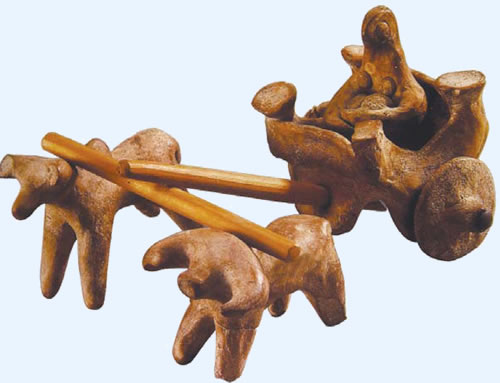
Indus Valley cities lived by trade. Farmers brought food into the cities. City workers made such things as pots, beads and cotton cloth. Traders brought the materials workers needed, and took away finished goods to trade in other cities.Trade goods included terracotta pots, beads, gold and silver, coloured gem stones such as turquoise and lapis lazuli, metals, flints (for making stone tools), seashells and pearls. Minerals came from Iran and Afghanistan. Lead and copper came from India. Jade came from China and cedar tree wood was floated down the rivers from Kashmir and the Himalayas.Indus Valley traders crossed mountains and forests. They followed rivers walking along the river bank. They also used boats. In a boat, it was easier and quicker going downstream (the same direction as the river was flowing). Some traders carried goods on their backs. Others drove wooden carts pulled by Bullocks. Archaeologists  have found clay models of carts, which look like the bullock-carts still seen in India today.Traders probably journeyed in groups. At night they made camp, or slept in roadside hotels. Sometimes it was safer to travel in groups, for protection against robbers or hungry tigers.Some traders settled in other lands. Traders from another civilisation called Mesopotamia made their homes in Indus cities, and people from the Indus Valley went to live in cities in Mesopotamia.

Trade with Mesopotamia:

Sargon of Akkad (2334 to 2279 BC) was a king in Mesopotamia. This was one of the first ancient civilisations. We know Indus Valley traders went there, because Indus seals have been found in Mesopotamia. Sargon's scribes kept written records of ships from other lands. So we learn that the Mesopotamians bought gold, copper and jewellery from 'Meluhha'. Was Meluhha the Mesopotamian name for the Indus civilisation? Or was it the Indus Valley people's own name for their land?.Most Probably. To reach Mesopotamia, Indus ships sailed west. They probably kept close to land. Bits of old Indus pottery found on beaches in Oman, in the Gulf, came from storage jars left behind by traders.


 Impact of Indus Art on Indian Art and Craft :

Interestingly, Indus art and craft has a deep effect on modern Indian art and crafts as well. In modern India the use of Collerium and other toiletry items are seen that were also prevalent in the Indus civilisation. The ability to create powerful symbols was something that could only be done by using special technologies and specific raw materials that were not easily accessible to the common people. The new elites and powerful merchants of the state controlled the crafts that became very significant in strengthening social and ritual status. From one generation to the next, through network of kins, the awareness of definite craft technologies were passed on. Faience working and seal carving are the crafts which were indisputably associated with the growth and integration of new social groups which used distinct types of artifacts to demarcate themselves and their ideologies, customs and tradition. There is a very preliminary but stimulating pattern in the predominant location of craft production on the southern half of the city mounds. Else the northern halves of mounds tend to have either private habitations or public buildings. While the Harappan culture has revealed excellence in sculpture and crafts, there are very few remains of paintings. Patterns on pottery are considered as rare exceptions. The pots had beautiful forms finished with a reddish glaze which were decorated with a diversity of geometric designs done in black.

It is said that the artists of the Indus Valley had a great feel for natural forms and could depict them with marvelous skill. It can well be understood from the power and energy of the bulls and the fierceness of the tigers on the seals. They could model or carve with enormous sensitivity. In the art of Indus Valley the appearance of yogic postures is very fascinating, and also the association of humans with trees. These are motifs which have evolved through centuries enriching the language of Indian art. Thus, Indus art and craft, display some of the most interesting characteristics of rich artistic heritage that existed ages back. These also have an influence on the modern art and craft. The excavated bits and pieces are a source of wide ranging information about their handicrafts, which is really attractive. Indus art and crafts speak a great deal about the civilisation that vanished without a trace.

Decline of the Indus Valley Civilization:

By about 1700 B.C., the Harappan culture was on the verge of decline. The causes of its decline are not certain. The physical existence of the civilization may have ended due to various factors.

 (a) Ecological changes - might have led to the decline of land and agriculture, thereby enforcing the need to evacuate to other area might have been the reason for the disintegration of the Indus valley. Shifts in the monsoon pattern and changes in temperature led to the area become even more arid. The decline in monsoon rains led to weakened river dynamics, and played a critical role both in the development and the collapse of the Harappan culture which was dependent on river floods to fuel their agricultural surplus.

(b) Increase in population, excessive deforestation, decline in agriculture etc. might have created economic problems leading to the gradual decay of the culture. The marked decline in the quality of building and town planning indicates that the authorities were losing control.

(c) The changes in the river flow patterns and correspondent widespread flooding would have disrupted the agricultural base.

(d) The invasion of the Aryans is the other view that is said to be another reason which might have also led to the decline of the Indus valley.



Thursday, December 29, 2011

Science’s Breakthrough of the Year (2011)


Antiretroviral Therapy (ART)


The journal Science has lauded an eye-opening HIV study, known as HPTN 052, as the most important scientific breakthrough of 2011. This clinical trial demonstrated that people infected with HIV are 96% less likely to transmit the virus to their partners if they take antiretroviral drugs (ARVs).The findings end a long-standing debate over whether ARVs could provide a double benefit by treating the virus in individual patients while simultaneously cutting transmission rates. It’s now clear that ARVs can provide treatment as well as prevention when it comes to HIV, researchers agree.


The Hayabusa Mission 

After some near-disastrous technical difficulties and a stunningly successful recovery, Japan’s Hayabusa spacecraft returned to Earth with dust from the surface of a large S-type asteroid. This asteroid dust represented the first direct sampling of a planetary body in 35 years, and analysis of the grains confirmed that the most common meteorites found on Earth, known as ordinary chondrules, are born from these much larger S-type asteroids.

Click --> Chondrites


Unraveling Human Origins 

Studying the genetic code of both ancient and modern human beings, researchers discovered that many humans still carry DNA variants inherited from archaic humans, such as the mysterious Denisovans in Asia and still-unidentified ancestors in Africa. One study this year revealed how archaic humans likely shaped our modern immune systems, and an analysis of Australopithecus sediba fossils from South Africa showed that the ancient hominin possessed both primitive and Homo-like traits.


Capturing a Photosynthetic Protein 

In vivid detail, researchers in Japan have mapped the structure of the Photosystem II, or PSII, protein that plants use to split water into hydrogen and oxygen atoms. The crystal-clear image shows off the protein’s catalytic core and reveals the specific orientation of atoms within. Now, scientists have access to this catalytic structure that is essential for life on Earth—one that may also hold the key to a powerful source of clean energy.

Pristine Gas in Space

Astronomers using the Keck telescope in Hawaii to probe the faraway
universe wound up discovering two clouds of hydrogen gas that seem to have maintained their original chemistry for two billion years after the Big Bang. Other researchers identified a star that is almost completely devoid of metals, just as the universe’s earliest stars must have been, but that formed much later. The discoveries show that pockets of matter persisted unscathed amid eons of cosmic violence.

Getting to Know the Microbiome

Research into the countless microbes that dwell in the human gut demonstrated that everyone has a dominant bacterium leading the gang in their digestive tract: Bacteroides, Prevotella, or Ruminococcus. Follow-up studies revealed that one of these bacteria thrives on a high-protein diet while another prefers vegetarian fare. These findings and more helped to clarify the interplay between diet and microbes in nutrition and disease.

A Promising Malaria Vaccine

Early results of the clinical trial of a malaria vaccine, known as RTS,S, provided a shot in the arm to malaria vaccine research. The ongoing trial, which has enrolled more than 15,000 children from seven African countries, reassured malaria researchers, who are used to bitter disappointment, that discovering a malaria vaccine remains possible.

Strange Solar Systems

This year, astronomers got their first good views of several distant planetary systems and discovered that things are pretty weird out there. First, NASA’s Kepler observatory helped identify a star system with planets orbiting in ways that today’s models cannot explain. Then, researchers discovered a gas giant caught in a rare “retrograde” orbit, a planet circling a binary star system, and 10 planets that seem to be freely floating in space—all unlike anything found in our own solar system.

Designer Zeolites

Zeolites are porous minerals that are used as catalysts and molecular sieves to convert oil into gasoline, purify water, filter air, and produce laundry detergents (to name a few uses). This year, chemists really showed off their creativity by designing a range of new zeolites that are cheaper, thinner, and better equipped to process large organic molecules.

more about zeolites

Clearing Senescent Cells

Experiments revealed that clearing senescent cells, or those that have stopped dividing, from the bodies of mice can delay the onset of age-related symptoms such as cataracts and muscle weakness. Mice whose bodies were cleared of these loitering cells didn’t live longer than their untreated cage-mates—but they did seem to live better, which provided researchers with some hope that banishing senescent cells might also prolong our golden years.