Monday, October 15, 2012

Indian Classical Music


Evolution 

Indian classical music has one of the most complex and complete musical systems ever developed. It has developed through various interactions between different peoples of different races and cultures over several thousand years. Like Western classical music, it divides the octave into 12 semitones of which the 7 basic notes are Sa Re Ga Ma Pa Dha Ni Sa, in order, replacing Do Re Mi Fa So La Ti Do. The origins of Indian classical music can be found from the oldest of scriptures, part of the Hindu tradition known as the Vedas. The Samaveda, one of the four Vedas, describes music at length and was created out of Rigveda so that its hymns could be sung as Samagana; this style eventually evolved into Ragas, a very popularly known term. Indian classical music evolved as traditionally practice oriented. The rules of Indian music and compositions themselves are taught from a Guru to a Shishya, in person. Players of the tabla usually keep the rhythm in Hindustani music. The prime themes of Hindustani music are romantic love, nature and devotionals. Yet, Indian classical music is independent of such themes. To sing a raga, any poetic phrase appropriate for the raga may be chosen and the raga would not suffer. Once the raga is established, the ornamentation begins to become rhythmical, gradually speeding up.

Trends write-up 

 Originally, all Indian music was sung in Sanskrit. But after the two systems divided, Hindustani music was centered around Hindi, whereas the Carnatic system was mainly influenced by Telugu as well as by Kannadese and Tamil. The trend was that tradition of music should be passed on in ‘gharanas’ or regional schools or styles of performance in the cities of Northern India, especially through family dynasties of famous teachers and musicians, frequently named after the place where it originated. Today, teaching has often transferred to colleges and conservatoires, but the traditional system through guru-shishya instruction persists, and so do the dynasties. Pure tradition of Classical Music was where improvisation predominates, and written notation, when used, is skeletal. Such intrinsic music of past generations is irrevocably lost today.


What is Hindustani classical music?

The classical music of North India is called Hindustani Classical Music.

How is Indian classical music different from Western classical music? What are their similarities?


Melody and rhythm are the common grounds for music, be it Western or Indian. Indian music is essentially monophonic (single melody format or homophonic) while Western music can be polyphonic (multiple notes played or sung in harmonised unison), monophonic or a combination of both.

Western classical music is based upon the equal tempered scale, and rests upon melody, harmony and counterpart while Swara and Tala are the two basic components of Indian classical music.

Swaras are the twelve notes and the intervening semitones , while a Tala is a cycle of beats, starting with a stress point called the Sam and ending with a release point called the Khali. It is this (sam & khali) that brings life to a Tala.

What is meant by 'Hindustani' and 'Carnatic' music?


Indian classical music has two distinct styles-Hindustani classical music and Carnatic music. Hindustani music is prevalent all over India except in the Southern States, where Carnatic music is practiced.

What is the origin of these two styles of music and which is older?

No definite answer can be given about the antiquity of either of these styles of music. The tradition of Indian music practiced and developed is nearly three thousand years old. Indigenous musical styles and schools evolved and developed in different regions of the country by blending purely ritualistic music and folk music. The basic elements remain the same. The semantic divide between the two styles started from the time of the 'Sangeetaratnakara' of Sharangadeva (1210-1247 AD). This was later enhanced by the Muslim influence and this musical bifurcation was described for the first time as Hindustani and Carnatic music by Haripaladeva in his text the 'Sangeetsudhakara' (1309-1312 AD).

What are the similarities and differences between 'Hindustani' and 'Carnatic' music?


Both the styles are monophonic, follow a melodic line and employ a drone (tanpura) with the help of one or two notes against the melody. Both the styles use definite scales to define a raga but the Carnatic Style employs Shrutis or semitones to create a Raga and thus have many more Ragas than the Hindustani style. Carnatic ragas differ from Hindustani ragas. The names of ragas are also different. However, there are some ragas which have the same scale as Hindustani ragas but have different names; such as Hindolam and Malkauns, Shankarabharanam and Bilawal. There is a third category of ragas like Hamsadhwani, Charukeshi, Kalavati etc. which are essentially Carnatic Ragas. They share the same name, the same scale (same set of notes) but can be rendered in the two distinctively different Carnatic and Hindustani styles. Unlike Hindustani music, Carnatic music does not adhere to Time or Samay concepts and instead of Thaats, Carnatic music follows the Melakarta concept.

What is a raga?

Each Raga has its own scale consisting of minimum five and maximum seven notes (swaras). A raga has specific ascending (Aaroh) and descending (Avaroh) movements, specific dominating notes (vadi) and specific notes complementing the Vadi (Samvadi) notes. The characteristic phrases of a raga (Pakad) establish its identity and mood.

How many ragas are there?

Originally, there were six Ragas and thirty-six Raginis (melodies with softer emotions). Hundreds of Ragas were created with the help of these Ragas and Raginis, many of which have become obsolete. In recent times, musicians have composed many more ragas. There are today, approximately, 120-150 ragas in use.

Are these ragas used in classical music only?


Ragas are used in semi-classical and light music as well.

What is a Thaat?

 Thaat is a system by which different sets of complete scale of seven notes, in ascending order, are formulated to categorize the maximum number of ragas under it. Thaat or Mela is known as the Parental scale. There are ten Thaats under which most of the Hindustani ragas can be catagorised. These Thaats have the names of ragas and they are Bilawal, Khamaj, Poorvi, Kafi, Bhairavi, Kalyan, Bhairav, Marwa, Asavari and Todi.

How significant is 'Thaat' in classical music? Is it relevant in other types of music too?

For a performer, Thaats have little significance but for a student of music, the system comes as a great help to understand the classification of ragas. Thaat does not have relevance in other types of music.

What is a 'Tanpura'? How does it help the singers?


Tanpura or Tambura is a drone instrument, usually consisting of four or six strings tuned to Pa or Ma or Ni, Sa, Sa, Sa (Sol or Fa or Ti, Doh, Doh, Doh). The two strings in the centre are Sa of middle octave. The Pa or Ma or Ni and the last Sa are of the lower octave. The droning of the Tanpura helps singers to get set on the scale and it resonates to create a musical atmosphere.

What are the other instruments for vocal support? What is their origin? Why has the Harmonium become so popular in comparison with other instruments?

Sarangi, Violin and Harmonium. The Sarangi originated from a folk instrument of Rajasthan, while the origin of the Violin and the Harmonium is from the West. The Harmonium is easy to master and therefore became very popular, though it is not worthy of pure Indian classical music. Its equal tempered notes, like the piano, cannot capture the embellishments (Shruti, Meend, Gamak etc.). It came into vogue not very long ago.

What are the prominent percussion instruments used for accompaniment?

Tabla is the most prominent percussion instrument, apart from the 'Pakhawaj'_ an old, traditional instrument played to accompany Dhrupad singers. All other forms of Hindustani classical music use tabla, which came into being with the evolution of Hindustani classical music. The Tabla is believed to have been devised by Hazrat Amir Khusro.

Do vocalists and accompanists rehearse together for a long period of time like their counterparts in the West?

No. Accompanists of the performers of Indian classical music do not necessarily rehearse together. Indian music is essentially, solo music. The training of a tabla player is not complete till he masters the art of accompaniment or stagecraft. He practices with many musicians to develop his skills as an accompanist just as the main performer does with different tabla players. In some cases, a musician may continue to practice with an accompanist of his choice for a long time.

For a vocal or instrumental performance, other accompanying artistes are seen with the main performer. How is it then a solo music?

As the vocalist performs and music flows, the accompanists on the tabla and harmonium provide support by keeping the beats and following the mood of the performer. It is therefore, essentially, solo music.

What is a Khayal? How many such forms are there?

Khayal is a form of rendering a raga. The essential component of a khayal is a composition (Bandish) and the expansion of the text of the composition within the framework of the raga. The nuances and sub forms employed to improvise and embellish the rendition vary from singer to singer. There are two forms of Khayal. Bada-Khayal in slow tempo and Chhota-Khayal in medium to fast tempo.

What is a Dhrupad? What are the differences between Dhrupad and Khayal?

Dhruvapada or Dhrupad is another form of rendering a raga. It has a specific composition, consisting of four parts and is sung in different styles. The percussion accompaniment is the Mridang or Pakhawaj, a one-piece drum, as opposed to the two-piece drum, the tabla in khayal. The main difference between these two musical forms is that the Dhrupad is rigidly bound by the composition and the tala, within which all improvisation has to be made. The Khayal, on the other hand, has the freedom to free itself from the rhythmic beat and then return to the beginning of each time cycle (tala). Also, the two essential idioms used in Khayal, which are absent in Dhrupad, are the Sargam and Taan. Sargam is the singing of the notes (sa, re, ga,..), per se, instead of words while Taan is the sequential movement through the different notes using the vowel "Aa".

What is a Thumri?

The Thumri is yet another form of rendering ragas. However , this very popular, light classical form of Hindustani music, is limited to specific ragas whose key emotion is lyricism and eroticism, e.g. Bhairavi, Gara, Pilu. Effective word-play usually characterizes a Thumri. Chiefly associated with folk songs of UP and Punjab, the Thumri is composed in dialects of Hindi.

Sometimes the words of a Khayal or Thumri are difficult to follow. Why is it so?

Sometimes the words are not intelligible because they are sung in a stylized manner and do not always follow the necessary scansion and get elongated with the notes.

Very often some artistes utter a small portion of the text three times and arrive at a stressed beat. What is it called and what is its significance?

Very often musicians repeat a particular phrase thrice and arrive on the first beat of the rhythm known as 'Sam'. This division of any Tala, or rhythm cycle, into three equal parts to create variation and musical thrill is known as 'Tihaayi'. Artistically phrased tihaayi enhances the beauty of a performance.


Trivia:
 
~Indian classical music can be divided into Hindustani Classical (North India) and Carnatic (South India).

~Bharat’s Natyashastra is the first treatise laying down the fundamental principles of drama, dance and music in India.

~In Hindustani music, the performance usually begins with a slow elaboration of the raga, known as Alap.

~There is a significant amount of Persian influence in Hindustani music, in terms of both the instruments and the style of presentation.

~Popular terms of the Indian Classical Music era that are famous the world over include- Sitar, sarod, tabla, sarangi, khayal, ghazal or raga, tala and gharana.



Sunday, October 14, 2012

Amazon with Bruce Parry


A breathtaking journey from the Amazon's source deep in the Peruvian Andes to its vast mouth on Brazil's Atlantic coast. The Amazon is a complex, shifting environment. The deforestation ruthlessly driven by the profits of logging and soya bean plantations has seen one fifth of Amazon destroyed already. The lands of the indigenous tribes are disappearing and their traditional way of life is sorely threatened. Travelling  by foot, light aircraft and boat, Bruce moves to stay with these tribes that live silently beneath the rainforest canopy. Immersing himself in their lives, he reveals how they are affected by the changing world around them. This series is also the story of the people who live and work there too: the soya farmers, the cattle barons, the loggers and the illegal miners stripping the jungle for traces of gold; the environmental campaigners dying to save the forest, the bio-prospectors and scientists searching for new medicines. 


Monday, September 10, 2012

Resposibility to Protect ( R2P )


The Responsibility to Protect (“RtoP” or “R2P”) is a new international security and human rights norm to address the international community’s failure to prevent and stop genocides, war crimes, ethnic cleansing and crimes against humanity.

 Origin

This concept grew out of genocide and ethnic cleansing in Rwanda and Srebrenica in the 1990s.

The doctrine of the responsibility to protect was first elaborated in 2001 by a group of prominent international human rights leaders comprising the International Commission on Intervention and State Sovereignty. Under their mandate, the Commission sought to undertake the two-fold challenge of reconciling the international community's responsibility to address massive violations of humanitarian norms and ensuring respect for the sovereign rights of nation states.The "responsibility to protect" doctrine received renewed emphasis in 2004 when the United Nations Secretary-General Kofi Annan created the High-Level Panel on Threats, Challenges, and Change. The Panel was established to identify major threats facing the international community in the broad field of peace and security and to generate new ideas about policies and institutions aimed at preventing or confronting these challenges.The panel suggested collective international responsibility to protect, exercisable by the Security Council authorizing military intervention as a last resort, in the event of genocide and other large scale killing, ethnic cleansing or serious violations of international humanitarian law which sovereign Governments have proved powerless or unwilling to prevent.

In September 2005, R2P was once again enlivened, this time with the full support of the international community. At the 60th session of the U.N. General Assembly gathering, 191 heads of state and government representatives unanimously endorsed a resolution supporting the Responsibility to Protect doctrine. This resolution laid the foundations for a new global moral compact between every State and every population on earth. As adopted, atrocity crimes , genocide, crimes against humanity (including ethnic cleansing) and war crimes - were considered a universal concern and therefore were responsibility of the international community.

This commitment, entitled the Responsibility to Protect, is based on the idea that sovereignty is not a right, but a responsibility.

It stipulates that :
  • The State carries the primary responsibility for protecting populations from genocide, war crimes, crimes against humanity and ethnic cleansing, and their incitement.
  • The international community has a responsibility to encourage and assist States in fulfilling this responsibility.
  • The international community has a responsibility to use appropriate diplomatic, humanitarian and other means to protect populations from these crimes. If a State is manifestly failing to protect its populations, the international community must be prepared to take collective action to protect populations, in accordance with the Charter of the United Nations.

India’s position :

India is in support of the R2P concept but it considers many a unilateral actions by the Western powesr in the recent past unjustified.

India recently told a United Nations meeting on R2P concept that Western air strikes on Libya were a complete violation of the U.N. Security Council’s resolution number 1973.

The fundamental aspects of the concept as India sees them are as follows:
  1.  R2P cannot be used to address all social evils, including violations of human rights and humanitarian law.  Rather it must only be confined to the four identified crimes, i.e., genocide, war crimes, ethnic cleansing, and crimes against humanity.  
  2. The default response of the international community cannot be coercive measures under Chapter VII of the Charter.
  3. In reality R2P cannot be seen as a pretext for humanitarian intervention. 
  4. R2P also cannot turn out to be a tool legitimizing big power intervention on the pretext of protecting populations from the violations of human rights and humanitarian law. 
  5. It cannot be seen as codifying a system of coercion, providing a tool in the hands of powerful governments to judge weaker states, and encourage regime change primarily on political considerations.
  6. Armed intervention can be a measure of last resort when everything else has failed. Selectivity must be avoided at all cost and the principle must be applied uniformly to all parties to a conflict.
  7. The implementation of R2P requires an effective discharge of responsibility and obligations by states under the U.N. Charter in a balanced and impartial manner.


Sunday, September 9, 2012

Hydrogeology


Hydrogeology (hydro- meaning water, and -geology meaning the study of the Earth) is the area of geology that deals with the distribution and movement of groundwater in the soil and rocks of the Earth's crust,commonly in aquifers.The term geohydrology is often used interchangeably.The study of the interaction between groundwater movement and geology can be quite complex. Groundwater does not always flow in the subsurface down-hill following the surface topography. Groundwater follows pressure gradients (flow from high pressure gradient to low) often following fractures and conduits in circuitous paths.Aquifers are broadly classified as being either confined or unconfined (water table aquifers), and either saturated or unsaturated,the type of aquifer affects the properties that control the flow of water in that medium. 

What is Ground Water ?

Ground water is the water that is found beneath the earth's surface. It is the water that fills pores and fractures in the ground.

Water table and Vadose Zone 

The top of the ground water is called water table. Water table is the boundary between unsaturated zone and saturated zone  Between water table and land surface is the unsaturated or vadose zone.In the unsaturated zone/Vadose zone water moves downward to the water table to recharge the ground water .

The vadose zone, also termed the unsaturated zone, is the part of Earth between the land surface and the top of the phreatic zone i.e. the position at which the groundwater (the water in the soil's pores) is at atmospheric pressure ("vadose" is Latin for "shallow"). Hence the vadose zone extends from the top of the ground surface to the water table. Water in the vadose zone has a pressure head less than atmospheric pressure, and is retained by a combination of adhesion (funiculary groundwater), and capillary action (capillary groundwater). If the vadose zone envelops soil, the water contained therein is termed soil moisture. In fine grained soils, capillary action can cause the pores of the soil to be fully saturated above the water table at a pressure less than atmospheric. In such soils, therefore, the unsaturated zone is the upper section of the vadose zone and not identical to it.

Movement of water within the vadose zone is studied within soil physics and hydrology, particularly hydrogeology, and is of importance to agriculture, contaminant transport, and flood control.


What is an Aquifer ? 

Aquifer - "A water-bearing layer of rock, or of unconsolidated sediments, that will yield water in a usable quantity to a well or spring.".Aquifers are typically saturated regions of the subsurface that produce an economically feasible quantity of water to a well or spring .There are two basic types of aquifers: confined and unconfined.

 An aquifer is considered unconfined if water only partially fills the aquifer materials and water freely rises and declines along the unsaturated/saturated zone boundary. These unconfined aquifers are often referred to as water-table aquifers and wells that are opened to these unconfined aquifers indicates the position of the water-table. It can also be defined as an aquifer whose upper boundary is defined by the water table (water is at atmospheric pressure). Water usually saturates only part of the geologic unit and there is no upper confining layer. Also called a "water table aquifer".

 A confined aquifer is generally defined when water completely fills the aquifer materials and is overlain by a confining bed. A common term for a confined aquifer is an artesian aquifer. The water level from a well that permits water solely from a confined aquifer to enter the well will stand at some point above the top of the confined aquifer but not necessarily above the land surface. The water level in a well open to a specific confined aquifer stands at the level of the potentiometric surface. If the potentiometric surface is above land, the well is often considered as a free-flowing artesian well.It can also be defined as a fully saturated aquifer whose upper and lower boundaries are impervious geologic units. Water is held under pressure and the water level in wells stands above the top of the aquifer.

Confining Bed - "A layer of rock, or of unconsolidated sediments, that retards the movement of water in and out of an aquifer and possesses a very low hydraulic conductivity."


  Water is continually recycled through aquifer systems. Groundwater recharge is any water added to the aquifer zone. Processes that contribute to groundwater recharge include precipitation, streamflow, leakage (reservoirs, lakes, aqueducts), and artificial means (injection wells). Groundwater discharge is any process that removes water from an aquifer system. Natural springs and artificial wells are examples of discharge processes.

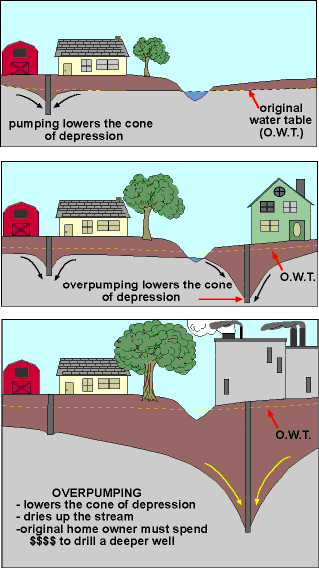
 Pumping water from a well causes a cone of depression to form in the water table at the well site. Overpumping can have two effects. It can cause a change in the groundwater flow direction. It also lowers the water table, making it necessary to dig a deeper well.


  Factors influencing groundwater flow :

   Many factors influence groundwater movement such as hydraulic head, hydraulic gradient, and velocity which was based on Darcy's Law.Other influencing factors include soil and aquifer properties, aquifer type, geology, and topography.   ( Movement of groundwater depends on rock and sediment properties and the groundwater’s flow potential. Porosity, permeability, specific yield and specific retention are important properties of groundwater flow.)

Topography

Ground water general flows away from topographical high spots and toward topographic lows.
 
Porosity of Earth Materials 

Porosity is percentage of rock or soil that is void of solid material.

Porosity is the volume of pore space relative to the total volume (rock and/or sediment + pore space). Primary porosity (% pore space) is the initial void space present (intergranular) when the rock formed. Secondary porosity (% added openings) develops later. It is the result of fracturing, faulting, or dissolution. Grain shape and cementation also affect porosity.

Effective Porosity = porosity available for fluid flow (interconnected and large enough pore throats)

Porosity depends on packing of grains (cubic or rhombohedral), grain size distribution (sorting), and shape of grains. Porosity  depends on the range of grain size (sorting) and shape of the subject material, but not on the size. Fine-grained materials tend to be better sorted than coarse-grained materials, thereby exhibiting greater porosities.

Permeability is the capability of a rock to allow the passage of fluids. Permeability is dependent on the size of pore spaces and to what degree the pore spaces are connected. Grain shape, grain packing, and cementation  affect permeability.

Aquifer properties :

An aquitard is a zone within the earth that restricts the flow of groundwater from one aquifer to another. An aquitard can sometimes, if completely impermeable, be called an aquiclude or aquifuge. Aquitards comprise layers of either clay or non-porous rock with low hydraulic conductivity.

Storativity

Storativity is the volume of water released from storage per unit decline in hydraulic head in the aquifer, per unit area of the aquifer.Confined aquifers have very low storativity values which means that the aquifer is storing water .. Unconfined aquifers have storativities (typically then called specific yield) greater than , they release water from storage by the mechanism of actually draining the pores of the aquifer, releasing relatively large amounts of water .

Specific Yield

Specific yield is the ratio of the volume of water that drains from a saturated rock owing to the attraction of gravity to the total volume of the rock. (indicates the amount of water released due to drainage from lowering the water table in an unconfined aquifer. ). Grain size has a definite effect on specific yield. Maximum specific yield occurs in medium to coarse sand size sediments.  Smaller grains have larger surface areas.Larger surface areas mean more surface tension. Fine-grained sediment will have a lower specific yield than more coarsely-grained sediment. Sorting of material affects groundwater movement.Poorly sorted material is less porous than well-sorted material.

Specific Retention 

The ratio of the volume of water a rock can retain against gravity drainage to the total volume of the rock or Specific retention (Sr) is the ratio of the volume of water a rock can retain (in spite of gravity) to the total volume of rock.

Specific yield plus specific retention equals porosity (often designated with the Greek letter phi).

P = Sy + Sr

Porosity, permeability, specific yield, and specific retention are all components of hydraulic conductivity.

Hydraulic Conductivity  is the ability of subsurface materials (sand, rock etc.) to allow a fluid (ie water) to flow through it.

Hydraulic Head

Water entering an unconfined or confined well will stand at a particular level. This level is often termed as the hydraulic head and is actually the sum of three components - the pressure head, elevation head and velocity head. The velocity head is often disregarded because ground water movement in most cases is relatively slow.In an aquifer the altitude to which rise in a properly constructed well is the Hydraulic Head.

 Hydraulic Gradient

 The change in hydraulic head (pressure) per unit distance in a given direction (dimensionless). It is the driving force of fluid flow in a porous medium.

Darcy's Law

 Henry Darcy was a French engineer who studied the movement of water through sand in 1856. He found that the rate of water flow through a tube is proportional to the difference in the height of the water between the two ends of the tube, and inversely proportional to the length of the tube. He also discovered that flow was proportional to a coefficient, K, which is called hydraulic conductivity.


More Details : 

Water Report Hydrology