Friday, January 18, 2013

Missiles


What is a Missile ? 

A missile is a self-propelled guided weapon system.

In military usage, munitions projected towards a target are broadly categorised as follows:
  • A powered, guided munition that travels through the air or space is known as a missile (or guided missile.)
  • A powered, unguided munition is known as a rocket.
  • Unpowered munitions not fired from a gun are called bombs whether guided or not; unpowered, guided munitions are known as guided bombs or "smart bombs".
  • Munitions that are fired from a gun are known as projectiles whether guided or not. If explosive they are known more specifically as shells or mortar bombs.
  • Powered munitions that travel through water are called torpedoes (an older usage includes fixed torpedoes, which might today be called mines).
  • Hand grenades are not usually classed as missiles.
A common further sub-division is to consider ballistic missile to mean a munition that follows a ballistic trajectory and cruise missile to describe a munition that generates lift.

History of  Missiles

The Greek author Philostratus (lived c. 170-247 AD) wrote in Life of Apollonius of Tyana Book II, chapter xxxiii, that some "wise men" (σοϕοί) lived in a fort in India between the Indus valley and the Ganges, and that when invading armies tried to take the wise men's fort, the wise men drove off the attackers by "πρηστῆρες [= "things which eject strongly") and βρονταί (= "thunders") which were hurled obliquely from above and fell upon their armour."; the Loeb Classical Library edition translates πρηστῆρες as "rockets of fire".

The availability of black powder (gunpowder) to propel projectiles was a precursor to the development of the first solid rocket. Ninth century Chinese Taoist alchemists invented black powder while searching for the Elixir of life; this invention led to experiments in the form of weapons such as bombs, cannon, incendiary fire arrows and rocket-propelled fire arrows.

Rocket technology first became known to Europeans following their use by the Mongols, Genghis Khan and Ögedei Khan, when they conquered parts of Russia, Eastern, and Central Europe. The Mongolians had acquired the Chinese technology by conquest of the northern part of China and also by the subsequent employment of Chinese rocketry experts as mercenaries for the Mongol military.

Additionally, the spread of rockets into Europe was also influenced by the Ottomans at the siege of Constantinople in 1453, although it is very likely that the Ottomans themselves were influenced by the Mongol invasions of the previous few centuries.

The first iron-cased and metal-cylinder rocket artillery, made from iron tubes, were developed by the Hindu weapons suppliers of Tipu Sultan, a Muslim ruler of the Kingdom of Mysore, and his father Hyder Ali, in the 1780s. Tipu Sultan championed the use of mass attacks with rocket brigades within the army, and he wrote a military manual on it, the Fathul Mujahidin. He successfully used these metal-cylinder rockets against the larger forces of the British East India Company during the Anglo-Mysore Wars. The Mysore rockets of this period were much more advanced than what the British had seen, chiefly because of the use of iron tubes for holding the propellant; this enabled higher thrust and longer range for the missile (up to 2 km range). The effect of these weapons on the British during the Second, Third and Fourth Mysore Wars in 1792 was sufficiently impressive to inspire the British to develop their own rocket designs. Several Mysore rockets were sent to England, who then took an active interest in the technology and developed it further during the 19th century.The Royal Woolwich Arsenal started a military rocket research and development program in 1801, based on the Mysorean technology. Several rocket cases were collected from Mysore and sent to Britain for analysis. Their first demonstration of solid-fuel rockets came in 1805 and was followed by publication of A Concise Account of the Origin and Progress of the Rocket System in 1807 by William Congreve, son of the arsenal's commandant. Congreve rockets were soon systematically used by the British

The British used Congreve rockets on several occasions during the Napoleonic Wars, first from boats and then on land.During their confrontation with the US during the War of 1812, the British used rockets at the Battle of Bladensburg, which led to the burning and surrender of Washington, D.C.The weapon remained in use until the 1850s, when it was superseded by the improved spinning design of William Hale.The Hale rocket removed the need for a rocket stick, travelled further due to reduced air resistance, and was far more accurate.

In 1932, the Reichswehr (which in 1935 became the Wehrmacht) began to take an interest in rocketry. Artillery restrictions imposed by the Treaty of Versailles limited Germany's access to long distance weaponry. Seeing the possibility of using rockets as long-range artillery fire, the Wehrmacht initially funded the VfR team, but seeing that their focus was strictly scientific, created its own research team. At the behest of military leaders, Wernher von Braun, at the time a young aspiring rocket scientist, joined the military (followed by two former VfR members) and developed long-range weapons for use in World War II by Nazi Germany, notably the A-series of rockets, which led to the infamous V-2 rocket (initially called A4). The liquid-propellant rocket was the world's first long-range combat-ballistic missile  and first known human artifact to enter outer space. It was the progenitor of all modern rockets, including those used by the United States and Soviet Union's space programs. During the aftermath of World War II the American, Soviet and British governments all gained access to the V-2's technical designs as well as the actual German scientists responsible for creating the rockets, via Operation Paperclip, Operation Osoaviakhim and Operation Backfire respectively.

Cruise missile designs fundamentally derive from the German V-1 of World War II. Advances in transistor and computer technology have contributed to self-correcting avionic and aeronautical designs that allow missiles to be guided in flight, as opposed to only at launch. These advances developed into guided missiles and guided bombs, and later into the modern cruise missile.

More Info : 

Click Here --> 1 & 2 & 3

Components of a Missile 

Missiles have four system components: targeting and/or guidance, flight system, engine, and warhead. 

More Details -- Click Here

Classification of  Missiles

Missiles come in types adapted for different purposes: surface-to-surface and air-to-surface (ballistic, cruise, anti-ship, anti-tank), surface-to-air (anti-aircraft and anti-ballistic), air-to-air, and anti-satellite missiles.Missiles are generally classified on the basis of their Type, Launch Mode, Range, Propulsion, Warhead and Guidance Systems.

On the basis of Type:

(i) Cruise Missile : A cruise missile is an unmanned self-propelled (till the time of impact) guided vehicle that sustains flight through aerodynamic lift for most of its flight path and whose primary mission is to place an ordnance or special payload on a target. They fly within the earth’s atmosphere and use jet engine technology. These vehicles vary greatly in their speed and ability to penetrate defences.Cruise missiles can be categorised by size, speed (subsonic or supersonic), range and whether launched from land, air, surface ship or submarine.

Depending upon the speed such missiles are classified as:

1) Subsonic cruise missile

2) Supersonic cruise missile

3) Hypersonic cruise missile

Subsonic cruise missile flies at a speed lesser than that of sound. It travels at a speed of around 0.8 Mach. The well-known subsonic missile is the American Tomahawk cruise missile. Some other examples are Harpoon of USA and Exocet of France.

Supersonic cruise missile travels at a speed of around 2-3 Mach i.e.; it travels a kilometre approximately in a second. The modular design of the missile and its capability of being launched at different orientations enable it to be integrated with a wide spectrum of platforms like warships, submarines, different types of aircraft, mobile autonomous launchers and silos. The combination of supersonic speed and warhead mass provides high kinetic energy ensuring tremendous lethal effect. BRAHMOS is the only known versatile supersonic cruise missile system which is in service.

Hypersonic cruise missile travels at a speed of more than 5 Mach. Many countries are working to develop hypersonic cruise missiles. BrahMos Aerospace is also in the process of developing a hypersonic cruise missile, BRAHMOS-II, which would fly at a speed greater than 5 Mach.

(ii) Ballistic Missile: A ballistic missile is a missile that has a ballistic trajectory over most of its flight path, regardless of whether or not it is a weapon-delivery vehicle. Ballistic missiles are categorised according to their range, maximum distance measured along the surface of earth's ellipsoid from the point of launch to the point of impact of the last element of their payload.

Types of Ballistic Missiles -:

    Short-range ballistic missile
    Intermediate Range Ballistic missile
    Intercontinental ballistic missile
    Submarine launched ballistic missile
    Theatre ballistic missile
    Tactical ballistic missile 

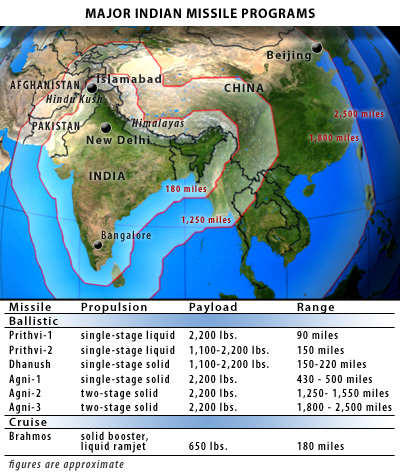
The missiles carry a huge payload. The carriage of a deadly warhead is justified by the distance the missile travels. Ballistic missiles can be launched from ships and land based facilities. For example, Prithvi I, Prithvi II, Agni I, Agni II and Dhanush ballistic missiles are currently operational in the Indian defence forces.

On the basis of Launch Mode:

(i) Surface-to-Surface Missile: A surface-to-surface missile is a guided projectile launched from a hand-held, vehicle mounted, trailer mounted or fixed installation. It is often powered by a rocket motor or sometimes fired by an explosive charge since the launch platform is stationary.

(ii) Surface-to-Air Missile: A surface-to-air missile is designed for launch from the ground to destroy aerial targets like aircrafts, helicopters and even ballistic missiles. These missiles are generally called air defence systems as they defend any aerial attacks by the enemy.

(iii) Surface (Coast)-to-Sea Missile: A surface (coast)-to-sea missile is designed to be launched from land to ship in the sea as targets.

(iv) Air-to-Air Missile: An air-to-air missile is launched from an aircraft to destroy the enemy aircraft. The missile flies at a speed of 4 Mach.

(v) Air-to-Surface Missile: An air-to-surface missile is designed for launch from military aircraft and strikes ground targets on land, at sea or both. The missiles are basically guided via laser guidance, infrared guidance and optical guidance or via GPS signals. The type of guidance depends on the type of target.

(vi) Sea-to-Sea Missile: A sea-to-sea missile is designed for launch from one ship to another ship.

(vii) Sea-to-Surface (Coast) Missile: A sea-to-surface missile is designed for launch from ship to land based targets.

(viii)Submarine launched Missile:A Submarine launched Missile is a missile that can be launched from a submarine. They include ballistic missiles (SLBMs) and cruise missiles (SLCMs).
(ix) Anti-Tank Missile: An anti-tank missile is a guided missile primarily designed to hit and destroy heavily-armoured tanks and other armoured fighting vehicles. Anti-tank missiles could be launched from aircraft, helicopters, tanks and also from shoulder mounted launcher.

On the basis of range :

This type of classification is based on maximum range achieved by the missiles. The basic classification is as follows:

(i) Short Range Missile
(ii) Medium Range Missile
(iii) Intermediate Range Ballistic Missile
(iv) Intercontinental Ballistic Missile

On the basis of propulsion :

(i) Solid Propulsion: Solid fuel is used in solid propulsion. Generally, the fuel is aluminium powder. Solid propulsion has the advantage of being easily stored and can be handled in fuelled condition. It can reach very high speeds quickly. Its simplicity also makes it a good choice whenever large amount of thrust is needed.

(ii) Liquid Propulsion: The liquid propulsion technology uses liquid as fuel. The fuels are hydrocarbons. The storage of missile with liquid fuel is difficult and complex. In addition, preparation of missile takes considerable time. In liquid propulsion,  propulsion can be controlled easily by restricting the fuel flow by using valves and it can also be controlled even under emergency conditions. Basically, liquid fuel gives high specific impulse as compared to solid fuel.

(ii) Hybrid Propulsion: There are two stages in hybrid propulsion - solid propulsion and liquid propulsion. This kind of propulsion compensates the disadvantages of both propulsion systems and has the combined advantages of the two propulsion systems.

(iii) Ramjet: A ramjet engine does not have any turbines unlike turbojet engines. It achieves compression of intake air just by the forward speed of the air vehicle. The fuel is injected and ignited. The expansion of hot gases after fuel injection and combustion accelerates the exhaust air to a velocity higher than that at the inlet and creates positive push. However, the air entering the engine should be at supersonic speeds. So, the aerial vehicle must be moving in supersonic speeds. Ramjet engines cannot propel an aerial vehicle from zero to supersonic speeds.

(iv) Scramjet: Scramjet is an acronym for Supersonic Combustion Ramjet. The difference between scramjet and ramjet is that the combustion takes place at supersonic air velocities through the engine. It is mechanically simple, but vastly more complex aerodynamically than a jet engine. Hydrogen is normally the fuel used.

(v) Cryogenic: Cryogenic propellants are liquefied gases stored at very low temperatures, most frequently liquid hydrogen as the fuel and liquid oxygen as the oxidizer. Cryogenic propellants require special insulated containers and vents which allow gas to escape from the evaporating liquids. The liquid fuel and oxidizer are pumped from the storage tanks to an expansion chamber and injected into the combustion chamber where they are mixed and ignited by a flame or spark. The fuel expands as it burns and the hot exhaust gases are directed out of the nozzle to provide thrust.

On the basis of Warhead:

(i) Conventional Warhead: A conventional warhead contains high energy explosives. It is filled with a chemi al explosive and relies on the detonation of the explosive and the resulting metal casing fragmentation as kill mechanisms.

(ii) Strategic Warhead: In a strategic warhead, radio active materials are present and when triggered they exhibit huge radio activity that can wipe out even cities. They are generally designed for mass annihilation.

 On basis of guidance system :

 (i) Wire Guidance: This system is broadly similar to radio command, but is less susceptible to electronic counter measures. The command signals are passed along a wire (or wires) dispensed from the missile after launch.

(ii) Command Guidance: Command guidance involves tracking the projectile from the launch site or platform and transmitting commands by radio, radar, or laser impulses or along thin wires or optical fibres. Tracking might be accomplished by radar or optical instruments from the launch site or by radar or television imagery relayed from the missile.

(iii) Terrain Comparison Guidance: Terrain Comparison (TERCOM) is used invariably by cruise missiles. The system uses sensitive altimeters to measure the profile of the ground directly below and checks the result against stored information.

(iv) Terrestrial Guidance: This system constantly measures star angles and compares them with the pre-programmed angles expected on the missile’s intended trajectory. The guidance system directs the control system whenever an alteration to trajectory is required.

(v) Inertial Guidance: This system is totally contained within the missile and is programmed prior to launch. Three accelerometers, mounted on a platform space-stabilised by gyros, measure accelerations along three mutually perpendicular axes; these accelerations are then integrated twice, the first integration giving velocity and the second giving position. The system then directs the control system to preserve the pre-programmed trajectory. This systems are used in the surface-to-surface missiles and in cruise missiles.

(vi) Beam Rider Guidance: The beam rider concept relies on an external ground or ship-based radar station that transmits a beam of radar energy towards the target. The surface radar tracks the target and also transmits a guidance beam that adjusts its angle as the target moves across the sky.

(vii) Laser Guidance: In laser guidance, a laser beam is focused on the target and the laser beam reflects off the target and gets scattered. The missile has a laser seeker that can detect even miniscule amount of radiation. The seeker provides the direction of the laser scatters to the guidance system. The missile is launched towards the target, the seeker looks out for the laser reflections and the guidance system steers the missile towards the source of laser reflections that is ultimately the target.

(viii) RF and GPS Reference: RF (Radio Frequency) and GPS (Global Positioning System) are examples of technologies that are used in missile guidance systems. A missile uses GPS signal to determine the location of the target. Over the course of its flight, the weapon uses this information to send commands to control surfaces and adjusts its trajectory. In a RF reference, the missile uses RF waves to locate the target.

Indian Missiles

History

The use of missiles dates back to the Vedic age in India. Indian warriors have used "Astras"  as missiles in various forms from that period in the subcontinent, proofs of which can be drawn from a number of epics such as the Mahabharata and the Ramayana.

The deadly weapons and the scriptures regarding the technology were later concealed to prevent any future happenings of the ‘Idikasa’ (an important historic part in the history of Indian religion) for the sake of the survival of mankind.

In olden days, the Astra (a supernatural weapon) was controlled by ‘Mantras’ (a sound, syllable, or group of words that are considered capable of creating transformation) that could be correlated to the mission control software of the modern day missiles.

Fighting the British colonial army, Tipu Sultan and his army used thousands of rockets resulting in the defeat of the troops in the Srirangapatnam war in 1792. The rockets were attached with bamboo or steel spears and powered by gun powder, propellant compacted in a cast iron chamber with nozzle and igniters capable of attacking enemy cavalry and soldiers.


The modern day missiles have their roots in Germany as the country developed the first successful Guided missiles V1 and V2. After World War II, several other nations developed a variety of missile systems.

India had mastered missile technology from olden days, but it was left behind in this field when the Britishers ruled the country for hundreds of years, resulting in lack of resources, research environment and capabilities.

In 1983 India's most successful defense research project was launched. for the research and development of a comprehensive range of missiles. The program was managed by the Defense Research and Development Organization (DRDO) and Ordnance Factories Board in partnership with other Indian government research organizations.The project started in 1983 and ended in 2008 after these strategic missiles were successfully developed.The IGMDP is one of India's most successful defence research project, as all the missiles - Prithvi, Akash, Trishul, Nag, Agni - have been successfully tested and inducted by the Indian armed forces.
The Integrated Guided Missile Development Program (IGMDP) was formed in 1983 with the aim of achieving self-sufficiency in missile development & production and today comprises of five core missile programs —> the strategic Agni ballistic missile, the tactical Prithvi ballistic missile, the Akash and Trishul surface-to-air missiles and the Nag anti-tank guided missile. The program has given India the capability to produce indigenous missiles in other key areas and a few ‘known’ missiles under development have been listed below.

List of Indian Missiles

Air-to-Air missile :

Astra

Astra  is an active radar homing beyond-visual-range air-to-air missile (BVRAAM) developed by the Defence Research and Development Organisation (DRDO), India. Astra is designed to be capable of engaging targets at varying range and altitudes allowing for engagement of both short-range targets (up to 20 km) and long-range targets (up to 80 km) using alternative propulsion modes.

Anti Tank Missile:

Nag

The Nag (Cobra) is a third generation, all weather, top-attack, fire-and-forget anti-tank guided missile. It is one of five missile systems developed by the Defence Research & Development Organization (DRDO) under the Integrated Guided Missile Development Program (IGMDP).
Operational Range - Land version : 500m to 4km (Air launched: 7-10km)
                  Speed - 230 m/s
Launch Platform - Nag Missile Carrier (NAMICA),HAL Dhruv Helicopter (Helina- Helicopter launched Anti-tank missile)

Surface-to-Air Missiles :  

Akash 

Akash is a medium-range mobile surface-to-air missile defense system developed by the Defence Research and Development Organisation (DRDO), Ordnance Factories Board and Bharat Electronics Limited (BEL).The missile system can target aircraft up to 30 km away, at altitudes up to 18,000 m. A nuclear warhead could potentially give the missile the capability to destroy both aircraft and warheads from ballistic missiles.

 Maitri

The Maitri missile project is a next-generation quick-reaction Surface-to-Air Missile (QRSAM) with a lethal hundred per cent kill probability under development by India's Defence Research and Development Organisation. It is a short-range (15 km, 9.3 mi) surface-to-air point defense missile system.
Trishul 
The Trishul (Trident) is a short range, quick reaction, all weather surface-to-air missile designed to counter a low-level attack. It has been flight tested in the sea-skimming role and also against moving targets. It has a range of 9 km.India officially shut the down Trishul Missile project on February 27, 2008.Trishul had demonstrated a number of complex technologies, including an ability to defeat sea-skimming targets, it still had not been proved to be effective. By continuing the program as a technology demonstrator, India hopes that some of the technology from Trishul can be incorporated in other missile projects.

Surface-to-Surface Missiles :
Short Range Ballistic Missiles (Surface-to-Surface) - Prithvi I,Prithvi II,Prithvi III,Dhanush
Medium Range and Intermediate Range Ballistic Missiles : Agni & Shaurya
Intercontinental Ballistic Missiles : Agni V & Agni VI


Range of Ballistic Missiles :


Submarine Launched Ballistic Missile :

K-15 Sagarika : nuclear-capable submarine-launched ballistic missile with a range of 700 kilometres.

Cruise Missiles :

Subsonic Cruise Missile - Nirbhay

Supersonic Cruise Missile - BrahMos

Hypersonic Cruise Missiles - BrahMos II
  
Indian Ballistic Missile Defense Programme - Click Here


Monday, January 14, 2013

Human Growth and Development - Prenatal Stage


Prenatal development refers to the process in which a baby develops from a single cell after conception into an embryo and later a fetus.The process of prenatal development occurs in three main stages. They are germinal stage, the embryonic stage, and the fetal stage.The first two weeks after conception are known as the germinal stage,the third through the eighth week are known as the embryonic period, and the time from the ninth week until birth is known as the fetal period.The average length of time for prenatal development to complete is 38 weeks from the date of conception.

Three Stages in Prenatal Development :

Germinal stage

Conception occurs when the female egg (ovum) is fertilized by a  male sperm. Under normal circumstances, one egg is released approximately once a month from a woman's ovary during a process called ovulation. The egg makes its way into a fallopian tube, a structure that guides the egg away from the ovary toward the uterus. For fertilization to occur, sperm ejaculated during sexual intercourse (or introduced during artificial insemination) in a substance called semen must have made their way from the vagina into the uterus and subsequently into the fallopian tube where the ovum has been released. This process can take up to ten hours after ejaculation. For fertilization to occur, a sperm must penetrate the tough outer membrane of the egg called the zona pellucida. When one sperm successfully binds with the zona pellucida, a series of chemical reactions occurs to allow only that sperm to penetrate. Fertilization occurs when the sperm successfully enters the ovum's membrane. The genetic material of the sperm and egg then combine to form a single cell called a zygote and the germinal stage of prenatal development commences.

The zygote soon begins to divide rapidly in a process called cleavage, first into two identical cells called blastomeres, which further divide to four cells, then into eight, and so on. The group of diving cells begins to move along the fallopian tube toward the uterus. About sixty hours after fertilization, approximately sixteen cells have formed to what is called a morula, still enclosed by the zona pellucida.Three days after fertilization, the morula enters the uterus. As cell division continues, a fluid-filled cavity called a blastocoele forms in the center of the group of cells, with the outer shell of cells called trophoblasts and an inner mass of cells called embryoblasts. The zona pellucida disappears and the morula becomes a blastocyst. At this stage the blastocyst consists of 200 to 300 cells and is ready for implantation. The blastocyst is made up of three layers. The three layers also known as germ layers are formed by a process called gastrulation.

Those three layers are : 

The ectoderm (which will become the skin and nervous system)
The endoderm (which will become the digestive and respiratory systems)
The mesoderm (which will become the muscle and skeletal systems)

Finally, the blastocyst arrives at the uterus and attaches to the uterine wall, a process known as implantation.

Implantation, the process in which the blastocyst implants into the uterine wall, occurs approximately six days after conception. Hormones secreted from the mother's ovaries and a chemical secreted by the trophoblasts begin to prepare the uterine wall. The blastocyst first adheres to the wall then moves into the uterine tissue.Implantation is not always an automatic and sure-fire process. Researchers estimate that approximately 58 percent of all natural conceptions never become properly implanted in the uterus, which results in the new life ending before the mother is ever aware she is pregnant.When implantation is successful, hormonal changes halt a woman’s normal menstrual cycle and cause a whole host of physical changes. Implantation marks the end of the germinal stage and the beginning of the embryonic stage.

Embryonic stage

The embryonic stage begins after implantation and lasts until eight weeks after conception. Soon after implantation, the cells continue to rapidly divide and clusters of cells begin to take on different functions (called differentiation). A process (gastrulation) leads to the formation of three distinct layers called germ layers: the ectoderm (outer layer), the mesoderm (middle layer), and the endoderm (inner layer). As the embryo develops, each germ layer differentiates into different tissues and structures. For example, the ectoderm eventually forms skin, nails, hair, brain, nervous tissue and cells, nose, sinuses, mouth, anus, tooth enamel, and other tissues. The mesoderm develops into muscles, bones, heart tissue, lungs, reproductive organs, lymphatic tissue, and other tissues. The endoderm forms the lining of lungs, bladder, digestive tract, tongue, tonsils, and other organs.The process of differentiation takes place over a period of weeks with different structures forming simultaneously.

 Some of the major events that occur during the embryonic stage are as follows:

-Week 3: Beginning development of the brain, heart, blood cells, circulatory system, spinal cord, and digestive system.
-Week 4: Beginning development of bones, facial structures, and limbs (presence of arm and leg buds); continuing development of the heart (which begins to beat), brain, and nervous tissue.
-Week 5: Beginning development of eyes, nose, kidneys, lungs; continuing development of the heart (formation of valves), brain, nervous tissue, and digestive tract.
-Week 6: Beginning development of hands, feet, and digits; continuing development of brain, heart, and circulation system.
-Week 7: Beginning development of hair follicles, nipples, eyelids, and sex organs (testes or ovaries); first formation of urine in the kidneys and first evidence of brain waves.
-Week 8: Facial features more distinct, internal organs well developed, the brain can signal for muscles to move, heart development ends, external sex organs begin to form.

 By the end of the embryonic stage, all essential external and internal structures have been formed. The embryo is now referred to as a fetus.

 Fetal stage

This period of develop begins during the ninth week and lasts until birth. Although all of the organ systems were formed during embryonic development, they continue to develop and grow during the fetal stage.The fetus continues to grow in both weight and length.This stage of prenatal development lasts the longest and is marked by amazing change and growth. During the third month of gestation, the sex organs begin to differentiate and by the end of the month all parts of the body will be formed.

When an embryo becomes a fetus at eight weeks, it is approximately 3 centimeters (1.2 inches) in length from crown to rump and weighs about 3 grams. By the time the fetus is considered full-term at 38 weeks gestation, he or she may be 50 centimeters (20 inches) or 3.3 kilograms .

Examples of some of the major features of fetal development by week are as follows:


-Weeks 9–12: The fetus reaches approximately 8 cm in length; the head is approximately half the size of the fetus. External features such as the face, neck, eyelids, limbs, digits, and genitals are well formed. The beginnings of teeth appear, and red blood cells begin to be produced in the liver. The fetus is able to make a fist.
-Weeks 13–15: The fetus reaches approximately 15 cm  in length. Fine hair called lanugo first develops on the head; structures such as the lungs, sweat glands, muscles, and bones continue to develop. The fetus is able to swallow and make sucking motions.
-Weeks 16–20: The fetus reaches approximately 20 cm in length. Lanugo begins to cover all skin surfaces, and fat begins to develop under the skin. Features such as finger and toenails, eyebrows, and eyelashes appear. The fetus becomes more active, and the mother can sometimes begin to feel fetal movements at this stage.
-Weeks 21–24: The fetus reaches approximately 28.5 cm in length and weighs approximately 0.7 kg . Hair grows longer on the head, and the eyebrows and eye lashes finish forming. The lungs continue to develop with the formation of air sac (alveoli); the eyes finish developing. A startle reflex develops at this time.
-Weeks 25–28: The fetus reaches approximately 38 cm in length and weighs approximately 1.2 kg . The next few weeks mark a period of rapid brain and nervous system development. The fetus gains greater control over movements such as opening and closing eyelids and certain body functions. The lungs have developed sufficiently that air breathing is possible.
-Weeks 29–32: The fetus reaches approximately 38–43 cm in length and weighs approximately 2 kg . Fat deposits become more pronounced under the skin. The lungs remain immature but breathing movements begin. The fetus's bones are developed but not yet hardened.
-Weeks 33–36: The fetus reaches approximately 41–48 cm in length and weighs 2.6–3.0 kg . Body fat continues to increase, lanugo begins to disappear, and fingernails are fully grown. The fetus has gained a high degree of control over body functions.
-Weeks 36–38: The fetus reaches 48–53 cm in length is considered to be full-term by the end of this period. Lanugo has mostly disappeared and is replaced with thicker hair on the head. Fingernails have grown past the tips of the fingers. In a healthy fetus, all organ systems are functioning.

While prenatal development usually follows this normal pattern, there are times when problems or deviations occur . (Details --> Click Here)

Factors influencing Growth rate

 Click Here

Prenatal Development - Videos 


Fertilization (Conception)


Weeks 1-9
 
    
Weeks 10 - 14


Weeks 15 - 20


Weeks 21 - 27


Weeks 28 - 37


Development of sexual organs


More Info :

1

2

3

4 


Sunday, January 13, 2013

Diplomacy


Diplomacy can be regarded as an application of intelligence and tact to the conduct of official relations between the governments of independent States.Diplomacy is a complex and often challenging practice of fostering relationships around the world in order to resolve issues and advance interests.The purpose of diplomacy is to strengthen the State and to serve in its relations with others. One of the functions of diplomacy is to minimize frictions and conflicts with other states through negotiations.  

Difference between Diplomacy and Foreign policy 

The terms diplomacy and foreign policy are often used interchangeably, diplomacy is an instrument of foreign policy. Foreign policy is orientated towards settling goals, occasionally with mention to the strategies and tactics to be used. Diplomacy is used to its accomplishment.

Types of Diplomacy
  • Appeasement
Appeasement is "the policy of settling international quarrels by admitting and satisfying grievances through rational negotiation and compromise, thereby avoiding the resort to an armed conflict which would be expensive, bloody, and possibly dangerous."
  • Ping Pong Diplomacy
Ping pong diplomacy refers to the exchange of ping pong players between the United States and People's Republic of China (PRC) in the 1970s. The event marked a thaw in U.S.–China relations that paved the way to a visit to Beijing by President Richard Nixon.
  • Panda Diplomacy
Panda Diplomacy is a term used to describe China's use of Giant Pandas as diplomatic gifts to other countries. The practice existed as far back as the Tang Dynasty, when Empress Wu Zetian (625 – 705AD) sent a pair of pandas to the Japanese emperor.
  • Gunboat Diplomacy
Gunboat diplomacy is the use of military troops to maintain hegemony over a sphere of influence, usually associated with the age of imperialism and colonialism.
  • Dollar diplomacy
Dollar diplomacy is a form of diplomacy that involves investing in foreign nations to stabilize them. The term is often used specifically to represent efforts conducted in self interest by the United States.dollar diplomacy in this sense of the word is diplomacy that will benefit the interests of the United States. This approach to diplomacy has been practiced for a very long time by a number of nations, not just the United States.
  • Shuttle Diplomacy
Use of a neutral third party to negotiate peace between two groups of people that refuse to directly talk with each other.Diplomatic negotiations conducted by an official intermediary who travels frequently between the nations involved.
  • Cultural Diplomacy
Cultural diplomacy is the interchange of ideas and other cultural features between nations or other distinct groups as a means of diplomacy between the groups.
  • Citizen Diplomacy
Citizen diplomacy is the concept that, in a vibrant democracy, the individual citizen has the right,even the responsibility to help shape foreign relations.In practical terms, citizen diplomats are professionals, families, students, interns, and travelers who make an impact by reaching out to individuals from other countries to build bridges of mutual understanding.
  • Public Diplomacy
Standard diplomacy might be described as the ways in which government leaders communicate with each other at the highest levels, the elite diplomacy we are all familiar with. Public diplomacy, by contrast focuses on the ways in which a country (or multi-lateral organization such as the United Nations) communicates with citizens in other societies.Public diplomacy is regarded as the framework of activities by which a government seeks to influence public attitudes in a manner that they become supportive of its foreign policy and national interests. It differs from traditional diplomacy in that public diplomacy goes beyond governments and interfaces primarily with non-governmental individuals and organizations. Furthermore, public diplomacy activities often present many differing views as represented by private individuals and organizations in addition to official Government views and positions. A key facet of Public diplomacy is that it goes beyond unidirectional communication; it is also about listening to a range of actors. Successful public diplomacy involves an active engagement with the public in a manner that builds, over a period of time, a relationship of trust and credibility. It requires systems that acknowledge the importance of an increasingly interconnected world where citizens expect responsiveness to their concerns on foreign policy (and other issues).

Film, television, music, sports, video games and other social/cultural activities are seen by public diplomacy advocates as enormously important avenues for otherwise diverse citizens to understand each other and integral to the international cultural understanding, which they state is a key goal of modern public diplomacy strategy. It involves not only shaping the message(s) that a country wishes to present abroad, but also analyzing and understanding the ways that the message is interpreted by diverse societies and developing the tools of listening and conversation as well as the tools of persuasion.
  • Economic diplomacy
Economic diplomacy is concerned with economic policy issues. Economic diplomats also monitor and report on economic policies in foreign countries and offer advice to the home government on how best to influence them. Economic diplomacy engages contacts with foreign and sending states’ institutions, businesses and international organizations to advance the sending state’s economic interests,seeks to resolve bilateral trade disputes and negotiate with trading partners to liberalize world trade.
  • Multi-Track Diplomacy
Multitrack Diplomacy is an expansion of the original distinction made by Joseph Montville in 1982, between track one (official, governmental action) and track two (unofficial, nongovernmental action) approaches to conflict resolution.The nine tracks of diplomacy included in Multi-Track Diplomacy are:

Track 1 – Government
Track 2 – Non-government/Professional
Track 3 – Business, or Peacemaking through Commerce.
Track 4 – Private Citizen, or Peacemaking through Personal Involvement.
Track 5 – Research, Training, and Education
Track 6 – Activism, or Peacemaking through Advocacy
Track 7 – Religion, or Peacemaking through Faith in action.
Track 8 – Funding, or Peacemaking through Providing Resources.
Track 9 – Communications and the Media, or Peacemaking through Information


Other Classification :

Type of diplomacy based on number of parties involved - bilateral diplomacy or diplomacy between two states (i.e. diplomatic representation of the sending state in a receiving state), multilateral diplomacy which involves diplomacy regarding regional or global issues and is used with a plurality of States through an international organization or at international conferences, and ad hoc diplomacy which involves other forms of diplomacy than the two aforementioned types of diplomacy. For example one can think of special missions to which States resort in order to entrust a diplomatic officer with the task to carry out one or many diplomatic assignments in a foreign State even though this officer does not belong to a permanent mission accredited to a country. 

Tools of Diplomacy

Various processes and procedures have evolved over time for handling diplomatic issues and disputes:

Arbitration and mediations

Nations sometimes resort to international arbitration when faced with a specific question or point of contention in need of resolution. For most of history, there were no official or formal procedures for such proceedings. They were generally accepted to abide by general principles and protocols related to international law and justice.Sometimes these took the form of formal arbitrations and mediations. In such cases a commission of diplomats might be convened to hear all sides of an issue, and to come some sort of ruling based on international law.In the modern era, much of this work is often carried out by the International Court of Justice at The Hague, or other formal commissions, agencies and tribunals, working under the United Nations.Below are some examples.

Hay-Herbert Treaty Enacted after the United States and Britain submitted a dispute to international mediation about the US-Canadian border.

Pakistan's complaint that the Baghlihar project has violated the Indus Treaty was being examined by Swiss water expert Raymond Lafitte, who has been appointed as an arbitrator with the consent of both the countries.

Conferences

Other times, resolutions were sought through the convening of international conferences. In such cases, there are fewer ground rules, and fewer formal applications of international law.However, participants are expected to guide themselves through principles of international fairness, logic, and protocol.Some examples of these formal conferences are:

Congress of Vienna (1815) – After Napoleon was defeated, there were many diplomatic questions waiting to be resolved. This included the shape of the map of Europe, the disposition of political and nationalist claims of various ethnic groups and nationalities wishing to have some political autonomy, and the resolution of various claims by various European powers.

The Congress of Berlin (June 13 – July 13, 1878) was a meeting of the European Great Powers' and the Ottoman Empire's leading statesmen in Berlin in 1878. In the wake of the Russo-Turkish War, 1877–78, the meeting's aim was to reorganize conditions in the Balkans.

Negotiations

Sometimes nations convene official negotiation processes to settle an issue or dispute between several nations which are parties to a dispute. These are similar to the conferences mentioned above, as there are technically no established rules or procedures. However, there are general principles and precedents which help define a course for such proceedings.Some examples are:

Camp David accord Convened in 1978 by President Jimmy Carter of the United States, at Camp David to reach an agreement between Prime Minister Mechaem Begin of Israel and President Anwar Sadat of Egypt. After weeks of negotiation, agreement was reached and the accords were signed, later leading directly to the Israel-Egypt Peace Treaty of 1979.

Treaty of Portsmouth Enacted after President Theodore Roosevelt brought together the delegates from Russia and Japan, to settle the Russo-Japanese War. Roosevelt's personal intervention settled the conflict, and caused him to win the Nobel peace prize.

The outcomes of diplomacy are usually spelled out through the following instruments: 

Treaties : A treaty is an agreement under international law where the parties to it  namely sovereign states and international organizations negotiate to reach common ground and avoid further conflict or disagreement 

Conventions : A convention begins as an international meeting of representatives from many nations that results in general agreement about procedures or actions they will take on specific topics.It include many signatories and the original signatories encourage other countries to join long after the original agreement is reached.Ex : In 1973, representatives of 80 countries agreed on a Convention on International Trade in Endangered Species to protect rare plants and animals around the world.

Protocols : A protocol is an agreement that diplomatic negotiators formulate and sign as the basis for a final convention or treaty. The treaty itself may not be completed for many years.

Accords : An accord is an agreement but may not be legally binding where as treaty is a legally binding agreement

Alliances: An alliance is a pact, coalition or friendship between two or more parties, made in order to advance common goals and to secure common interests. It is a Political agreement between countries to support each other in disputes with other countries.

Diplomat 

A diplomat is a person appointed by a state to conduct diplomacy with another state or international organization. The main functions of diplomats revolve around the representation and protection of the  interests and nationals of the sending state, as well as the promotion of information and friendly relations.According to the Vienna Convention some of the roles of diplomat are as follows:
  1. The representation of state socially, politically and ceremonially in other countries.
  2. The protection of states interest, overseas nationals and states commercial activities.
  3. Negotiations on behalf of government and signing of agreements.
  4. Information gathering of states activities externally, and in missionary cases, gathering information from host countries.
  5. The promotion of cordial and friendly relations in the international system.
  6. Diplomats also create relationships and maintain good level of communication between external affairs and internal structures 
Types of Diplomatic Missions

A country may have several different types of diplomatic missions in another country.

Embassy -- A diplomatic mission located in the capital city of another country which generally offer a full range of services, including consular services.

High Commission -- An embassy of a Commonwealth country located in another Commonwealth country.

Permanent Mission -- A diplomatic mission to a major international organization.

Consulate General -- A diplomatic mission located in a major city, other than the capital city, which provides a full range of services, including consular services.

Consulate -- A diplomatic mission that is similar to a consulate general, but which does not provide a full range of services.

Consulate Headed by Honorary Consul  -- A diplomatic mission headed by an Honorary Consul which provides only a limited range of services.

More Info : Indian Diplomacy 


Sunday, December 30, 2012

Earth : Making of a Planet


Planet earth and the history behind its evolution to the modern day form carries with in lots of amazing and astonishing facts. Earth did not turn up the way it is in just a single day. Millions of years of evolution stand behind earth in its present form. All possible research has been made to discover the earth’s  past and more is being done. Buried civilization and remains of primitive signs of life help earth scientist to join the knots and formulate the overall picture. Each and every aspect of planet earth has been developing since its creation and even before its creation.

Theories of evolution of human and planet earth bring out amazing facts which remain unbelievable for a normal human being. Lots of species and places have been swallowed by the planet earth. Deep in the remains of earth and waters remain the signs of human evolution and some of the signs have been eaten away and human can just think of their probability. Dinosaurs are one such specie that most of us have heard of and at the same time we also believe in. Making of our wonderland did not happen in just a single day.If we could just gather the facts and take our imagination to the path of history, we will come across the earth that we may not even believe in. Evolved through the big bang and coming into its primitive existence with such violent and sudden manner was not something that earth could itself have controlled. Earth has gone through ice age, volcanic eruptions and emissions and much more that we as humans find hard to imagine and it would have been even worse for us to be present at that time. Just imagine living in the Stone Age with no technological advancement and so much of hardship around.

The history of our planet is an epic journey-from its birth out of cosmic rubble to the unique complex of land, sea, atmosphere and life we know now.This National Geographic film takes a photographic journey thorough time from the violent birth of our planet earth, four and a half billion years ago, through ice-ages, massive volcanic eruptions and the dinosaur's reign to the first humans.Go back to five billion years ago and discover the birth of the Earth that is the only home to life as far as we know, see how life flourished and evolution worked, from the first single-celled organism to age of the dinosaurs and the first humans who walked on the planet, through the dazzling images and CGI animations. 


Dances of India


Dance in India has a rich and vital tradition dating back to ancient times.The Indian dances are broadly divided into Classical dances and folk dances.The Classical dances of India are usually spiritual and religious in content.Indian Classical dance is also known as the traditional Indian dance which has abundant forms and takes human figure as its basic medium of expressions. Like the Indian culture, Indian classical dances are equally diverse in nature.The folk dances of India are also spiritual and religious in content but the main force behind the folk dances of India is the celebratory mood.There are numerous classical dance forms in India and innumerable folk dances.Each dance form can be traced to different parts of the country. Each form represents the culture and ethos of a particular region or a group of people.

Classical Dances


India has a very rich tradition of classical dance. Each form has its own specialty & grace, along with a set pattern of costumes & make-up.Indian classical dance is a relatively new umbrella term for various codified art forms rooted in Natya, the sacred Hindu musical theatre styles, whose theory can be traced back to the Natya Shastra of Bharata Muni (2nd century BC).Even though the art of Natya includes nritta, or dance proper, Natya has never been limited to dancing and includes singing, abhinaya (mime acting). These features are common to all the Indian classical styles.The foundation of the conventions and methodical movements and types of dance lies in an ancient book of dance, music and drama called Natyashastra.

According to a popular belief, Brahma, the Creator of the World, combined literature from the Rig Veda, songs from the Sama Veda, abhinaya (expression) from the Yajur Veda and rasa (aesthetic experience) from the Atharva Veda, to form natyashastra .It has has over 36,000 verses. Natyashastra is also known as fifth veda.It explains the nuances of dance, giving stress on mudras (hand formations) and their meanings, the kind of emotions and their categorization.Apart from the abhinaya and the performance of rasa, the audience is amused by the attire and ornaments of the artist. The majority of Indian classical dance forms are focused on the depiction of the nine rasas (Navarasas or the emotions), which includes Hasya (happiness), Krodha (anger), Bhibasta (disgust), Bhaya (fear), Shoka (sorrow), Viram (courage), Karuna (compassion), Adbhuta (wonder) and Shanta (serenity). 

As per the ancient treatises, dance is considered as having three aspects: natya, nritya and nritta. Natya highlights the dramatic element and most dance forms do not give emphasis to this aspect today with the exception of dance-drama forms like Kathakali. Nritya is essentially expressional, performed specifically to convey the meaning of a theme or idea. Nritta on the other hand, is pure dance where body movements do not express any mood (bhava), nor do they convey any meaning. To present nritya and natya effectively, a dancer should be trained to communicate the navarasas.

Sangeet Natak Akademi, the national academy for performing arts, recognizes eight distinctive traditional dances as Indian classical dances, which might have origin in religious activities of distant past.They are:

1.       Bharatanatyam - Tamil Classical Dance
2.       Odissi - Orrisa Classical dance
3.       Kathakali - Malayalam Classical Dance
4.       Kathak - North Indian Classical Dance
5.       Manipuri - Manipur Classical Dance
6.       Kuchipudi - Telugu Classical dance
7.       Mohiniaattam - Kerala Classical Dance
8.       Sattriya - Asamese Classical Dance


From the Natya Shastra, 3 religious dance/drama forms developed:

Agama Nartanam:  Dances performed inside the sanctum of the temple according to the ritual.  This was a spiritual dance form.
Carnatakam: Dances performed in royal courts to the accompaniment of classical music.  This was an intellectual art form. 
Darbari Aattam: Dances performed more for common Indians which educated them about their religion, culture and social life. These dances were performed outside the temple precincts in the courtyards.

A dance style is classical to the extent it incorporates the Natya Shastra techniques. Some of the styles such as Kathak use very few elements found in Natya Shastra. Other art dances yet to be conferred as classical dances, whose theories and techniques can also be traced back to the Natya Shastra are:

Andhra Natyam - Telugu art dance
Vilasini Nrityam/Natyam - Telugu art dance
Kerala Natanam - Kerala classical dance

Out of the eight recognized dance forms, the only two temple dance styles that have their origin in Natya Shastra and are prescribed by the Agamas are Bharata Natyam and Odissi. These two most faithfully adhere to the Natya Shastra but currently do not include Vaachikaabhinaya (dialog acts), although some styles of Bharata Natyam, such as Melattur style, prescribe the lip and eye movements indicating Vaachikaabhinaya.

Kuchipudi, which also prescribes the lip movements indicating Vaachikaabhinaya, and Mohiniyattam are relatively recent Darbari Aatam forms, just as Kathakali, and two eastern Indian styles, Manipuri and Sattriya, that are quite similar.

Kathak originated as a court dance. Some believe it evolved from Lord Krishna's raas lilas, forms of which have also evolved into the popular Garba-style dances popular in North India and Gujarat. The style gradually changed during the Mughal period under the influence of Persian dance, a major change being straight knees instead of the bent knees used in most other Indian classical forms. Intricate footwork and spins, as well as abhinaya, are the highlights of Kathak.

Currently, Sangeet Natak Akademi does not consider the recently reconstructed dance styles of Andhra Pradesh such as Andhra Natyam and Vilasini Natyam as "classical." Bharatanrithyam, despite being the one most closely following Natya Shastra's precepts, is considered as a variety of Bharata Natyam.


Folk Dances


Folk dance in India is a term broadly used to describe all forms of folk and tribal dances in regions across India(These types of dances can be categorised into two major categories: Folk and Tribal dances).Folk dances are numerous in number and style, and vary according to the local tradition of the respective state, ethnic or geographic regions. There are cultural differences between the two forms- folk and tribal dances- the folk dances are the rural extensions of the larger Indian population for example Bhangra of Punjab and Garba of Gujarat. However, the tribal dances are dances by adivasis, which have a very different culture from the larger Indian population. It may be noted here that Indian tribal dances are vastly dissimilar from Indian folk dances, which can never be related. A common example of a tribal dance is the Santhali Dance, indigenous from Chottanagpur region. Other tribal dances of India include the Dhimsa dance by Oriya tribes, the Dhimsa dance, yet another tribal dance from Andhra Pradesh, the Nagaland tribal dances,etc. Each of these aboriginal tribes possesses its own distinguishable dance traditions and invariably all of them are interwoven with the life of the people who dance it.

Indian Folk dances have originated with a view to be a creation of different socio-economic set up and traditions. While Indian classical dance is considered a higher form of art and was practiced in courts, temples and on special occasions, folk dance forms are practiced in groups in rural areas as an expression of their daily work and rituals.  Indian folk as well as tribal dances are simple and performed to express joy and performed to celebrate a season, festivals and so on. Its simplicity is shown by its less movement and uncomplicated steps.Some of the popular folk dances that are performed across villages and cities are Bhangra, Garba, Kalbelia and Bihu.Many folk dances are devoted to the presiding God of the specific community. The most appealing element of a folk dance is the requisite outfit for its performance. In Indian Folk Dances the accessories play a vital role, these costumes provide a separate identity to the folk dance. Many a time, folk dances are termed as per the name of the accessory used.

Almost all the regions of the country have their specific folk music and dance, which proves to be a wonderful way of expression of their community and its traditions. Though these folk dances are not as complex as the classical dance forms, they are very beautiful, because of the essence of rawness in them. Folk dances are performed for every possible occasion, to celebrate the arrival of seasons, birth of a child, a wedding and festivals. The folk dances are extremely simple with minimum of steps or movement. Indian folk dances are full of energy and vitality. Some dances are performed separately by men and women while in some performances men and women dance together. On most occasions, the dancers sing themselves, accompanied by artists with instruments. Each form of folk dance has a specific costume and rhythm. Most of the costumes, worn for folk dances, are colorful with extensive jewels and designs.


List of Indian Folk Dances -- Click Here


More Details : Click